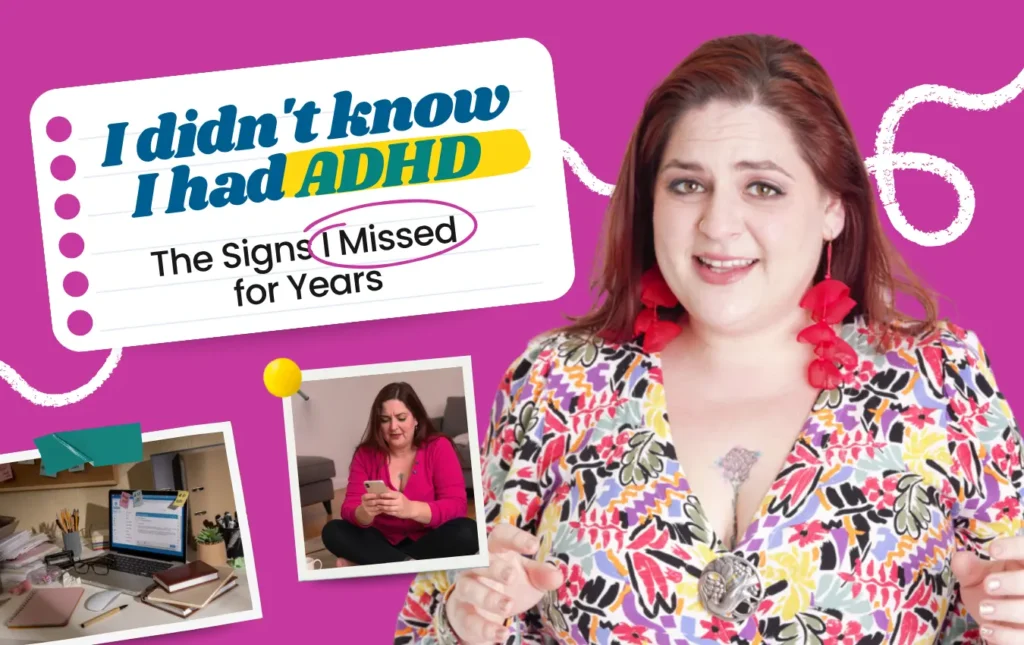
For most of my life, I thought I was just “bad at life.”
I was the girl with the messy room, the multiple planners, the forgotten appointments. The one who always had a hundred ideas, but rarely finished them. Teachers told me I was smart but “not living up to my potential.” Friends joked about how I was always late, always scattered. And I laughed along, while quietly wondering what was wrong with me.
It wasn’t until I was in my 30s—after burnout, after therapy, after endless self-help books—that I heard something that changed everything:
“You might have ADHD.”

Late Discovery, Lifelong Truths
I began pursuing an evaluation to understand what was happening with me. What I discovered along the way was how difficult it is to find the right professionals. Even those who work with ADHD usually don’t work with adults. Finally, I found the right people, after much trial and error.
I opted not to pursue an autism diagnosis formally. I’m self-diagnosed, and I’m okay with that. I didn’t need permission to validate what I’d already lived. I’d been mislabeled and misunderstood for years—called anxious, depressed, dramatic. My mom even tried on terms like borderline and bipolar to explain me.
But none of those were the full story.
None of those captured the spark.
At 30, I said “enough.” I got formally diagnosed with ADHD, and I chose to own it. But more than that, I chose to own “me”. My difference. My brilliance. My way of thinking. And the years of being told I was too much, too intense, too complicated? They no longer feel like evidence of my brokenness. They feel like evidence of a world that wasn’t built with brains like mine in mind.
Alisto Was Never an Accident
When I built Alisto, I thought I was just solving my own problem—creating a system that supported how I work. What I didn’t expect was that every client who came through the door would say some version of: “I’ve got ADHD. I’m bipolar. I’ve got OCD.” It became obvious: I had created something that resonated with other high-achieving, spicy-brained humans. People like me. People who don’t fit the mold, because we’re out here building our own.

We Don’t Need Fixing. We Need Frameworks.
This isn’t about labels. It’s about recognition.
It’s about giving ourselves the tools, the grace, and the support we need to thrive in a world that wasn’t designed for us.
And it’s about building community.
I often say: high-achieving brains are like balloons—you need someone to hold the string. Or like race cars—we can go fast, but not without a pit crew. We need systems, support, and people who get it. That’s what I built. That’s what I lead with. And that’s what I want to give others.
Wait, What Is ADHD Really?
ADHD—Attention-Deficit/Hyperactivity Disorder—isn’t just about little boys bouncing off the walls. It’s a neurodevelopmental condition that affects how the brain regulates attention, emotion, memory, and time.
There are actually three types:
- Inattentive Type: easily distracted, forgetful, a walking pile of lost keys and big dreams.
- Hyperactive-Impulsive Type: fidgety, constantly moving, acting before thinking.
- Combined Type: a blend of both, and the most common.
The reason so many girls and women like me go undiagnosed? We don’t always “look” like the stereotype. We daydream. We internalize. We overthink.
Adulting with ADHD
ADHD doesn’t magically disappear when you grow up. In fact, adult life—jobs, relationships, bills—can make symptoms worse. Before I had a name for it, I thought I was lazy. Disorganized. Maybe even a little broken.
But now I understand: ADHD affects executive function. That’s the part of the brain responsible for:
- Starting things (not just thinking about them at 2 a.m.)
- Managing time (I’m intimately familiar with “time blindness”)
- Regulating emotions (cue the tears over a mild inconvenience)
Knowing what to do but not being able to do it? That’s not a character flaw. It’s ADHD.

The Myths That Almost Kept Me from Getting Help
Here are just a few of the lies I believed before I knew better:
- “ADHD is just for kids.” Nope. Many of us aren’t diagnosed until adulthood—especially women.
- “You just need to try harder.” Trust me, if effort alone could fix this, I’d be a productivity goddess by now.
- “Everyone’s a little ADHD.” While many people get distracted, ADHD is chronic, consistent, and affects every area of life.
Getting Diagnosed Changed Everything
The diagnosis process wasn’t a single test or quick visit. It took:
- Reflecting on my childhood.
- Talking to a professional.
- Ruling out anxiety and depression (which I also had, because ADHD rarely travels alone).
But once I had a name for my struggles, I could stop blaming myself and start learning how to work with my brain.
What Hel Me the Most
Here’s what’s been game-changing on my ADHD journey:
- Medication: Can feel like someone turned the radio static down in your brain. It wasn’t the right move for me, but it may be for you. Consult with your medical team as there are many different medication combos that could help.
- Therapy + Coaching: CBT helped me rewrite shame-based narratives. EMDR helped me process trauma. Coaching gave me structure when my brain couldn’t.
- Movement + Sleep: Exercise isn’t just for fitness—it regulates mood and focus. And sleep? When I get enough, I swear I’m 40% more functional.
- Mindfulness: Sounds counterintuitive for a racing mind, but it taught me to notice instead of judge my thoughts.
Seeing My ADHD as a Superpower
Once I stopped seeing ADHD only as a “disorder,” I started to notice my strengths:
- I hyperfocus like a beast when I’m passionate.
- I connect dots other people don’t even see.
- I’m resilient, creative, and resourceful—because I’ve had to be.
I’ve also found my people. The online ADHD community? Incredible. We laugh. We share tips. We validate each other’s chaos.
Final Thoughts From One ADHD Brain to Another
If you think you might have ADHD, or if you’ve already been diagnosed—welcome. You are not lazy. You are not broken. You are not alone.
The more I learn about my brain, the more I realize: ADHD isn’t about less ability. It’s about different wiring. And once you understand it, you can start building a life that works for you—not against you.
I can still mess up with my schedule. I still lose the thing I am was just holding moments ago. But now I know why—and that knowing has made all the difference.
P.S. I also found a solution for employing the best executive assistants who understand how my brain works! That’s for another post.