Most productivity advice starts with the clock—wake up at 5 AM, plan every hour, stick to the script.
But for a nonlinear, neurodivergent brain, that script often feels more like a cage than a guide.
The Myth of the “Perfect Schedule”
You’ve tried every planner, time-block template, and productivity app. You lined up your tasks, you blocked your hours, you promised yourself: This time I’ll stick to it. And yet… you still end the day feeling behind, frustrated, and a little defeated.
Here’s what’s rarely said: the issue isn’t a lack of discipline, willpower, or commitment. The issue is misalignment—with your natural rhythm, your brain’s energy flow, the way you actually move.
If your schedule was built for a linear brain, trying to force your neurodivergent mind into that mold is like dancing to someone else’s beat.
So, what’s the alternative? Instead of forcing your life into time blocks, what if you built your time around your brain?
What Is Rhythm Mapping?
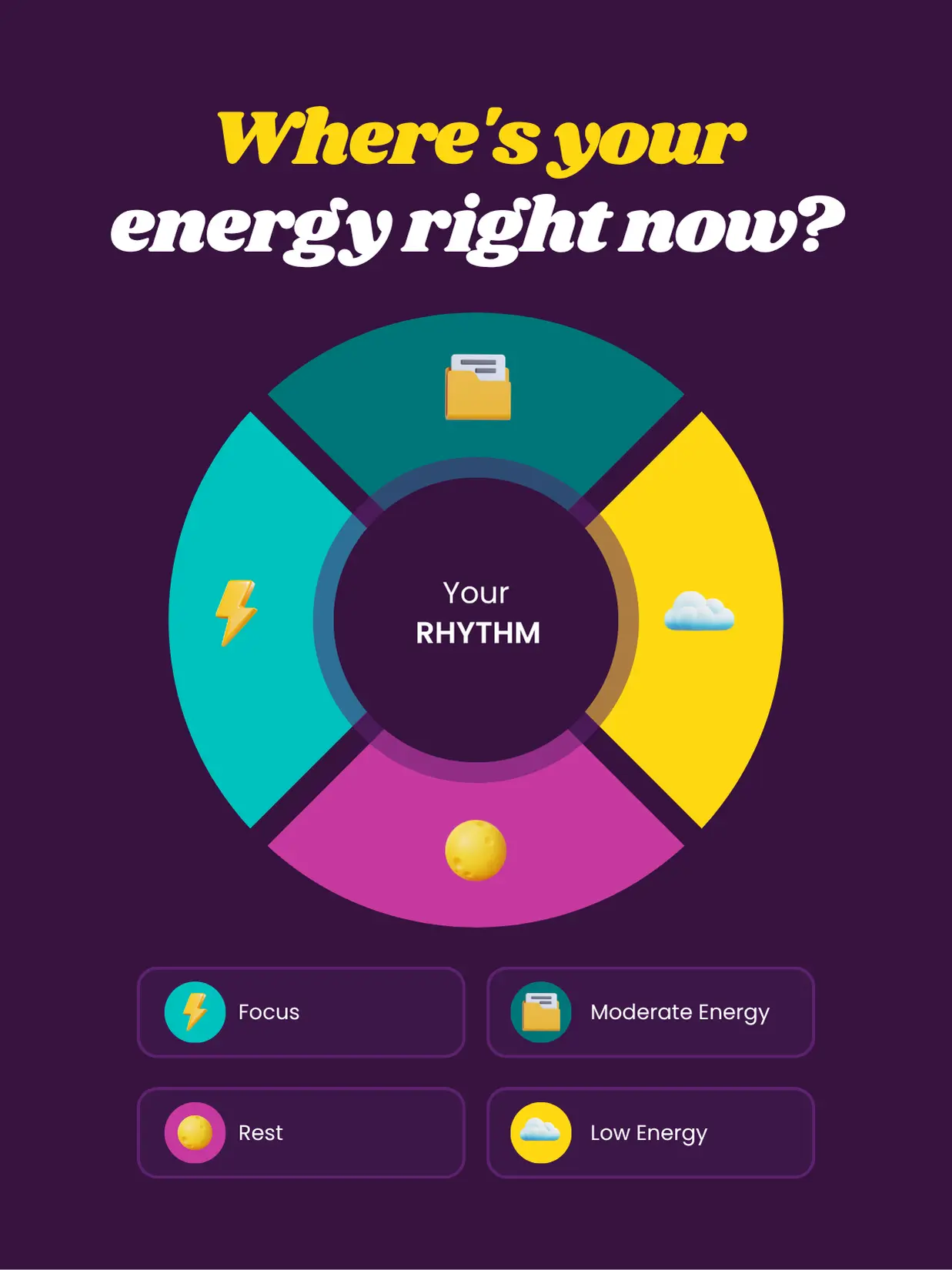
Rhythm mapping is the practice of identifying your personal windows of focus, rest, and recharge— and designing your day around them. Rather than asking “When should I work?” you ask, “How does my energy work today?”
This shift in perspective is powerful, especially for neurodivergent thinkers, whose energy isn’t steady, linear, or predictable. You may experience a burst of hyper-focus, then slump into fog. One day, your mind is clear by 9 AM: the next, you’re dragging until noon.
Recognizing that your energy flows are cyclical, not linear, is the first step in this method.
So how do you start recognizing those patterns? You begin by observing them—closely and compassionately.
How to Identify Your Peak Focus Hours
You don’t need a fancy tracker or a clinical study to start mapping your rhythm. You just need awareness. Ask yourself:
- When do I naturally feel most alert?
- When do ideas come easiest?
- When does my body ask for rest or distraction?
Try this:
For three consecutive days, log your energy levels each hour—high, medium, or low. Include notes on what you were doing, how long you could stay with a task, and whether your mind felt alive, distracted, or depleted.
After three days, look back:
- Do your “high” windows tend to cluster?
- Is there a consistent dip after lunch?
- When do you feel the strongest creative drive?
Now that you’ve spotted your rhythms, let’s talk about how to build a schedule that honors them—without boxing you in.
Using Rhythm Mapping for Consistency (Without Rigidity)
This is the part where most people give up: consistency. They crave structure, but structure has betrayed them too many times.
Here’s the truth: you don’t need perfect routines. You need predictable rhythms.
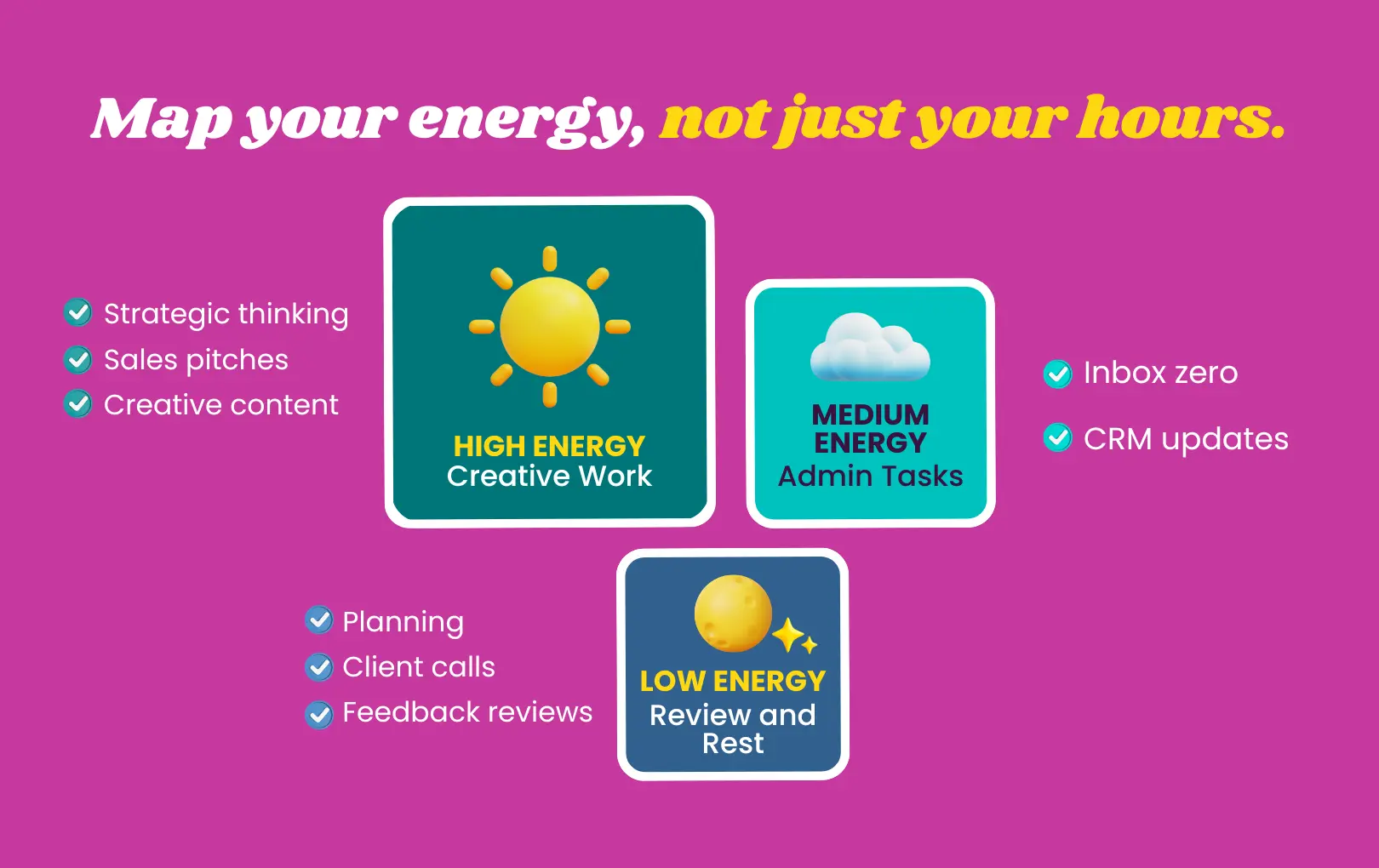
Let’s say your 3-day tracking showed this:
- High-focus (9:30 AM – 11 AM) → Creative work, deep writing, strategy
- Medium energy (1 PM – 3 PM) → Admin, emails, light planning
- Low energy (4 PM – 5 PM) → Review, scheduling, short wrap-ups
Instead of forcing tasks into rigid times, you assign them to energy zones. That way, your creativity flows when it’s most alive, and your busywork doesn’t steal your best mental hours.
Rhythm mapping gives you consistency—without the trap of rigidity. And if you’re wondering whether there’s science to back this up… there is.
The Science Behind It — Ultradian Rhythms
Your brain is built to work in cycles. Science refers to them ultradian rhythms—natural focus waves that last about 90–120 minutes. These are your brain’s high-alert windows, followed by a period of natural decline.
Pushing through those decline windows—ignoring your body’s call to pause—leads to what feels like burnout, distraction, or fog.
According to neuroscientist Dr. Andrew Huberman, honoring these intervals improves cognition, attention, and sustainable productivity. In fact, some studies suggest that even elite performers, like athletes and musicians, train in sync with these rhythms.
So, if world-class experts train in cycles, why wouldn’t your brain deserve the same grace?
Your Free Flow Day Blueprint
Now that you understand how your energy flows, you’re ready to build a day that supports it.
Download The Flow Day Blueprint—a free, fillable guide to help you design a day that finally fits your brain. Whether you’re navigating ADHD, burnout, or creative unpredictability, this guide will help you stop guessing and start mapping.
Your energy has a rhythm. Your mind has a tempo. You were never meant to march in step with a system that doesn’t recognize your music.
When you shift from managing time to mapping rhythm, you’re not just building a better schedule—you’re building trust with yourself. And that trust? It’s the most productive thing you’ll ever create.