


Most founders think burnout means they’re working too much.
So the advice is predictable.
Work fewer hours. Wake up earlier. Improve your discipline. Manage your time better.
But here’s the uncomfortable truth.
Burnout usually isn’t caused by workload.
It’s caused by unstructured access to your attention.
Clients message whenever they want. Teams escalate everything. Notifications never stop. And quietly, you become the emergency contact for your entire business.
No amount of discipline fixes that.
- Founder burnout usually comes from boundary leaks, not excessive workload
- Constant interruptions fragment attention and create cognitive exhaustion long before hours become the problem
- Most businesses leak through the same five structural failure points
- ADHD entrepreneurs absorb the cost of these leaks faster and harder than anyone talks about
- Boundaries aren’t personality traits — they’re business systems, and they’re buildable
Imagine sitting down to do the most important work of your day.
Strategy. Planning. Creative thinking.
Within ten minutes:
A Slack message. A client email. A team member who needs clarification.
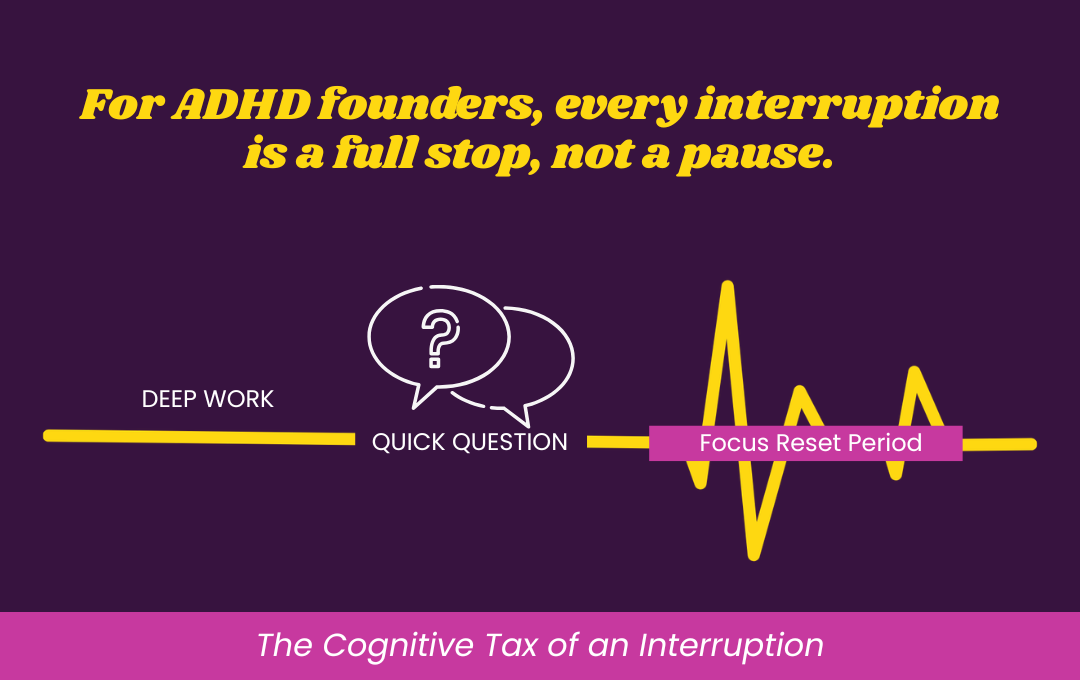
Each interruption takes a minute. But every interruption resets your thinking.
By the end of the day you’ve been busy nonstop — yet the work that actually moves the business forward never happened.
That’s one of the most common patterns behind founder burnout.
The Misunderstood Cause of Burnout
When founders feel exhausted, the first assumption is: “I must be working too much.”
So they try productivity hacks.
Better scheduling. New task managers. Stricter routines.
It doesn’t work. Because the real issue isn’t time.
It’s attention fragmentation.
Every interruption forces a context switch.
Strategy → response. Writing → troubleshooting. Planning → decision-making.
Those switches burn cognitive energy fast. When they happen all day, your brain never gets to do deep work.
This is why founders burn out even when they aren’t working extreme hours.
Discipline Isn’t the Solution
A lot of advice assumes founders just need more discipline.
But discipline can’t solve structural chaos.
If your phone is buzzing, your inbox is filling, and your team routes every question to you — willpower won’t fix it.
You can’t out-discipline a broken system.
Discipline is bullshit when the structure around you is broken.
The real solution isn’t working harder. It’s designing a business that protects your attention.
The Hidden Cost of Access
When boundaries don’t exist, people fill the gap with assumptions.
The assumption they always land on: the founder is available.
Clients message directly because it works. Teams bring every decision because nobody told them they didn’t have to. Notifications fire because nothing says they shouldn’t.
It’s not malicious. It’s what happens when access is unlimited and undefined.
The cost shows up in three ways.
Unlimited client communication.
Every channel becomes a live wire. Email, Slack, text, WhatsApp — clients find the fastest path and use it constantly.
Without communication boundaries, every message carries one implicit demand: respond now. Your nervous system treats it like one.
Decision escalation.
Your team doesn’t know what they’re allowed to decide without you. So they ask. About everything.
Not because they’re incompetent — because the system never told them otherwise. Every “quick question” is a decision that should have been made four rungs below you, landing directly on your plate.
Constant interruptions.
Each one seems harmless. Each one costs more than the minutes it takes to answer.
Because attention doesn’t pause — it collapses. And rebuilding it takes longer than anyone warns you about.
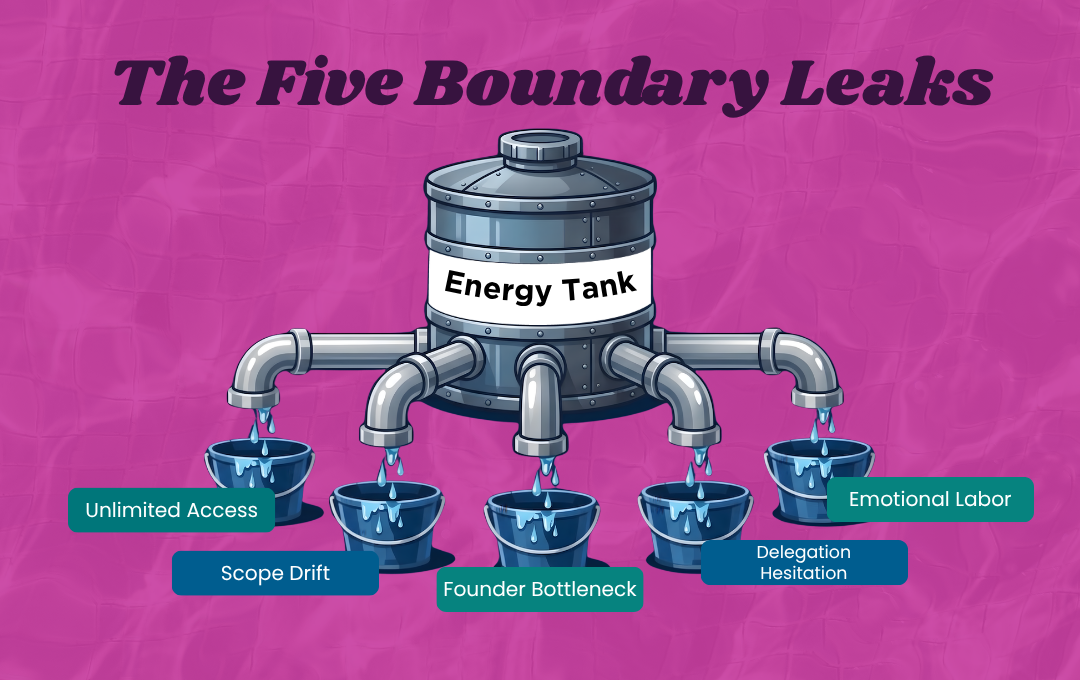
The Five Boundary Leaks
Same structural failures. Every founder. Every time.
Not personality problems. Not discipline problems. Business design problems.
Leak 1 — Unlimited Access. No communication windows. No response expectations. The founder is always reachable, so people reach constantly. Your attention becomes a communal resource nobody asked permission to use.
Leak 2 — Scope Drift. Work expands past the original agreement in increments too small to fight about — until you’re doing significantly more than you’re paid for and can’t pinpoint when it happened.
Leak 3 — Founder Bottleneck. Nobody established who else is allowed to make calls. Every decision routes back to you. Not because you demanded control — because the structure handed it to you by default.
Leak 4 — Delegation Hesitation. Handing things off feels riskier than doing them yourself. So they stay on your plate. Your ceiling becomes your capacity — nothing more, nothing ever.
Leak 5 — Emotional Labor. Reassuring clients, smoothing team tension, managing expectations, absorbing frustration. None of it is on the task list. All of it is on your nervous system. It’s why you’re wrecked by Thursday even when Wednesday looked manageable on paper.
Run all five simultaneously — which most founders are doing right now — and burnout isn’t a possibility. It’s a schedule.
Why ADHD Entrepreneurs Feel This So Much Harder
For founders with ADHD, interruptions aren’t just annoying. They’re expensive.
Focus resets take longer. Task switching drains more energy. Getting back to deep thinking after a disruption isn’t guaranteed — sometimes it just doesn’t happen that day.
When I work with neurodivergent founders, this is almost always the hidden story underneath the burnout.
It’s not that they’re working too much. It’s that every interruption costs more than it costs someone whose brain context-switches cheaply.
They’re not failing at productivity. They’re operating in an environment that was never designed for how their brain actually works.
Structure changes that.
Clear communication rules, defined decision ownership, real delegation systems — these dramatically reduce cognitive load. When the leaks are plugged, focus stabilizes. Not because the brain changed, but because the environment finally supports it.
The Boundary Reset
Burnout rarely improves when founders work fewer hours.
It improves when the business installs operational boundaries.
Strong boundary systems define:
- How communication happens
- Who owns decisions
- What work is included
- When responses are expected
- How attention is protected
When these structures exist, the founder stops being the emergency response center.
The business runs on systems instead of constant founder availability.
Quick Diagnostic
- Do clients message you directly throughout the day?
- Do team members frequently need your approval on small decisions?
- Do interruptions break your focus constantly?
- Do you end the day feeling busy but like nothing actually moved forward?
If several of these land — it’s not too much work. It’s boundary leaks.
Start with the Boundary Leak Audit.
Five minutes. Shows you exactly where your time, attention, and leadership capacity are draining out — and where clearer boundaries can reduce the pressure.