Most founders try to protect their calendar.
They block time for strategy. They schedule meetings carefully. They try to create space for deep work.
But the real asset you should be protecting isn’t your calendar.
It’s attention.
Because you can have a completely open calendar and still lose the entire day to interruptions. Messages. Notifications. “Quick questions.” Small decisions that somehow end up on your desk.
Your time might technically be available. But your attention is shattered.
And when attention fragments, leadership suffers.
- Founders often protect time instead of protecting attention
- Interruptions create constant cognitive resets that destroy deep work
- ADHD entrepreneurs feel this cost even more intensely
- Communication boundaries and delegation systems protect founder focus
- Attention protection is what allows you to operate at a strategic level
You block two hours for strategic thinking. The calendar is clear.
Within minutes:
A Slack notification. A client message. A team member with a quick question.
Each interaction takes less than a minute. But each one breaks concentration.
By the time the two hours are up, you haven’t actually thought deeply about anything. You were busy. But you weren’t focused.
That’s one of the most common hidden causes of founder burnout.
The Attention Economy
Modern business environments are designed to fragment attention.
Slack. Email. Text messages. Project management platforms. All of them create the same expectation: immediate response.
At first this feels efficient. But constant communication slowly turns you into the company’s response center. Instead of thinking strategically, you spend your day reacting. Answering. Clarifying. Approving.
Over time, attention scatters across dozens of small interactions.
And scattered attention cannot produce strategic thinking.
The Cost of Interruptions
Interruptions seem harmless. A quick message here. A quick decision there.
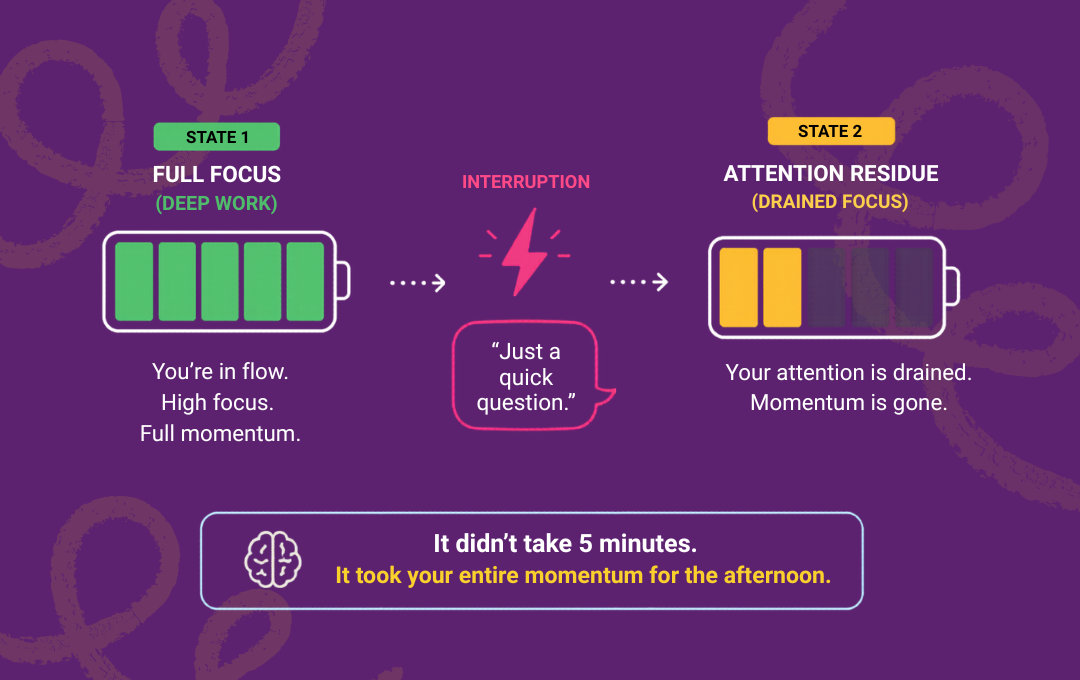
But here’s what nobody tells you: your brain doesn’t have a pause button. And attention doesn’t work like a lightswitch. And Also? Multitasking is a myth.
When you shift context, it has to rebuild the entire mental model of the work you were doing — from scratch. That reconstruction takes time and cognitive energy most founders don’t realize they’re spending. So every interruption isn’t a minor detour. It’s a full stop.
The more full stops that happen during the day, the harder it becomes to sustain deep thinking.
Eventually you hit a wall that feels familiar. Busy all day. Nothing meaningful moved forward.
ADHD Entrepreneurs Feel This Even More
For founders with ADHD, the cost of interruptions is amplified.
Focus requires momentum. When momentum breaks, it takes longer to rebuild. So each interruption doesn’t just pause the work — it forces your brain to restart the entire process of concentrating.
Environments filled with constant notifications and decision requests don’t just feel overwhelming. They’re designed to break exactly the kind of focus your brain needs most.
Nonstop context switching drains attention far faster than most founders realize. And for neurodivergent founders, the recovery time isn’t minutes. Sometimes it’s the rest of the day.
Boundaries Protect Attention
Attention protection requires more than personal discipline. It requires structural boundaries inside the business.
Without those systems, interruptions will always win.
Communication windows. Not every message requires an immediate response. Define where messages should be sent, when responses should occur, and which issues require urgent escalation. When communication expectations are clear, interruptions decrease dramatically.
Inbox triage. Most communication doesn’t require founder involvement. Inbox triage means someone else filters messages first. Routine issues get handled. Operational questions get routed. You only see what actually requires your leadership attention.
Your inbox should not be the first thing that touches your brain in the morning. It should be the last filter, not the first point of contact.
Delegation systems. When decision ownership is unclear, teams escalate everything upward. Clear delegation systems define who owns decisions, what authority people have, and when escalation is necessary. This dramatically reduces the “quick questions” that fragment your day.
Protecting Strategic Thinking
When attention is protected, something powerful happens.
You regain the ability to think strategically. Ideas have room to develop. Complex problems get proper analysis. Creative thinking becomes possible again.
This is where leadership actually happens. Not in the inbox. Not in constant messaging. In focused thinking about the future of your company.
Once your boundaries exist, your creativity can finally expand.
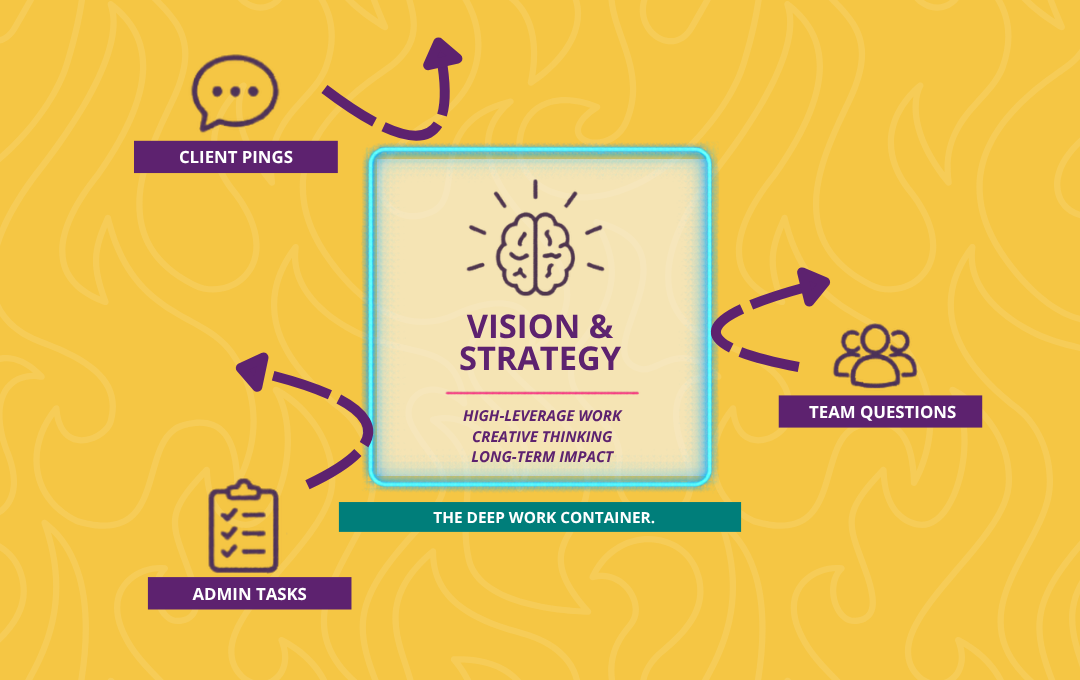
Quick Diagnostic
- Do notifications interrupt your focus throughout the day?
- Do team members frequently ask you quick questions?
- Do you struggle to find uninterrupted thinking time?
- Do you feel busy all day but rarely complete strategic work?
If several of these land — your attention is under constant attack. And protecting it requires structural changes, not more discipline.
The Real Leadership Shift
Many founders try to solve attention problems with personal discipline. Focus harder. Ignore notifications. Work longer hours.
But discipline alone cannot overcome a chaotic system.
If your business is structured around constant access to you, attention will always collapse.
You cannot scale a business that requires your attention for everything.
At some point, the math breaks. And when the math breaks, burnout follows.
Final Insight
Time is only useful when attention is intact.
A fragmented day may technically contain hours of availability. But without focus, those hours produce very little.
The founders who build sustainable companies don’t just protect their schedule. They protect their attention.
Because attention is where strategy lives.
A Strategy Call with Avy can help identify where communication systems, delegation structures, and operational boundaries can protect your attention and restore strategic focus.