Every productivity framework you have ever tried assumes the same thing: that you know what you should be doing and you just can’t make yourself do it.
That assumption is wrong.
If you are a neurodivergent founder with a business already in motion — one that has traction, has clients, has real capacity behind it — the problem is almost certainly not that you can’t focus. The problem is that you have built genuine capability in multiple directions. You can see the legitimate potential in more than one of them. And no one has handed you a filter that works for a brain that generates viable options faster than it can evaluate them.
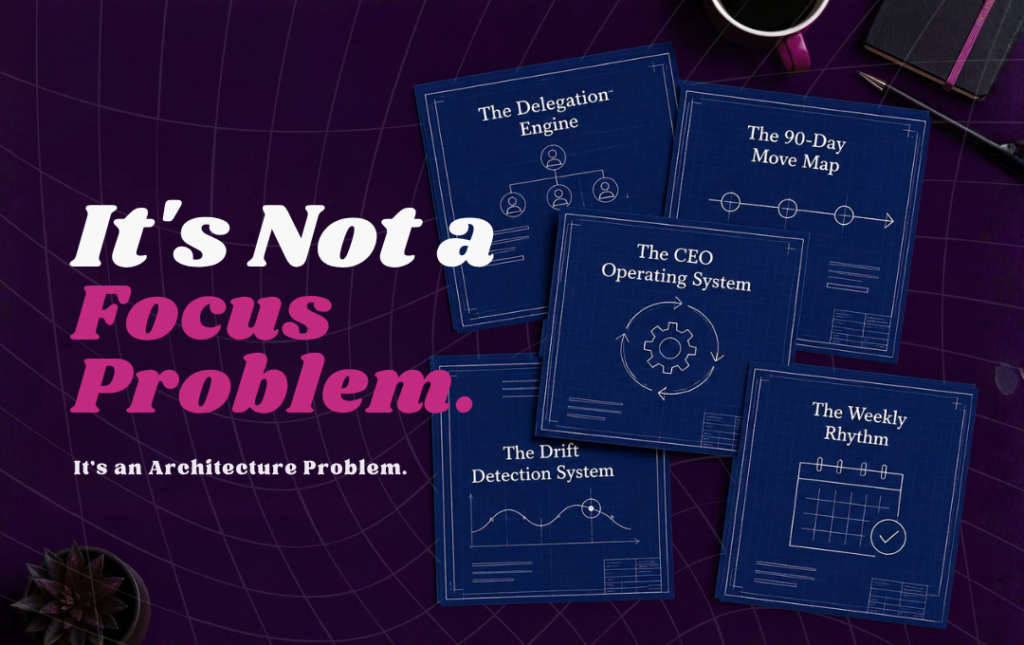
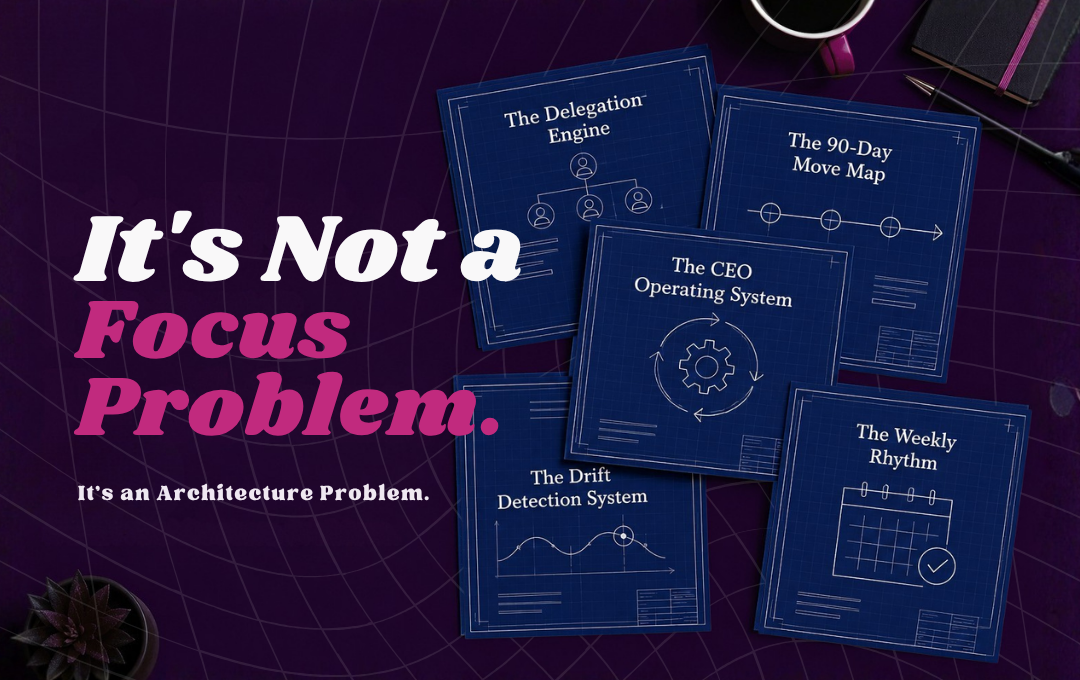
That is not a discipline problem. That is not a motivation problem. That is an architecture problem. And architecture is fixable.
Why “Just Pick One Thing” Fails Neurodivergent Founders
If I had a dollar for every coach, course, or conference that told neurodivergent founders to “just pick one thing and protect it,” I could fund a very satisfying bonfire of bad productivity advice.
The instruction is not wrong. The problem is that it skips the entire method. For a brain that generates ten viable ideas before breakfast — each with a legitimate use case, each with a compelling argument for why this one is the one — “just decide” is not an instruction. It is a judgment wearing a blazer.
What that advice leaves out: the process for evaluating real options against each other using actual criteria. The structure that holds everything you are not choosing right now, so those options stop competing for attention. The external architecture that makes a private decision stick in the real world. Without those three things, you will pick something, mean it completely, and quietly reopen it the next time something better shows up. Which is not a character flaw. It is a structural inevitability.
The Difference Between Scattered Focus and Legitimate Optionality
Almost nobody makes this distinction, and it costs founders significant time, money, and self-esteem.
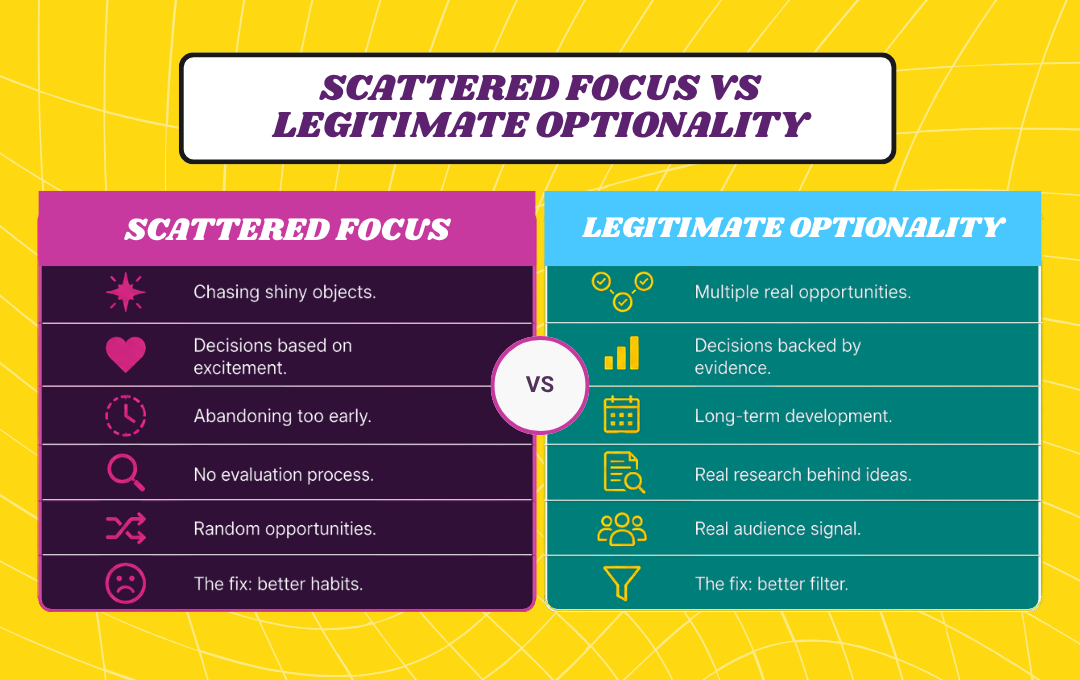
Scattered focus looks like chasing shiny objects with no evaluation process, abandoning things before they have had enough time to prove themselves, making decisions based on excitement rather than evidence.
Legitimate optionality looks different: you have a consulting practice producing revenue. A course framework you have been developing for two years. A partnership conversation that could genuinely change the scale of your business. All three are real. All three have merit. You are not scattered — you are overloaded with actual choices.
The fix for scattered focus is better habits. The fix for legitimate optionality is a better filter. Those are not the same thing, and treating them like they are is why so much productivity advice bounces right off founders like you.
If your list has items that have been sitting on it for more than six months — items with real research behind them, real audience signal, real revenue potential — you do not have a scattered focus problem. You have too many real options and no structure for choosing between them.
What It Actually Costs to Keep Too Many Directions in Motion
Most founders never do this calculation, and I think that is by design — because the number is uncomfortable.
Take every direction you are currently entertaining. Not the official ones. All of them. The main project, the side offer, the rebrand you keep revisiting, the idea that resurfaces no matter how many times you shelve it. Count them. Now estimate the cognitive overhead of each one — not just the hours you are actively working on it, but the mental real estate it occupies. The switching cost every time your brain picks it up and puts it back. The evaluation energy every time something new arrives and has to be compared against everything already in the queue.
For most founders I work with, that number lands somewhere between eight and fifteen hours a week. Not building. Not creating. Not moving any needle. Just managing the weight of open loops that were never formally evaluated or closed.
And then there is the second cost, the one that is harder to calculate but easier to feel: your team stops trusting the direction. Not because they don’t believe in you — they do. But they have learned from experience that today’s priority might not be next week’s priority. So they stop building ahead of your announcements. They check in more. They produce work that is technically correct but not fully committed. Because team commitment requires founder commitment first — and that starts with a direction that has been filtered, documented, and owned.
The Filter: What It Is, Why It Works, and Why Willpower Never Will
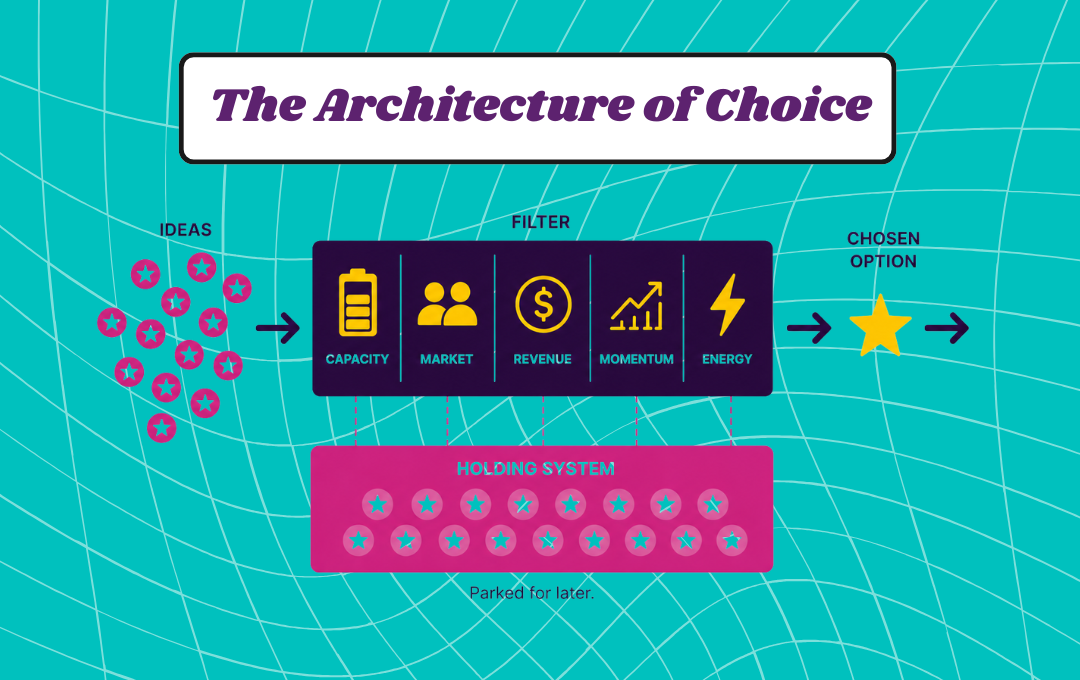
A decision filter is a set of criteria — specific to your business, your brain, and your current season — that every option must pass before it earns your active attention.
Five components: capacity fit (can you actually sustain this right now?), market alignment (is there an audience already looking for this?), revenue proximity (how far is this from actual dollars?), momentum evidence (is there traction, or are you starting from zero?), and founder energy (does thinking about this for the next 90 days make your energy go up or down?). Every direction gets scored. The one that survives is the direction. Not the most exciting one — the one that actually fits your business and your capacity right now.
Willpower alone never works for this because it requires the decision to be re-made every single time something challenges it. And something always challenges it. The genuinely good new idea. The opportunity that makes sense on paper. The conversation that opens a possibility you hadn’t considered. Willpower says “I will resist this.” The filter says “let me run this through the criteria” — and most of the time, the filter closes the decision without the founder having to make an emotional call at all.
Emotions are not bad. They are just terrible at comparing a half-finished current project against the full-color preview of something that hasn’t started yet.
The First Step: The Inventory
Before the filter can run, everything needs to be visible.
That means writing down every direction, idea, project, and commitment currently living in your head — active, background, shelved, “I should probably also be doing this.” Not evaluating them. Not prioritizing them. Just extracting them. Getting the whole queue out of your head and onto a page where it can actually be looked at.
Most founders are surprised by what is on the list. Not because the items are shocking, but because seeing them all in one place — instead of cycling through them endlessly in the back of your mind — changes the relationship. The queue is finite. It has items. They can be evaluated and closed.
The inventory is the first move. Everything else builds from it.
What a Committed Direction Actually Feels Like
Nobody tells you this part: commitment does not feel like freedom at first.
It feels like loss. Like closing doors you were not ready to close. Like betting on one future and watching the others quietly disappear. That feeling is real. For a high-generating brain that can see the legitimate potential in seven different directions, it can be genuinely acute.
It is also temporary.
Because what comes after — when the commitment is real, documented, owned, and operational — is a different kind of clarity entirely. The kind where your content knows where it is going. Where your team has a brief they can actually execute against. Where the next shiny thing arrives and instead of derailing your week, it goes through the filter. Interesting, not urgent. Evaluated, not entertained indefinitely.
A committed direction is not a door closing. It is the only way a door actually opens.
You are not broken. You are unfiltered. Let’s fix that.
Leading a nonprofit? This lands differently for mission-driven organizations — because every direction feels important and choosing between them feels like abandoning something that matters. The filter does not ask you to decide what matters most in the abstract. It asks what your organization can actually sustain right now, with current capacity. Clarity is not abandonment. It is stewardship.
Ready to run your inventory? The VISION Filter is a free tool that walks you through the full process — every direction extracted, scored, and either committed to or formally closed. Download it below.
