
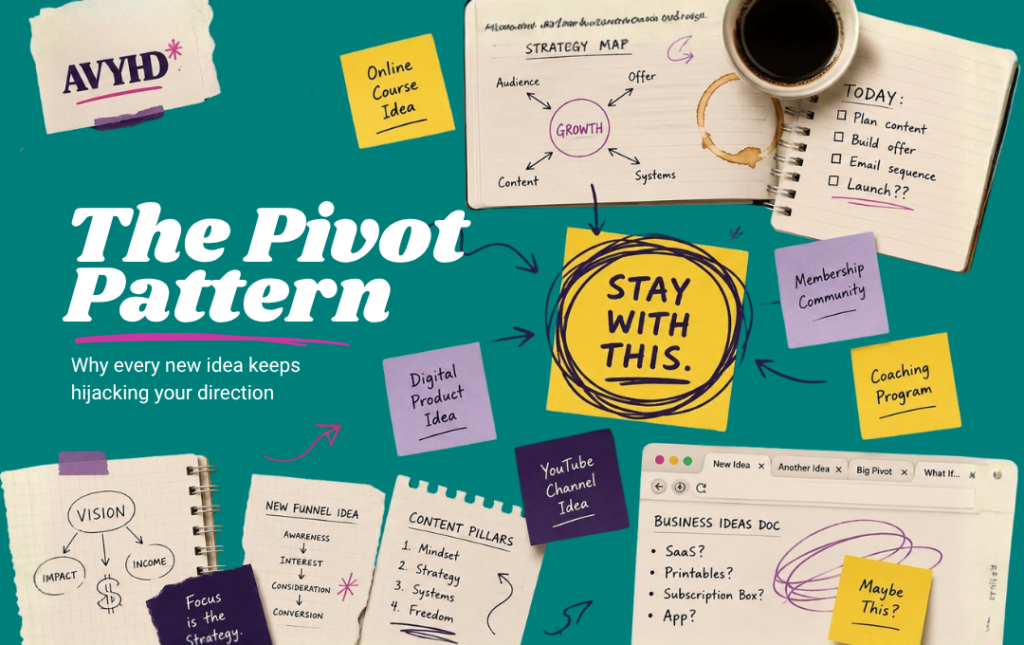
Let me describe something and you tell me if it sounds familiar.
You commit to a direction. You mean it this time. You tell your team, you update your content plan, you maybe even post about it publicly. For a few weeks it feels good — focused, clear, like you finally have the thing. And then something arrives. A new idea. A conversation that opens a possibility you had not considered. A piece of content from someone else that makes you quietly wonder if you are building the right thing.
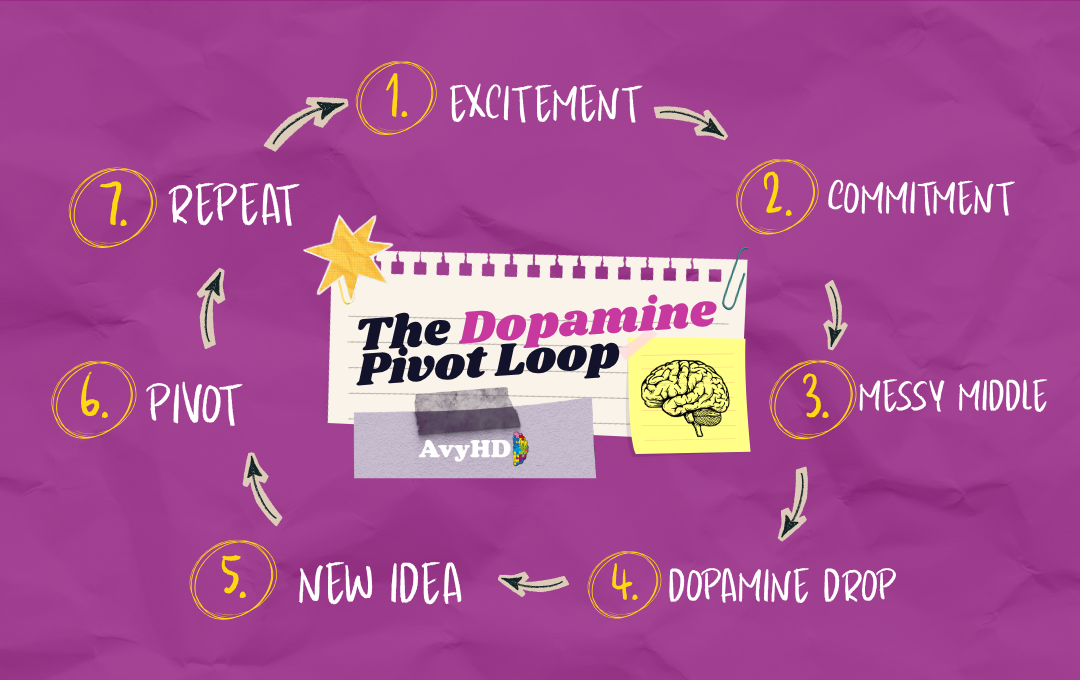
The current direction is in the messy middle. Nothing is exciting yet. Everything is just work. And this new thing has that full-color preview quality — all potential, no friction, no evidence yet that it will not work out perfectly.
So you pivot. With good reasons. You tell yourself this time is different. And three months later you are standing somewhere slightly different, having almost the exact same internal conversation.
That is the pivot pattern. And the reason it keeps happening is not what you think.
What the Pivot Pattern Actually Is
A strategic pivot and the pivot pattern are not the same thing, and conflating them is part of what makes the pattern so hard to see from inside it.
A strategic pivot is deliberate. It is driven by new data — market feedback, revenue signals, a genuine shift in the landscape that makes the previous direction less viable. It goes through some version of an evaluation process. It has a rationale that holds up when examined three months later.
The pivot pattern is different. It is driven by the arrival of a compelling new option at a moment when the current direction is not yet producing visible results. The rationale feels real in the moment — and it usually is partially real, because the new thing often does have genuine merit. But the decision is made on feeling, not evidence. And the pattern continues not because you keep choosing wrong directions, but because no direction ever gets enough time and focus to fully prove itself before the next one arrives.
The tell is in the timing. Pivot pattern pivots almost always happen in the middle — not at the beginning when you have data showing the direction is wrong, and not at the end when you have built something to completion. In the middle. When the work is hardest and the results are least visible.
The Neurological Mechanics
The pivot pattern is not a character flaw. It has a neurological basis, and understanding it is the first step to building the structure that interrupts it.
The ADHD brain is wired to respond to novelty. New stimulation activates the dopamine system in a way that established, familiar work simply cannot replicate — regardless of how good the established work actually is. This is not a bug in your brain. It is a feature that serves you extraordinarily well in the early stages of building something, in creative work, in problem-solving, in any context where generating new options is the job.
It becomes a liability specifically in the phase where the job is no longer generating options but executing on one. The point where momentum requires consistency. The messy middle where the direction is right but the dopamine is low.
At exactly that moment, a new idea arrives and activates exactly the neurochemical response the current direction stopped producing weeks ago. The pull is not irrational. It is physiological. And trying to override it with willpower alone — without structural support — is fighting your own neurology. You will lose that fight more often than you win it.
What Repeated Pivots Actually Cost
Every individual pivot feels manageable in the moment. The cumulative cost is what most founders have never fully reckoned with.
Each pivot resets the compounding clock. Momentum in a business is not linear — it compounds over time as audience trust builds, as the market learns what you do, as your systems get refined around a specific direction. A pivot does not just change the direction. It resets the compound interest you were accumulating on the previous one.
Each pivot erodes team trust in a specific and hard-to-repair way. Not trust in you as a person — but trust in the direction as something stable enough to build ahead of. Over time, the people supporting you learn to hold back. To wait and see. To do the minimum viable execution until the direction proves it is actually going to stick. That adaptive response is completely rational on their part. It is also the opposite of what high-performing execution requires.
Each pivot adds evidence to a story your own brain is building about your ability to follow through. That story is wrong — but it compounds anyway. And it makes the next commitment harder than the last one, because now you are not just making a decision, you are also negotiating with the version of yourself that has been here before and knows how it usually goes.
The Role of the Holding System in Breaking the Pattern
The pivot pattern cannot be stopped by commitment alone. It requires a structure that changes what happens when a compelling new option arrives.
Without a Holding System, a new idea has two options: it either competes for attention with the current direction, or it gets suppressed and resurfaces six weeks later. Both outcomes feed the pattern.
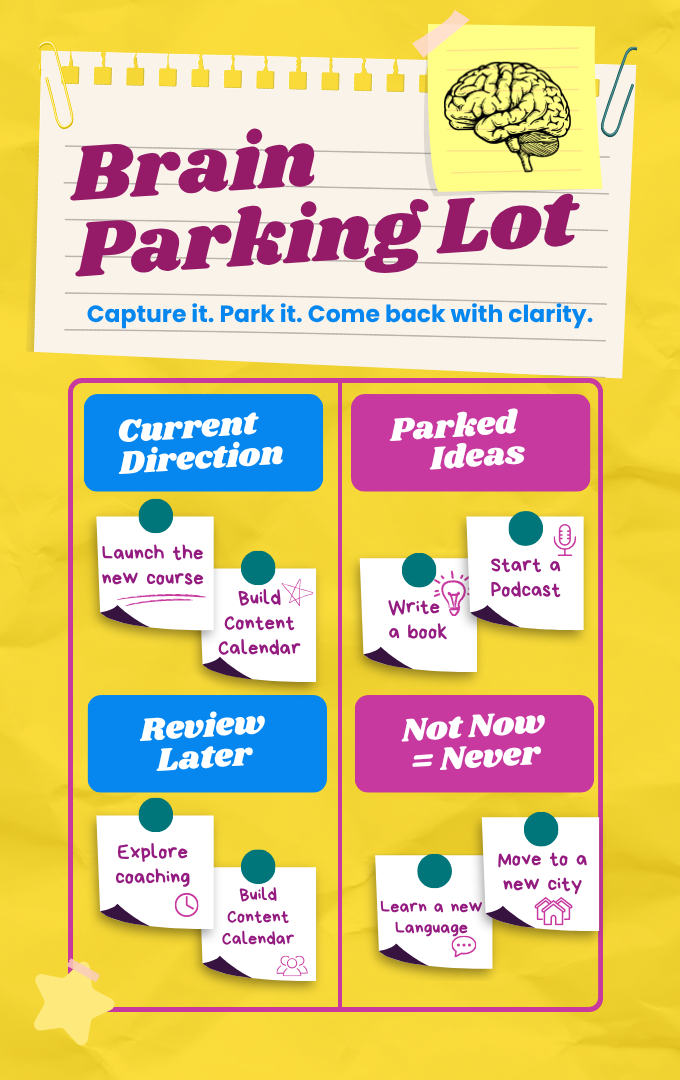
With a Holding System, a new idea has a third option: a legitimate place to exist that is not active competition with your current priority. It gets captured, designated, and given a review date. The loop gets closed without the idea getting killed. Your brain gets the relief of knowing it has not lost something valuable. The current direction retains its position without having to fight for it.
That is the structural intervention the pattern requires. Not more discipline. Not a better vision board. A place for the new thing to go that removes it from active competition without requiring you to pretend you do not find it interesting.
How to Make a Commitment That Sticks
A commitment that sticks is not just a private decision. It is a set of external structures that make the decision real in the world, not just in your head.
It means communicating the direction in writing to everyone who is executing against it — not a casual mention, a documented brief. It means auditing your calendar against the committed direction and removing the items that belong to something else. It means identifying the places where you are still hedging — the side project you have not officially closed, the offer you are still quietly developing “just in case” — and making a clean break.
It means, when the next good idea arrives mid-commitment, running it through the filter before giving it any real attention. Not dismissing it. Evaluating it. Most ideas that feel urgent do not survive honest evaluation against the criteria your current direction already passed. The ones that do get parked with a review date. The pattern breaks not because you become someone who stops having new ideas, but because the new ideas finally have somewhere to go that is not your current execution timeline.
What to Do When a Genuinely Good New Idea Arrives
It will. Count on it.
The good news is that a filter makes this manageable. Run the new idea through the five criteria — capacity fit, market alignment, revenue proximity, momentum evidence, founder energy. Score it. Compare the score against the direction you have already committed to.
If it scores lower: park it. It is a good idea for a different season. Give it a review date and let the current direction continue without interference.
If it scores the same or higher: do not pivot immediately. Sit with the score for a week. Run it by someone who can see your business from outside. Let the data settle before the decision gets made. A good idea that survives a week of honest scrutiny is more likely to be a real strategic opportunity than a dopamine response to novelty.
The pivot pattern does not end because you stop generating ideas. It ends because the ideas stop having unchecked access to your direction.
For nonprofit leaders: the pivot pattern at the organizational level shows up as initiative fatigue — a new priority gets announced with full leadership energy, the team mobilizes, and six months later something else has quietly taken center stage without the previous initiative ever being formally closed. Staff learn to wait out announcements rather than fully committing to implementation. The fix is the same: a filter, a holding system, and a committed direction that has been documented and distributed before the team is asked to execute against it.
If you are reading this and recognizing the pattern — not just intellectually but in your actual business history — the Strategy Call is the fastest way to break it. In 60 minutes, we run the filter using your real business data and produce a Direction Map that gives the commitment the external structure it needs to stick. $750, delivered in writing within 72 hours.