You have vision. That is not the problem.
You can describe the business in detail. You have probably described it to at least three people who told you it sounded incredible. You can see the offers, the audience, the revenue model, the version of your life on the other side of it. The vision is clear. Vivid, even.
And yet the business you are actually running does not quite match that picture. Not because you are not working hard. Not because you lack capability. Because the vision is clear and the commitment is not — and without commitment, vision is just an aspiration that makes the present feel perpetually inadequate.
That gap is what this blog is about.
The Difference Between Vision and Committed Direction
Vision and committed direction are not the same thing, and treating them as interchangeable is one of the most expensive mistakes founders make.
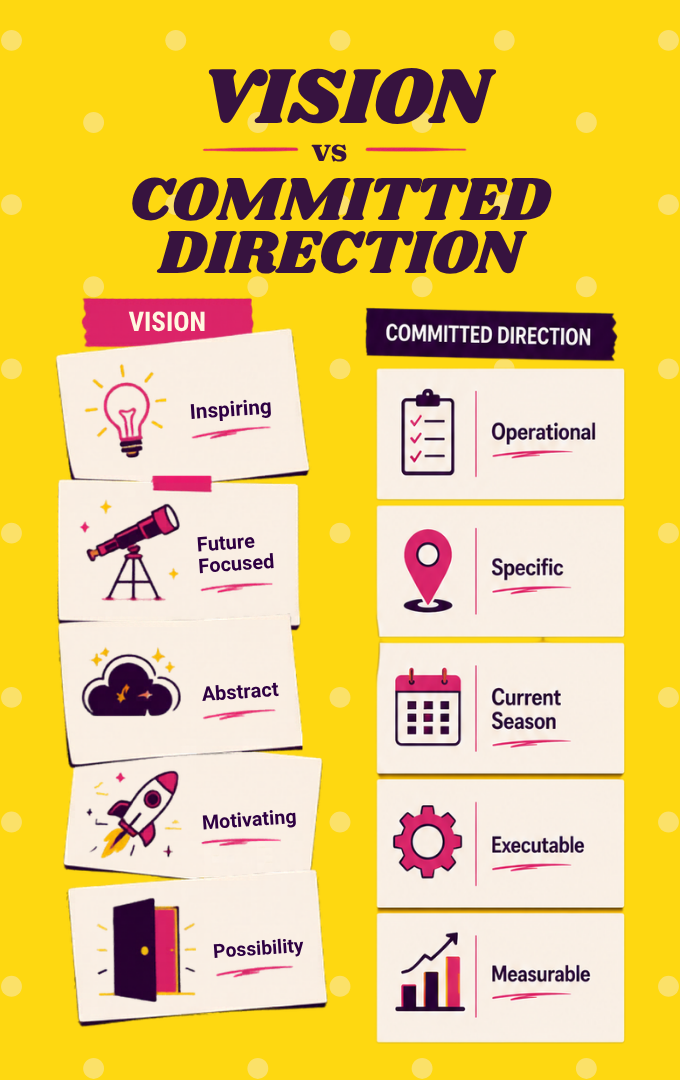
Vision is the picture. It is directional, inspiring, and almost always somewhat abstract. It lives in the future. It motivates. It gives the work meaning. All of that is genuinely useful — up to a point.
A committed direction is operational. It is specific to the current season of the business. It can be written down in one sentence and handed to your team as an executable brief. It tells you what you are building in the next 90 days, what you are not building, and what happens when something new arrives that competes for your attention.
Most founders have vision. Far fewer have a committed direction. And the gap between them is exactly the space where momentum goes to die — the place where capability and clarity and even hard work produce frustratingly little forward movement, because all of it is pointed at a future picture instead of a current, specific, owned next step.
Vision without a committed direction is inspiration. Inspiration without execution is a very stressful daydream you keep having while your to-do list gets longer.
Why Commitment Feels Risky
If commitment is so clearly useful, why is it so hard to actually do?
For neurodivergent founders, the resistance to commitment is usually not about fear of success or fear of failure in the abstract. It is about something more specific: the feeling that committing to one direction means permanently foreclosing on every other one.
The brain that can hold seven viable options simultaneously experiences commitment as loss. Not strategic repositioning. Loss. And the larger and more genuine the other options feel, the more acute that loss feels — even though nothing has actually been eliminated, just deprioritized for a season.
There is also the “what if I commit to the wrong one” problem. Which sounds like it has a research solution — gather more data, wait for more certainty — but usually does not. Because for a brain that generates new compelling options continuously, certainty never fully arrives. There will always be another option that feels slightly more aligned, slightly more exciting, slightly more right. Waiting for certainty is, in practice, a very sophisticated form of not deciding.
The antidote is not certainty. It is a filter that makes the decision with the best available data — and a structure that makes the commitment real enough in the world that reopening it requires a deliberate process rather than just a feeling.
What a Committed Direction Actually Looks Like Operationally
Most founders stop at the private decision. They make the commitment internally, maybe tell a friend, maybe journal about it — and then wonder why nothing changes.
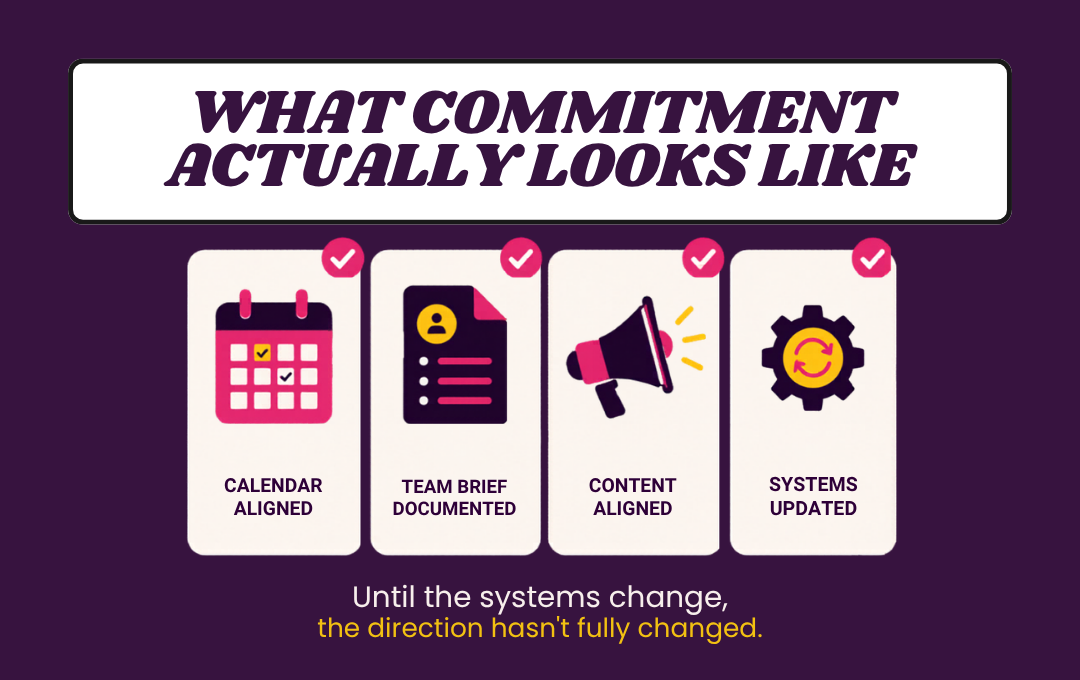
A committed direction is not a private decision. It is an operational state. And it looks like specific, concrete things that have changed in the real world.
Your calendar reflects the direction. The recurring commitments, meetings, and projects that belong to something other than the committed path have been identified, removed, or handed off. The calendar is not aspirational. It is aligned.
Your team has a written brief. Not a Slack message, not a verbal update in a Monday meeting — a documented, distributed direction brief that every contractor, collaborator, and support person has received and confirmed. The direction is not something people have to interpret from context. It is stated.
Your content is pointing at one destination. The blog series, the social content, the emails — they are building toward a specific thing. Not gesture toward a general theme. Building toward an offer, an audience, a specific result.
Your systems have been updated. The workflows, the automations, the task structures that were configured around the previous direction have been reconfigured. The infrastructure matches the intention.
When all four of those things are true, the commitment is real. Until then, it is a preference with good intentions.
The External Structures That Make Internal Commitment Real
Internal commitment is necessary. It is not sufficient.
The founders who keep their committed direction through the messy middle — through the weeks when results are not visible, when new ideas are arriving, when the motivation is lower than it was on day one — are not doing it through sheer force of will. They have built external structures that make reopening the decision costly in a structural sense, not just an emotional one.
A documented direction means that changing it requires going back through the filter. Not just having a feeling about it. Running it through the criteria. Scoring it. Comparing it against what you already chose and why. That is a structural barrier between a compelling feeling and an actual pivot.
A team brief means that changing direction requires a new brief. A formal communication. An acknowledgment that things are shifting. That friction is not bureaucracy — it is the exact amount of resistance required to ensure pivots are intentional rather than reactive.
A calendar audit means that every new commitment that arrives has to displace something. Nothing gets added without something being evaluated. The calendar becomes a live record of what the committed direction actually costs in hours and attention, which makes the decision to protect it much easier.
None of these structures are complicated. All of them require someone to build them. That is the work that comes after the commitment — and it is the work most founders skip.
The Role of the Decision Map
One of the outputs of the Strategy Call is a Decision Map — a written document, delivered within 72 hours, that makes the committed direction real on paper.
Not a plan. Not a roadmap. A map of the decision: what direction you are committed to, what the rationale is, what the first 90 days of execution looks like, and what the external structures are that need to be built to support it.
The Decision Map matters for a specific reason: it changes the relationship between the founder and the commitment. A direction that lives only in your head is vulnerable to every mood, every new idea, every difficult week. A direction that exists in a document — one you can return to, share with your team, and use as a reference point when the next shiny thing arrives — has a different kind of stability.
It is also, practically, a much better brief for the people supporting you. “This is the direction, here is the rationale, here is what the next 90 days looks like” is a document a DA can execute against. A DA cannot execute against a direction that exists only in the founder’s head and gets communicated through the occasional enthusiastic Slack message.
The Bridge to CREATE
The VISION framework ends at the same place CREATE begins.
Once the direction is committed, documented, owned, and operational — once the calendar reflects it and the team has the brief and the systems are configured around it — the question becomes: how do you actually build it with consistency? How do you create content, offers, and output that compound over time instead of scattering in the wind?
That is CREATE. Channeling Radical Expression and Thoughtful Execution. The frame where the build actually happens, with voice and consistency and a system that holds.
But you cannot create with intention until you know what you are creating. You cannot build a body of work from a revolving door of directions. VISION is not a prerequisite because someone decided it should come first. It is a prerequisite because the momentum CREATE requires is only available to founders who have already done this work.
You are one committed direction away from the business you have been describing.
For nonprofit leaders: vision statements are often crystal clear at the organizational level — and genuinely fragmented at the program level, where multiple initiatives are running simultaneously with partial resourcing and unclear ownership. Closing that gap requires the same thing it requires for individual founders: a filter, a committed direction, and the external structures that make the commitment real to the people who need to execute against it.
The Strategy Call is where the commitment gets built. In 60 minutes, we use your real business data to run the filter, produce the Direction Map, and hand you the document that makes the decision operational. $750, delivered in writing within 72 hours.