

You reread the post before hitting publish, and something’s off. It’s fine. It’s clean. It’s… nothing. It could have been written by any of a hundred people in your niche, and if you’re honest, it doesn’t sound like you at all.
You wrote it. You just can’t find yourself in it.
So you ask the question every founder eventually asks at 11pm, cursor blinking. Why does my content sound generic? Why does the stuff in my head feel sharp and specific and alive, and the stuff on my feed read like a press release for a company that doesn’t exist?
Here’s the answer nobody gives you, squirrel. Your content sounds generic because your brand is masking. And you taught it how.
TLDR
- If you’re asking why your content sounds generic, the cause usually isn’t a skill gap. It’s masking.
- Masking is the neurodivergent survival skill of translating yourself into a more palatable version. You’ve done it your whole life.
- Without deciding to, you taught your business the same move. The brand voice became the masked voice.
- It costs you twice: masking drains you personally, and the sanitized content it produces is forgettable.
- The fix isn’t “be more authentic.” It’s recovering the real voice and making it low-risk to use.
The move you’ve been running your whole life
If you’re neurodivergent, you know this one in your bones. You walk into a room and you read it. You clock the acceptable volume, the acceptable amount of intensity, the acceptable version of you that won’t cost you anything. Then you become that version. You soften the edges. You swallow the tangent. You perform fine.
That’s masking. You did it in classrooms that weren’t built for your brain. You did it in jobs where the real you was “a lot.” You did it at family dinners. It was never a character flaw. It was survival, and it worked well enough to get you here.
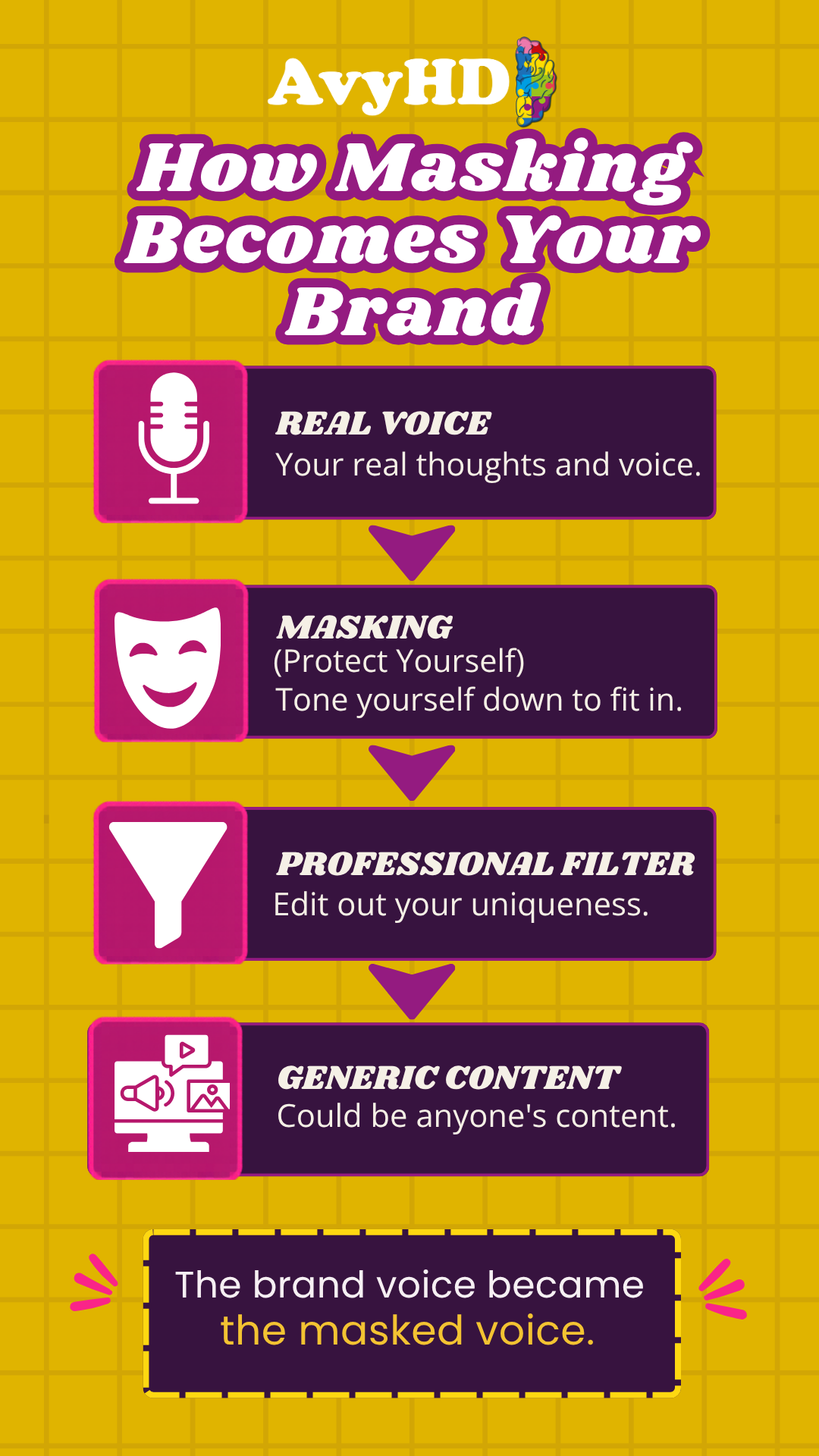
The problem is that masking doesn’t clock out when you start a business. It comes to work with you
.
How the survival skill became the brand voice
Nobody sat you down and told you to sand yourself off. It happened the way masking always happens. Quietly, automatically, in the name of being taken seriously.
You wanted to look legitimate. So you started writing the way you thought a real business owner writes. You cut the weird analogy. You deleted the strong opinion. You ran every post through the same filter you’ve run yourself through in every unsafe room since childhood, and out came content that offends no one and reaches no one.
This is why your content sounds generic. Not because you lack talent or ideas. Because the version of you that shows up on the page is the masked one, and the masked one is, by design, indistinguishable from everyone else performing the same acceptable neutrality. You built a brand voice out of the exact instinct that has always made you disappear.
The uncomfortable part
Here’s the thing you already suspect. You decided the real you wasn’t sellable.
Somewhere in the early days you looked at your unfiltered voice and judged it too much, too weird, too intense for a professional to lead with. And then you spent months proving yourself right. Every time you deleted the good line, you added another piece of evidence to the case against yourself, while quietly burying all the evidence that the real voice was the good one.
That’s hard to hear. It’s also the way out. You installed this. Which means you are allowed to uninstall it.
The double cost
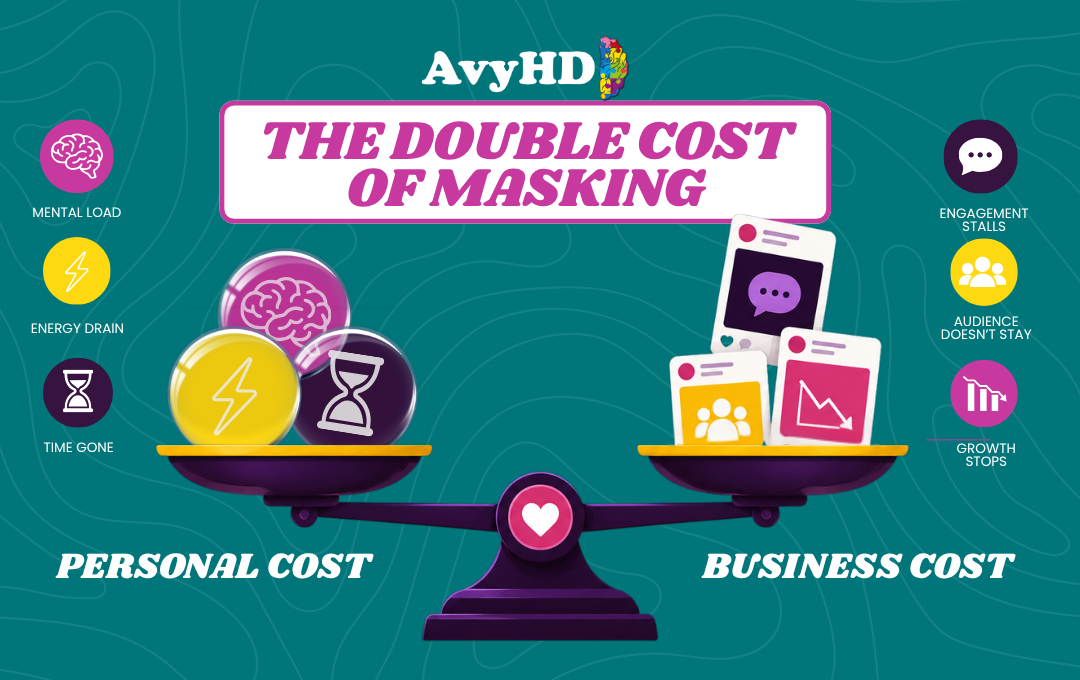
Masking your brand isn’t just an aesthetic problem. It bills you twice, and both invoices are real.
The first cost is you. Masking is expensive to run. It always has been. Every post you translate before publishing burns the same energy that leaves you flat after a day of performing normal. That’s why creating content feels so much heavier than it should. You’re not just writing. You’re writing and translating and self-monitoring, all at once, on a brain that finds that exhausting.
The second cost is the content. A masked voice is a forgettable voice, and forgettable doesn’t compound. You can post consistently for a year and build almost nothing, because none of it was distinct enough for anyone to remember, follow, or trust. People bond to voices, not to neutral competence. The thing you’ve been filing off is the exact thing that would have made them stay.
If you’re leading a nonprofit…
Your organization masks too, and it’s usually called “writing for funders.” Every story about the community you serve gets flattened into outcomes language and compliance phrasing until your appeals sound like every other org in your sector. The communities you serve and the donors you need both respond to the unflattened version, the one that actually sounds like the people doing the work. When mission communications sound generic, giving stalls, because nobody bonds to a grant report. The organizations that raise well sound like humans, not applications.
A quick gut-check
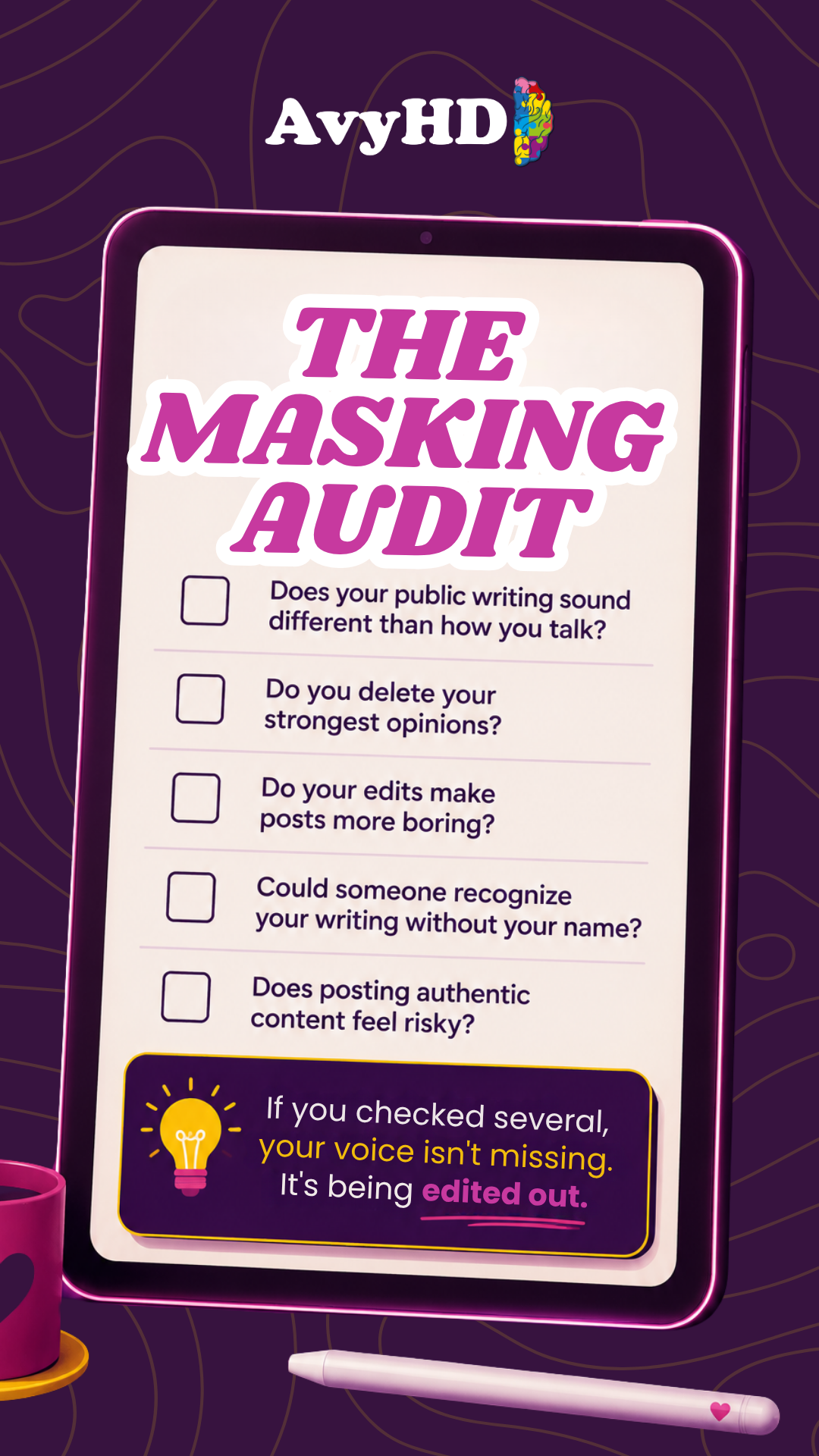
Not sure whether masking is what’s flattening your voice? Sit with these. Answer as the real you, not the aspirational one.
- When you tell a friend about your work, does it sound completely different from how you write about it publicly?
- Are there opinions you genuinely hold that have never once made it onto your feed?
- Do you edit posts to sound more “professional” and feel them get more boring as you go?
- If you stripped the names off your content and three competitors’, could anyone pick out yours?
- Does publishing something that sounds fully like you make your stomach drop a little?
If those landed, the issue was never your ability. It’s the mask, running on autopilot, standing between your real voice and the publish button.
The final insight
Your content doesn’t sound generic because you’re generic. It sounds generic because you’re publishing the masked version of a genuinely specific person. The voice isn’t gone. It’s just been translated out, one careful edit at a time.
You’re not broken. The system around your voice is. Let’s build a better one.
Start here
The Offer Spark Sprint is the fastest way to find out how to launch your contents and be consistent at them by following a system that allows you to create one and post 10 or more pieces of content. Take it, it’s free!
When you’re ready to design the fix on your real business data, your content load, your energy patterns, your gaps, that’s a Strategy Call with Avy. It’s the working session where we map your specific fix in the right order, and you leave with a Decision Map within 72 hours.