


Some expert tells you the fix for your boring content is simple. Just be authentic. Just be yourself. Show up real.
So you go home, open a blank document, and produce the exact same filtered, careful, sounds-like-everyone content you always do. Except now you feel worse, because apparently you can’t even be yourself correctly. You’ve been told the answer, you nodded along, and nothing changed.
Here’s why, squirrel. “Just be authentic” is useless advice. Not because authenticity doesn’t matter. Because it’s aimed at the wrong thing, and it leaves you to do all the hard work alone.
- If you’re looking for how to be authentic on social media, “just be yourself” is the least useful answer anyone can give you.
- The advice fails because it targets courage. Courage is not your problem.
- Authenticity isn’t a personality trait you switch on. It’s an engineering problem you solve with a system.
- The system has an order: recover the voice, document it, then build the machinery. Wrong order wastes months.
- You can’t see your own filter from the inside. That’s the part that doesn’t work solo.
Why courage-based advice always fails
“Just be authentic” assumes the only thing standing between you and a magnetic brand is nerve. Be braver. Post the scary thing. Stop caring what people think.
But nobody sustains bravery four times a week, indefinitely, on willpower. Willpower is a resource that runs out, usually by Wednesday. Any strategy that depends on you being courageous every single time you post is a strategy that will fail you the first bad week, and then hand you the shame for failing. You don’t have a courage deficit. You have a system that requires courage it should have made unnecessary.
Authenticity is an engineering problem
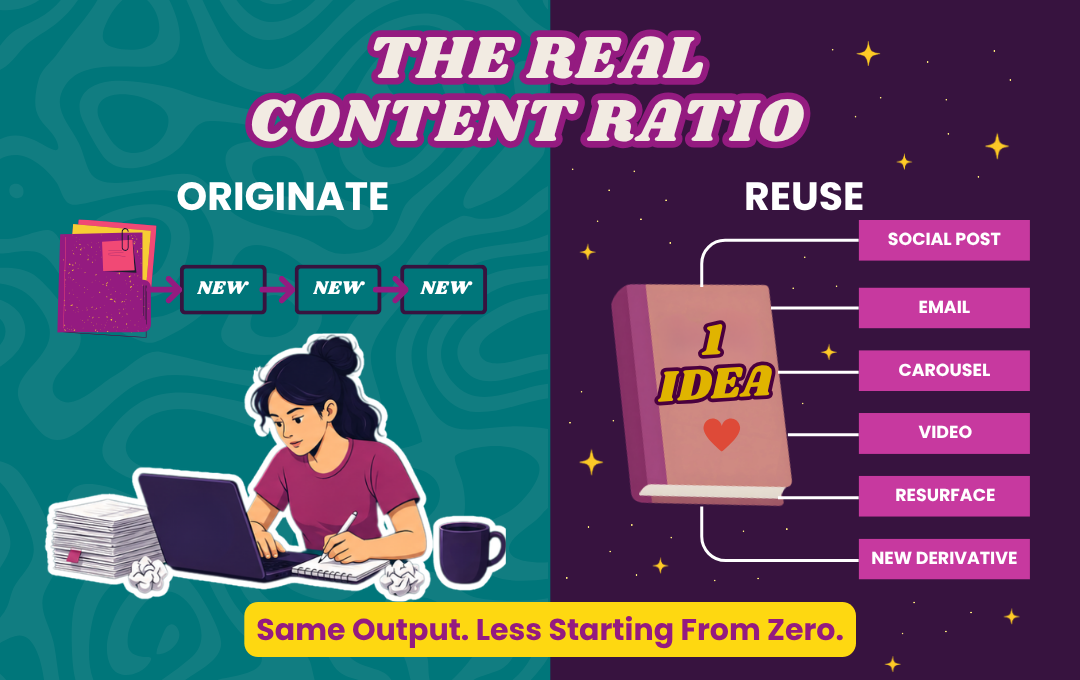
Here’s the reframe that actually changes things. Sounding like yourself, consistently, in public, is not a feeling you summon. It’s a structure you build.
Three parts. A documented voice, so the real you is repeatable instead of dependent on your mood. A pipeline, so publishing doesn’t stall every time your energy dips. And clear handoffs, so you’re not personally carrying every stage of every post. Build that, and authenticity stops being a daily act of bravery. It becomes the path of least resistance, the default setting, the easy thing instead of the hardest thing you do all week. You engineer the courage out of the equation.
The order of operations
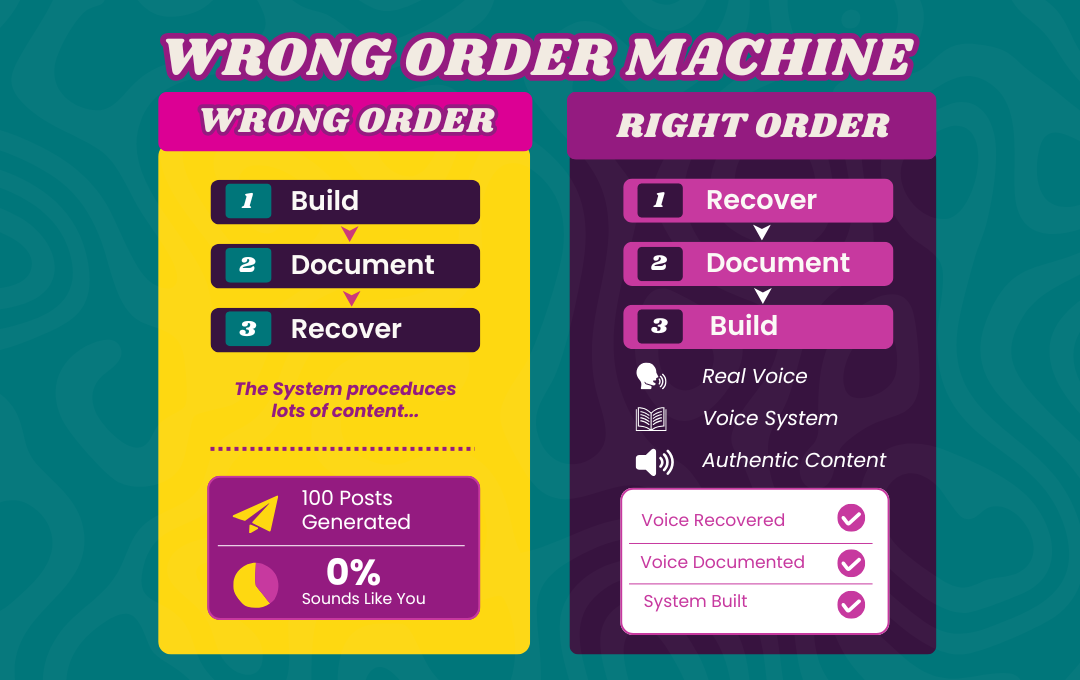
This is the part almost everyone gets wrong, and the order is not optional.
First, recover the voice. Dig the real one out of your voice notes, your DMs, your deleted drafts. Second, document it. Write down the words, the tone, the no-go list, so it stops living only in your head. Third, and only third, build the machinery to carry it. Do it in that order and it holds. Do it backwards, build the pipeline before you’ve recovered the voice, and you just mass-produce the filtered version at scale. Now you’re consistently forgettable, efficiently, which is worse than where you started. Recover, document, then build. The sequence is the strategy.
The uncomfortable part
You cannot see your own filter. That’s not a knock on you. It’s the definition of a filter. The whole reason it operates is that it’s invisible to the person running it. You’ve been staring at your own content for years and you still can’t reliably tell where the real voice got translated out, because you’re inside the translation.
That’s why the fix doesn’t work solo. Not because you’re not smart enough. Because nobody can read their own blind spot from inside it. The diagnosis needs an outside eye. It always has.
If you’re leading a nonprofit…
“Tell better stories” is the nonprofit version of “just be authentic.” True, useless, and aimed at the wrong layer. The organizations communicating well don’t have braver executive directors. They have documented voice standards and communication pipelines that don’t route through one exhausted person. If your mission’s story depends on the ED having a good week, the mission has a single point of failure, and no amount of “be more authentic” fixes a structural gap.
A quick gut-check
Not sure whether you need courage or a system? Sit with these honestly.
- Have you been told to “just be authentic” and found it changed nothing?
- Does sounding like yourself currently depend on a burst of nerve you can’t reliably summon?
- Have you tried to fix this alone, more than once, and landed back in the same place?
- Can you actually point to where your voice gets filtered out, or does it stay invisible to you?
- Is your real voice documented anywhere, or does it live only in your head?
If those landed, you don’t need another pep talk about being brave. You need the filter diagnosed from the outside and a system built in the right order.
The final insight
Stop trying to become a braver person. It’s a losing game and it was never the actual problem. Build a system where sounding like yourself is the default, not the dare. Authenticity isn’t a virtue you perform. It’s an architecture you install.
You’re not broken. The system is. Let’s build a better one.
Start here
The fix gets designed on a Strategy Call with Avy. You bring your real business data, your content, your energy patterns, your gaps, and we map the whole thing live: where your voice is getting filtered, and the system that makes sounding like yourself the default. You leave with a Decision Map within 72 hours. It’s a working session, not a pitch.
Not ready to put money on it yet? There’s a free Discovery Call if you’ve got a question you want to talk through first. It’s a quick conversation, not a strategy session. The actual design work happens on the Strategy Call.