

We’ve been taught to believe that structure equals success. That if we just follow the plan—hour by hour—we’ll finally feel in control.
When Time Blocking Backfires
Most productivity advice begins with the same approach: block your hours, color-code your calendar, and stick to your plan. But if you’re neurodivergent, that plan often goes out the window by 10:17 AM.
You had every intention. The schedule looked perfect on paper. But then an unexpected email derailed your focus, or your brain simply didn’t want to do what was written at 2 PM. And just like that—guilt, frustration, and the internal story: I can’t even follow a simple plan.
Let’s pause here. You’re not broken. The goal isn’t to control time, it’s to shape it.
So if time blocking doesn’t work for your brain, what actually does?
The Problem with Traditional Time Blocking
Time blocking asks your brain to show up at full capacity on command. It assumes your energy is consistent, your focus is predictable, and your transitions between tasks are seamless.
But neurodivergent brains—especially those with ADHD—don’t operate like that. We move in rhythms, bursts, dips, hyper-focus sprints, and foggy lulls.
In fact, CHADD (Children and Adults with ADHD) notes that time blocking can increase stress and reduce productivity for ADHD minds due to its rigid nature and poor fit for variable energy.
So instead of forcing time into boxes, what if we started sculpting it?
Introducing Day Sculpting
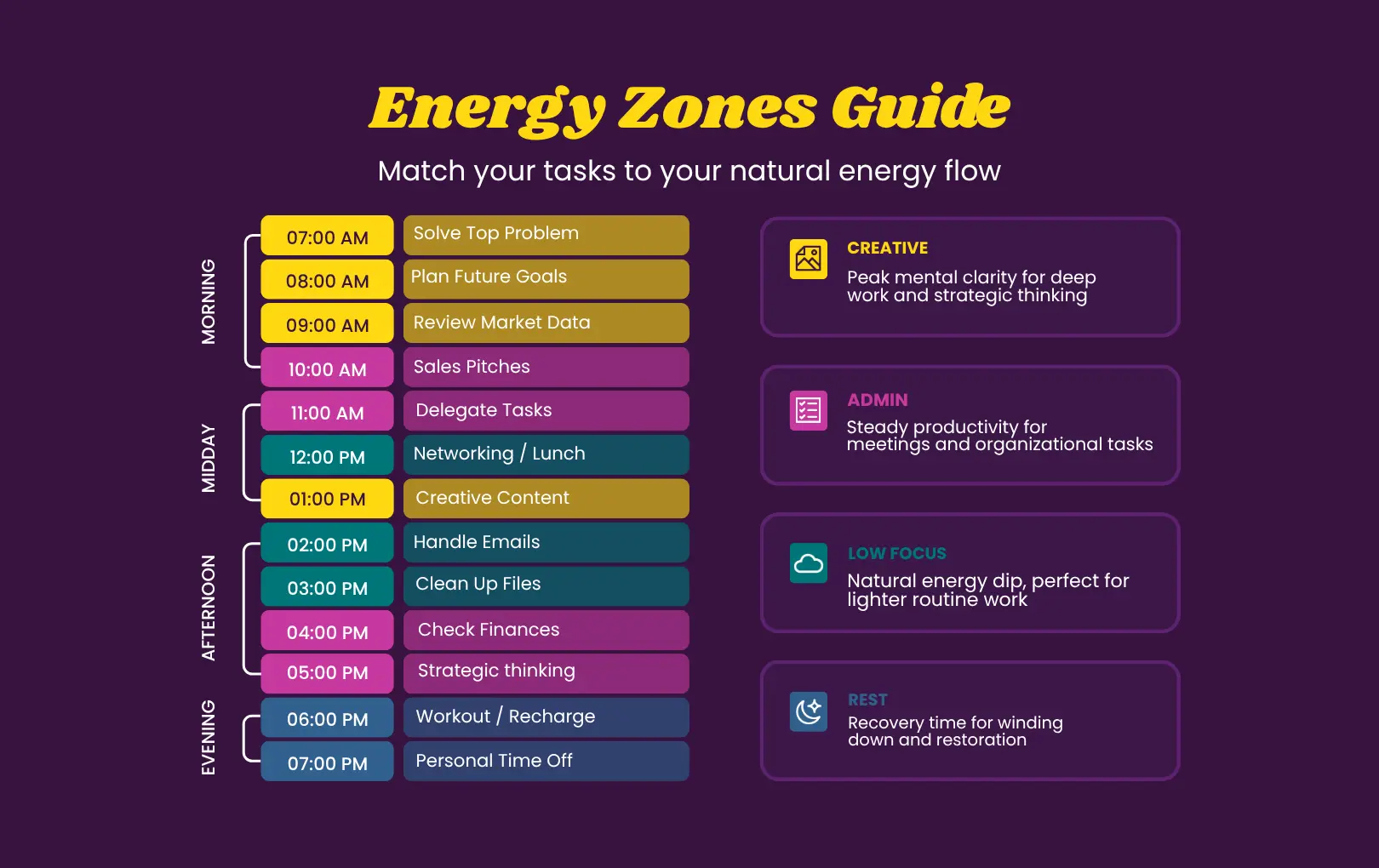
Day Sculpting is the art of shaping your day around how your energy, creativity, and attention naturally rise and fall.
Instead of locking into hourly chunks, you work in flexible zones that align with your internal state. Each zone is designed for a specific type of energy—not a specific time.
Here’s a simple example of a sculpted day:
- Morning → Planning or quiet setup
- Midday → Deep focus or creative sprint
- Afternoon → Light tasks or collaborative calls
- Evening → Reflection or rest
No rigid start or end times. Just intention. Flow. Space to pivot when your body—or brain—needs something different.
Psychology Today notes that “People with ADHD face more challenges when it comes to doing things. […] Studies show that ADHD individuals have more difficulties switching tasks or contexts.”
How to Group Tasks by Energy, Not Just Category
In a sculpted day, tasks are grouped by energy demand, not by subject or time.
Here’s how to think about it:
- High-energy tasks: Strategy, pitching, writing, problem-solving
- Medium-energy tasks: Admin, planning, meetings
- Low-energy tasks: Review, editing, replying to messages, cleanup
- Recovery tasks: Breaks, walks, sensory resets, naps
Instead of saying “I’ll do emails at 3,” you say, “When I hit my medium zone, I’ll answer emails.”
Want to make this visual? Use icons or color codes for each energy zone in your planner or digital calendar. That way, you can shift tasks around as needed—without losing the structure.
Research shows that people have natural performance peaks and dips based on chronotype and ultradian rhythms, meaning not all tasks are best done at the same time each day.
Real Examples of Flow-Based Daily Structures
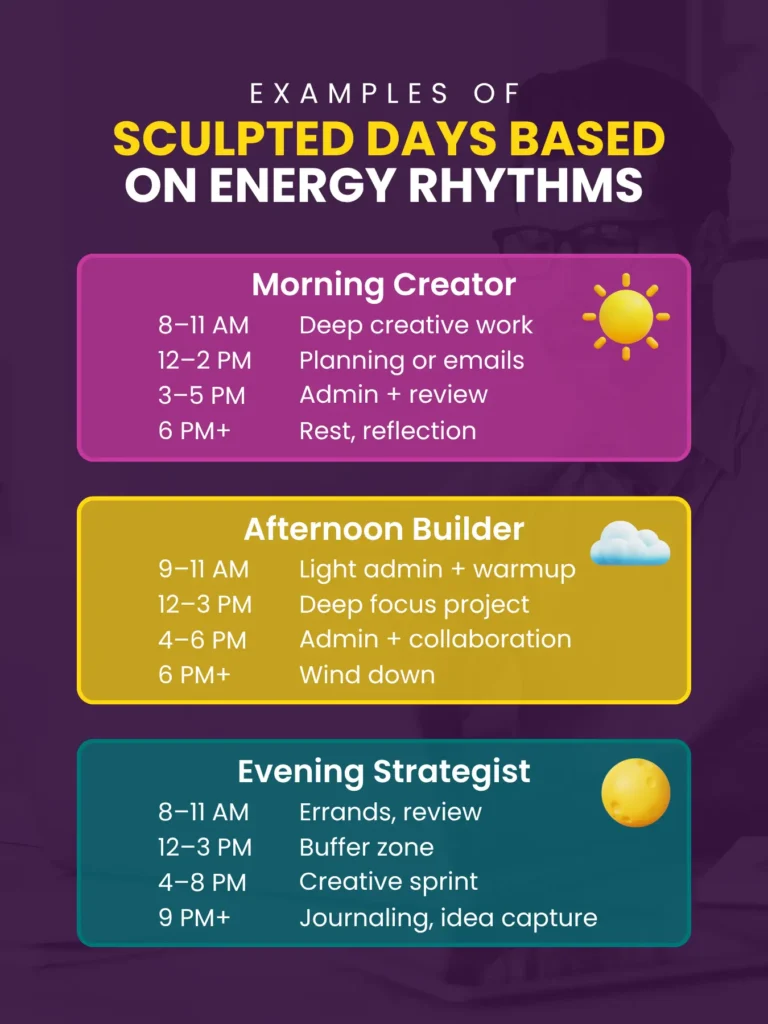
Need a visual? Here are three common rhythm types to help you find your own:
✍️ The Morning Creator
- Peak Energy: Early morning
- Sculpted Day:
- Morning → Writing, designing, problem-solving
- Afternoon → Admin, emails, light meetings
- Evening → Rest, reset, journaling
🧠 The Afternoon Builder
- Peak Energy: Midday
- Sculpted Day:
- Morning → Slow start, setup, light prep
- Afternoon → Deep creative sprint or focus session
- Evening → Collaboration or planning
🦉 The Evening Strategist
- Peak Energy: Late afternoon into evening
- Sculpted Day:
- Morning → Admin, errands, gentle movement
- Midday → Rest or buffer zone
- Evening → Creative push, brainstorming, editing
There’s no “perfect day” here—just a model to reflect your truth. The more honestly you observe your energy, the easier it becomes to shape a schedule that serves you instead of shaming you.
Download the Flow Day Blueprint
If this resonates, and you’re ready to create your own day flow, I’ve got something for you:
The Flow Day Blueprint — a free, fillable guide to help you design a sculpted day that finally works with your brain.
You’ll map your natural rhythm, identify your energy zones, and build a daily structure that bends with you—not against you.
You don’t need more control. You need more collaboration, with your body, your brain, and your energy.
Day Sculpting isn’t about squeezing productivity out of every hour. It’s about honoring your rhythm so you can show up with more intention, more ease, and maybe even a little joy.
Your plan doesn’t have to be perfect.
It just has to fit you.