

There is a version of strategic flexibility that looks like wisdom from the outside and feels like paralysis from the inside.
You tell yourself you are staying adaptable. Keeping your options open. Not rushing into a commitment you might regret. And all of that sounds reasonable — even smart — until you calculate what those open options are actually costing you every week in hours, attention, and momentum that never compounds because it is always being split.
This blog is that calculation. Fair warning: the number is going to bother you.
The Open Loop Tax
Cognitive science has a name for what happens when you leave a decision unresolved: the Zeigarnik effect. Named after the psychologist who first documented it, it describes the brain’s tendency to keep unfinished tasks active in working memory — running in the background, demanding processing power, resisting being set down.
For most people, this shows up as the mildly annoying experience of remembering something you forgot to do at an inconvenient moment. For neurodivergent founders with ten viable directions in motion simultaneously, it is a structural drain on executive function that compounds every single day.
Every open direction is a loop your brain has not closed. And open loops do not sit quietly. They cycle. They resurface. They show up at 2am and during conversations and in the middle of deep work sessions that were supposed to be about something else entirely. They do not wait to be convenient.
The cost of each individual loop feels small. The cumulative cost of carrying eight of them at once is not.
The Actual Weekly Calculation
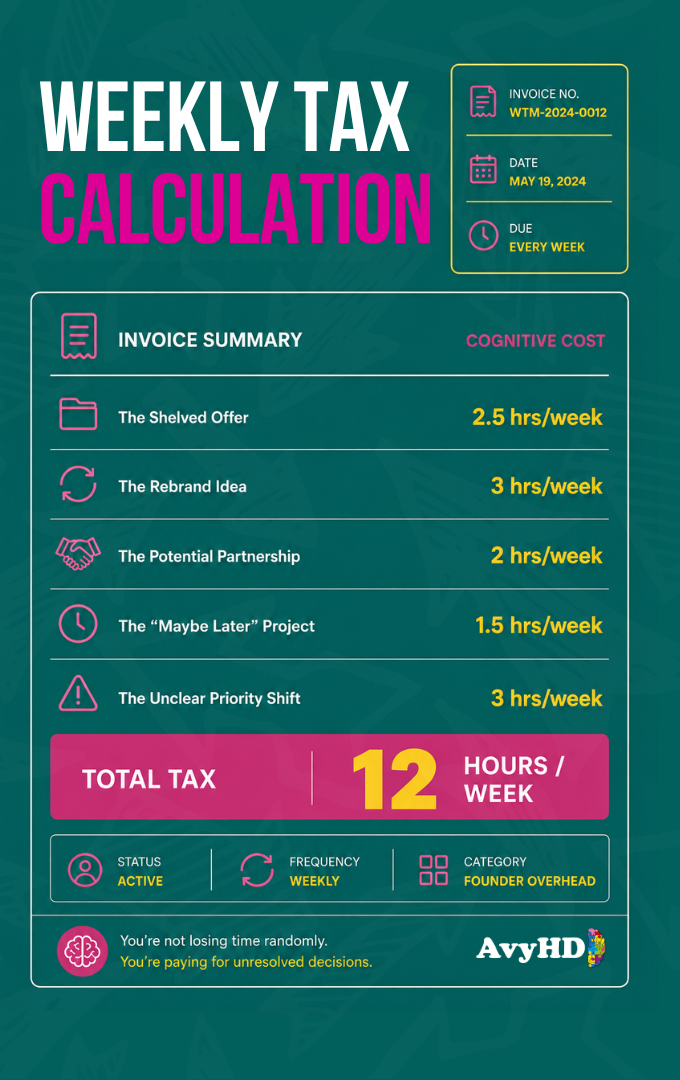
Most founders have never done this math, and the reason is simple: it is uncomfortable to look at directly. So let’s look at it directly.
Take every direction you are currently entertaining. Again — not the official ones. All of them. The main project. The offer you shelved but revisit every few months. The content direction you started and never fully committed to. The partnership conversation that is technically “on hold” but lives in the back of your mind. The rebrand. The new market. Write them all down.
For each one, estimate the cognitive overhead it carries in an average week. Not the active working hours — the background processing. The mental energy it takes to hold it as a live option. The time you spend in evaluation mode, comparison mode, “should I be doing this instead” mode.
Most founders I work with land somewhere between one and three hours per direction per week when they do this honestly. Multiply that by six or eight open directions and you are looking at eight to fifteen hours a week.
Not building. Not creating. Not executing toward anything. Just managing the weight of options that have never been formally evaluated or formally closed.
That is more than a full business day. Every week.
Strategic Optionality vs. Decision Avoidance
Before we go further — because this distinction matters — there is a real difference between strategic optionality and decision avoidance, and they can look identical from the outside.
Strategic optionality is intentional. You are gathering data before committing. You have a timeline. You know what information would move you from evaluation to decision. The options you are holding are in service of a decision you are actively working toward.
Decision avoidance wears strategic optionality’s clothes. The decision never gets made because making it feels too final, too risky, or too much like giving something up. The evaluation never ends because ending it would require choosing. The options stay open not because you need more data — but because committing feels like losing.
The tell is whether the open options have a deadline, a filter, and a holding structure — or whether they just keep circling indefinitely, fed by the occasional “I’ll revisit this next quarter” that never actually arrives.
If you are being honest with yourself: which one is it?
Why Neurodivergent Founders Carry This Differently
The Zeigarnik effect hits everyone. For neurodivergent founders — particularly those with ADHD — it is amplified in specific ways that most productivity frameworks are not built to account for.
The ADHD brain’s relationship with unfinished tasks is not just passive background noise. Incomplete loops actively compete for attention in a way that is neurologically distinct from how non-ADHD brains experience them. The pull toward the unresolved thing is stronger. The ability to set it down and not think about it is more limited. And the guilt and shame that accumulate around things that are “still open” can make the original problem feel even more unmanageable over time.
Which means the open loop tax for a neurodivergent founder is not just the lost hours. It is the cognitive exhaustion of carrying that load every day. The executive function depletion that makes the hard decisions feel harder than they should. The way unresolved optionality quietly degrades your capacity for the very clarity and decision-making you need to resolve it.
The fix is not to want it less. The fix is to change what the brain has to carry.
The Holding System: How to Close Loops Without Losing Ideas
Closing a loop does not mean killing an idea. This is the part that most founders miss — and it is the reason the standard advice to “just eliminate your distractions” never quite lands.
You are not distractible because you are weak. You are distractible because you have genuinely good ideas and no structure that gives them a legitimate place to exist that is not active competition with your current priority.
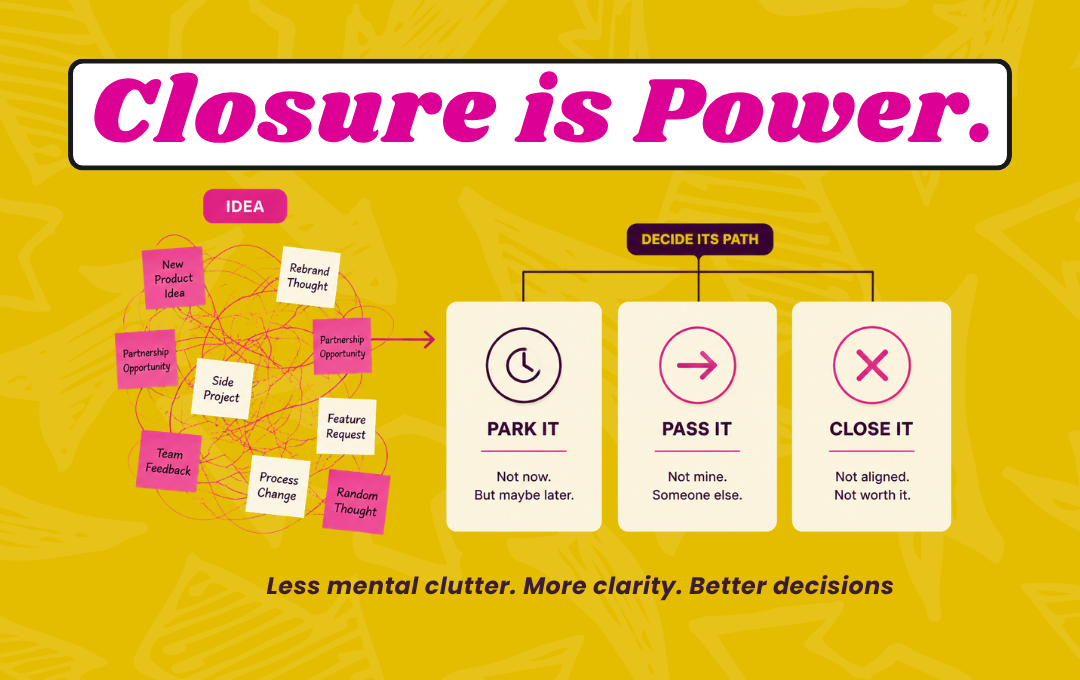
The Holding System is that structure. Every direction that does not pass the filter — every idea that is real but not right for this season — gets one of three designations.
Park It means real potential, wrong timing. The idea goes into the Holding System with a specific review date 90 days out. Your brain gets to close the loop because it knows the idea has not been lost — it has been scheduled. The relief that comes from a formally parked option is not trivial. It returns cognitive bandwidth that was being consumed by the open loop.
Pass It means it is a good idea that belongs to someone else. Route it, refer it, or let it go without guilt. Not every idea that lands on you was meant for you to execute.
Close It means this one was never going to happen and some part of you already knows it. A formally closed loop is worth more to your brain than an open one you are not acting on. Close it. Feel the relief. Move on.
The Holding System does not make you less creative. It makes your current direction finally able to receive your full attention.
What Changes When the Queue Is Clear
This is the part that is hard to fully explain until you have experienced it, but I will try.
When the queue is clear — when every open loop has either been committed to, formally parked, or deliberately closed — something shifts that is not just productivity. It is the quality of attention you are able to bring to the one direction that survived.
Content becomes more coherent because it is building toward something specific instead of gesturing in multiple directions at once. Team conversations become more useful because the direction is stable enough to execute against. New ideas become interesting instead of urgent — they show up, they get run through the criteria, they go into the Holding System or they get closed, and your week continues without derailment.
The compounding that you have been trying to create finally has the conditions it needs. Not because you worked harder. Because you stopped splitting the resource.
You built real capacity. The question is what you are going to do with it.
For nonprofit leaders: the open loop tax compounds across a leadership team, not just one person. Grant applications in progress, programs under consideration, board priorities pulling in multiple directions — each one running in the background for every person in the room who has not been given a clear filter. A Holding System applied at the organizational level does not just protect the executive director’s bandwidth. It protects the team’s capacity to execute with clarity and confidence.
The VISION Filter walks you through the full inventory and closing process — every open loop extracted, evaluated, and given a formal designation. Free download below.
