If you’ve ever sat at your desk, cracked your knuckles, opened your laptop… and then checked the weather in four cities you don’t live in…hello! I see you.
You’ve probably tried the tricks: Pomodoro. To-do lists. Hour-by-hour planning that lasts exactly one morning. And sure, some of those methods work… kind of. But if your brain still stalls out when it’s time to begin, it’s not a discipline problem.
It’s a cue problem.
What you might actually need is a focus ritual—a short, sensory routine that gently signals to your brain:
“Hey love, it’s time to shift gears.”
Why Rituals Work (Even When Routines Don’t)
Let’s clear something up: rituals are not routines.
Routines are often rigid. They ask for consistency and discipline—which can feel like pressure. Rituals, on the other hand, are intentional. They’re symbolic. They tell your brain, “This is ready-time,” without the internal yelling.
In fact, studies show that rituals—like a pre-game or pre-test routine—actually improve performance and reduce stress by easing the transition between mental states. They give your brain a moment to say, “Okay, we’re doing this now.” Not with force, but with flow.
This is especially powerful for neurodivergent minds, where shifting attention can feel like climbing a cliff with no rope. Sensory-based rituals ground you. Anchor you. Guide you through the friction zone between “thinking” and “starting.”
What Rituals Actually Do for Your Brain
Reduce Cognitive Load
No more decision fatigue about how to begin—your ritual is the beginning. That’s part of why rituals have been shown to lower cognitive effort and improve focus.
Improve Emotional Regulation
A quick breath, a scent, a song—it helps calm the nervous system, especially when overwhelm or anxiety is in the mix. This effect is well-documented in stress psychology and even sport psychology.
Smooth Transitions
Without a start signal, inertia takes over. A ritual becomes your launchpad. This is part of what makes pre-performance rituals effective in sports and performance psychology.
Create Consistency Without Rigidity
Unlike strict habits, rituals don’t punish you for missing a day—they evolve with you.
My Own Ritual: From Chaos to “I Can Start Now”
Before I had a focus ritual, my mornings were a mess.
I’d sit down excited about my work—then immediately spiral:
Do I write the email? Edit the podcast? Respond to DMs? I should stretch. Wait, did I drink water? Where’s my planner?
It wasn’t laziness. It was too much noise and no entry point.
So I made one.
Here’s the ritual I still use almost every weekday:
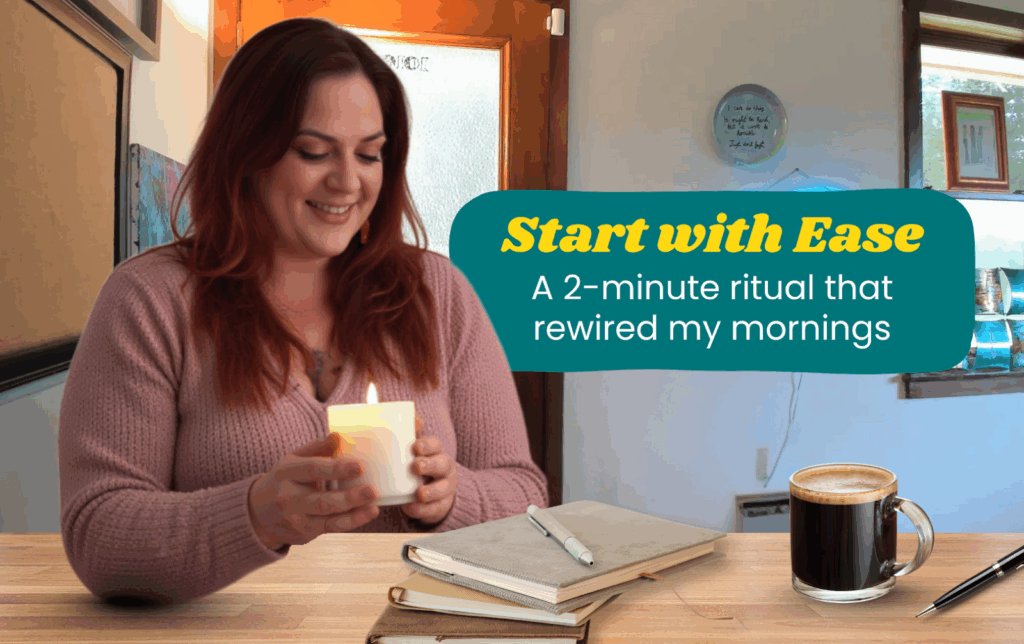
- I play one specific 30-second instrumental intro (no lyrics—my brain’s too chatty for that).
- I take 3 slow breaths with my feet flat on the floor.
- I open my task board and pick just one thing.
- I whisper: “Start with ease.”
That’s it. Two minutes, max. And it changes everything.
Not because it makes me hyper-productive—but because it gives me a gentle, grounded way to begin.
Build Your Own Focus Ritual (That Your Brain Will Actually Like)
Here’s your permission slip: don’t overthink this. The power of a ritual isn’t in how perfect it is, it’s in the way it helps you shift into focus.
Start with this:
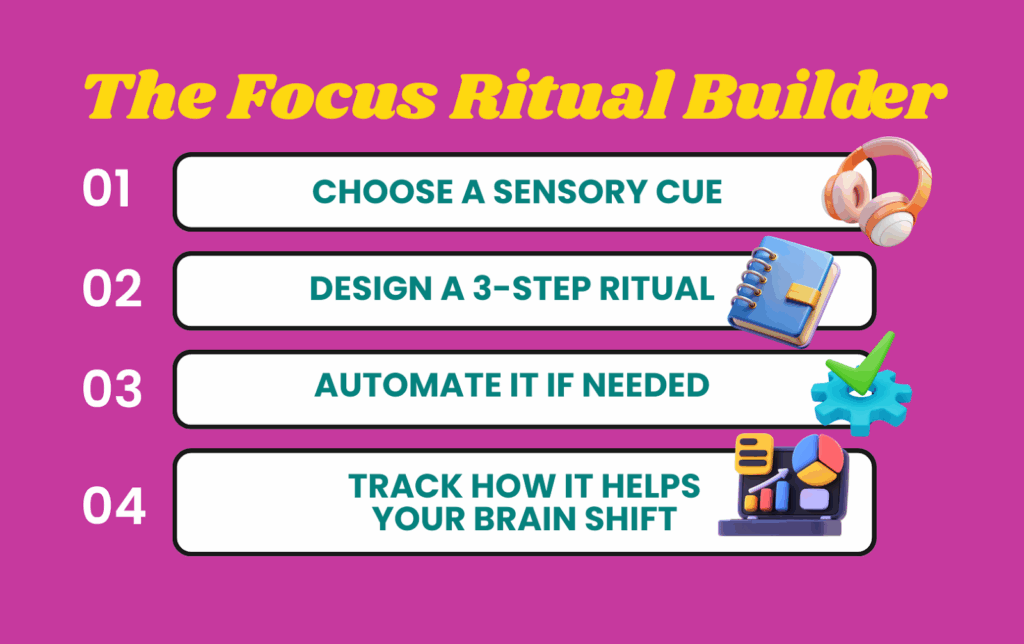
| Step | What to Do |
| 1⃣ | Choose a sensory cue: sound, scent, movement, phrase |
| 2⃣ | Keep it short: 2–3 steps are plenty |
| 3⃣ | Make it simple enough to repeat every day for a week |
| 4⃣ | Add it to your calendar or set a soft alarm |
| 5⃣ | Pay attention to how your brain responds—adjust as you go |
Ready to make this real? Don’t start from scratch.
👉 [Download the Focus Ritual Builder]
You’ll get:
- A template to design your sensory cues
- A ritual blueprint to follow (and tweak)
- Bonus: VA scripting for easy automation
It’s simple. It’s ADHD-friendly. And it’s yours.
Make It Sensory, Make It Yours
Your ritual can change based on how you feel that day. Here’s how to adapt it:
- Feeling fried? Try soft lighting, a warm drink, or gentle touch (think cozy sweater or smooth stone).
- Overstimulated? Add light movement: a shoulder roll, standing stretch, or a 30-second walk.
- Audio-driven? Use the same playlist intro, chime, or timer tone to start.
- Need visual clarity? Tidy a small space or light a candle to shift your environment.
It doesn’t have to be fancy. It just has to mean something to your brain.
The Ripple Effect of a Ritual
The beauty of ritual isn’t just internal—it’s cultural.
When I honor my own focus ritual, my team sees it. My clients feel it. It creates rhythm. Predictability. And maybe most important of all, it replaces shame with self-trust.
Over time, your ritual becomes part of your identity—not as someone who’s “disciplined,” but as someone who’s anchored. Who knows how to start, even when it’s hard.
Ritual Is the Start, Not the Solution
If you’ve been feeling like your productivity engine won’t turn over, this isn’t about working harder.
It’s about making the start gentle. Consistent. Your own.
That’s what a ritual does.So here’s your nudge: Build one. Try it for a week. Let it evolve.
You might be surprised by how powerful two minutes can be.
👉 Download the Focus Ritual Builder and make your starting point feel like yours.
Let’s build a softer way to begin—together.