

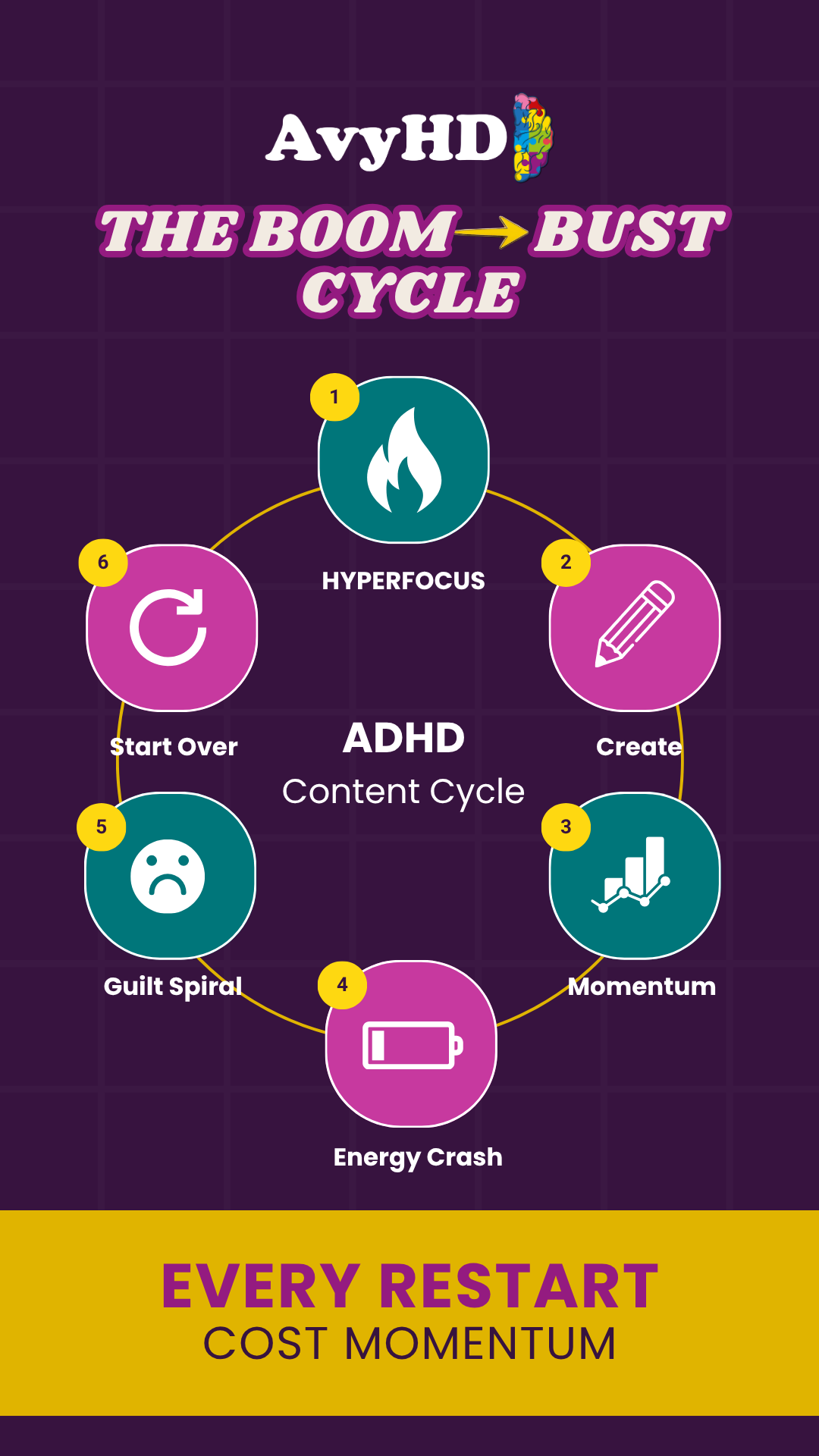
You know your pattern. It has run at least three times this year. Hyperfocus shows up out of nowhere, and for three weeks you are a machine. Posts, ideas, momentum, a little audience growth. You think: finally, this is the version of me that sticks.
Then it leaves. The crash hits. Six weeks of silence, a stale feed, and a guilt spiral that produces exactly zero content. Then hyperfocus comes back and you do it all again.
Every productivity guru calls this a discipline problem, squirrel. They’re wrong. And their advice has been making it worse.
- If you’re working out how to be consistent with ADHD, the boom-bust cycle is what’s stopping you. It is not a willpower failure.
- You produce in hyperfocus bursts, then you crash. That’s a season, not a malfunction.
- “Just post daily” was built for a brain you don’t have. That’s why it keeps failing you.
- The real cost isn’t the silent weeks. It’s the momentum you knock over every time you restart from zero.
- The fix isn’t forcing a neurotypical schedule. It’s a system that keeps publishing while you’re crashed.
The cycle, named
Say it plainly. Hyperfocus arrives. You ride it hard, because you know the window slams shut fast. You batch, you post, you feel unstoppable. Then the energy drains out, like it always does, and everything stops. Not slows. Stops.
Then comes the guilt, which is its own waste of time, because guilt has never produced a single post. You tell yourself you always do this. You decide you can’t be trusted with consistency. You file it under personal failing and wait, a little ashamed, for the next burst.
Why “just post daily” is built for the wrong brain
The standard advice assumes a brain that puts out the same steady output every day, motivated or not. Some brains do that. Yours doesn’t, and wanting it to won’t rewire you.
So you take advice built for a linear brain, you run it on a nonlinear one, and it fails. Then it hands you the verdict: you’re the problem, you couldn’t stick to the simple thing. But you were never the problem. The advice was the wrong tool. Telling an ADHD founder to just be disciplined and post daily is bullshit dressed up as help.
The real cost isn’t the silence
Here’s what actually makes the cycle expensive, and it isn’t the quiet weeks. It’s momentum.
Audiences and algorithms both reward continuity. Momentum stacks on itself, slowly, if you let it. Every time you go dark for six weeks and restart, you don’t pause that stacking. You knock it over. You pay the cost of building momentum from a cold start, again and again, and you never bank the returns that only show up after a long unbroken run. Three weeks on and six weeks off doesn’t average out to steady. It averages out to permanently starting over.
The uncomfortable part
You’ve been using the crash as evidence. Every silent stretch becomes proof of the story: you’re flaky, you can’t be trusted, you always wreck the good thing. And then you make decisions from inside that story, which is a garbage place to make decisions from.
The crash is not a character verdict. It’s data about how your brain is built. Treat it as data, not a moral failing, and you can design around it.
What working with the cycle looks like
You don’t fix the boom-bust cycle by forcing yourself to be even. You build a system that expects the unevenness and covers for it.
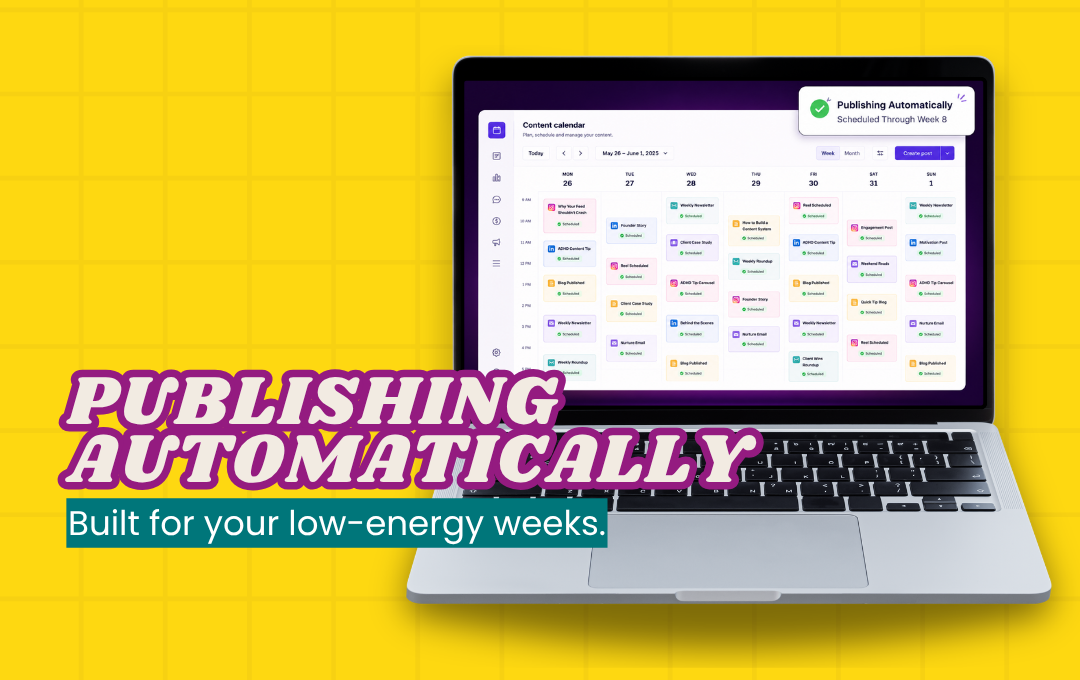
You batch hard during the boom. You capture far more than you publish while the window is open. The drafting, the part that actually needs your brain lit up, happens in the high-energy stretch. Then the rest of the pipeline, the formatting and scheduling and posting, either runs automatically or belongs to someone who isn’t you. So your content keeps going out while you’re flat on the couch. The silent weeks still happen inside your body. They just stop showing up on your feed.
That batching part has a whole method behind it. If you want the actual how-to, here’s how to build a content cascade that batches a month of content in one hyperfocus window. Come back when you’ve read it.
If you’re leading a nonprofit…
The ED version of this cycle runs on grant deadlines instead of hyperfocus. Communications surge around a campaign or a report, then vanish for months once the deadline passes. Donors read that silence as instability, and instability quietly suppresses giving. Continuity of communication isn’t vanity. It’s stewardship. An organization that only speaks when it needs money teaches its supporters to brace every time they see its name in the inbox.
A quick gut-check
Not sure the boom-bust cycle is your real bottleneck? Sit with these honestly.
- Does your publishing history look like intense bursts followed by long silences?
- When you crash, do you read it as proof you can’t be trusted with consistency?
- Do the systems you’ve tried assume a steady daily output you can’t actually sustain?
- When you go quiet, does the momentum you built seem to fully evaporate before you restart?
- Is drafting something you can only do when the energy is already high?
If those landed, the problem was never your discipline. Nothing exists to carry your content through the low weeks, so every crash erases the last climb.
The final insight
Consistency with an ADHD brain doesn’t come from becoming a steadier person. It comes from a system that expects your unevenness and ships the work anyway. You were never the flaky one. You were unsupported.
You’re not broken. The system is. Let’s build a better one.
Start here
The Offer Spark Sprint tells you whether your real bottleneck is your voice or your pipeline, which is exactly the question the boom-bust cycle raises. Turn your one idea into 10 content posts, determine your archetype to get you started with implementation.
When you’re ready to design the fix on your real business data, that’s a Strategy Call with Avy. It’s the working session where we map a system that keeps publishing through your low weeks, and you leave with a Decision Map within 72 hours.
