

Right now your brand voice lives in one place. Your head. Which means it only shows up when you do. Rested, regulated, and in the mood.
The day you’re tired, it’s gone. The day you try to hand a post to someone else, it can’t go with them, because you never wrote it down. So you sit down to write, your brain offers you nothing usable, and you call yourself inconsistent. You’re not inconsistent. You’re running your entire voice off memory and vibes.
A voice you keep in your head is a mood, squirrel. A voice you write down is an asset. That’s the whole difference.
- If you want to know how to define your brand voice, the answer is not a personality quiz. It’s a document.
- A voice that lives only in your head shows up only on your good days. That’s why your content feels inconsistent.
- Written down, your voice becomes something you can work from tired, and something a team can write from without you.
- The raw material already exists. It’s in your voice notes, your DMs, your rants, your deleted drafts.
- Once it’s on paper, sounding like yourself stops requiring a good brain day.
The mood problem
When your voice lives only in your head, every single post is a fresh negotiation with your brain. Are you sharp today? Are you funny today? Do you have the energy to sound like yourself, or are you going to phone it in and hate the result?
That’s an exhausting way to run a brand, and it’s completely invisible to you because you’ve always done it that way. You think writing is just hard. It isn’t. Writing from scratch, with no documented voice to lean on, on a brain that doesn’t produce evenly, is hard. Those are different problems, and only one of them is fixable by wanting it more.
What a voice system actually contains
Defining your brand voice doesn’t mean writing three adjectives on a moodboard. Bold. Playful. Authentic. That’s useless, and you know it’s useless, because you’ve tried it.
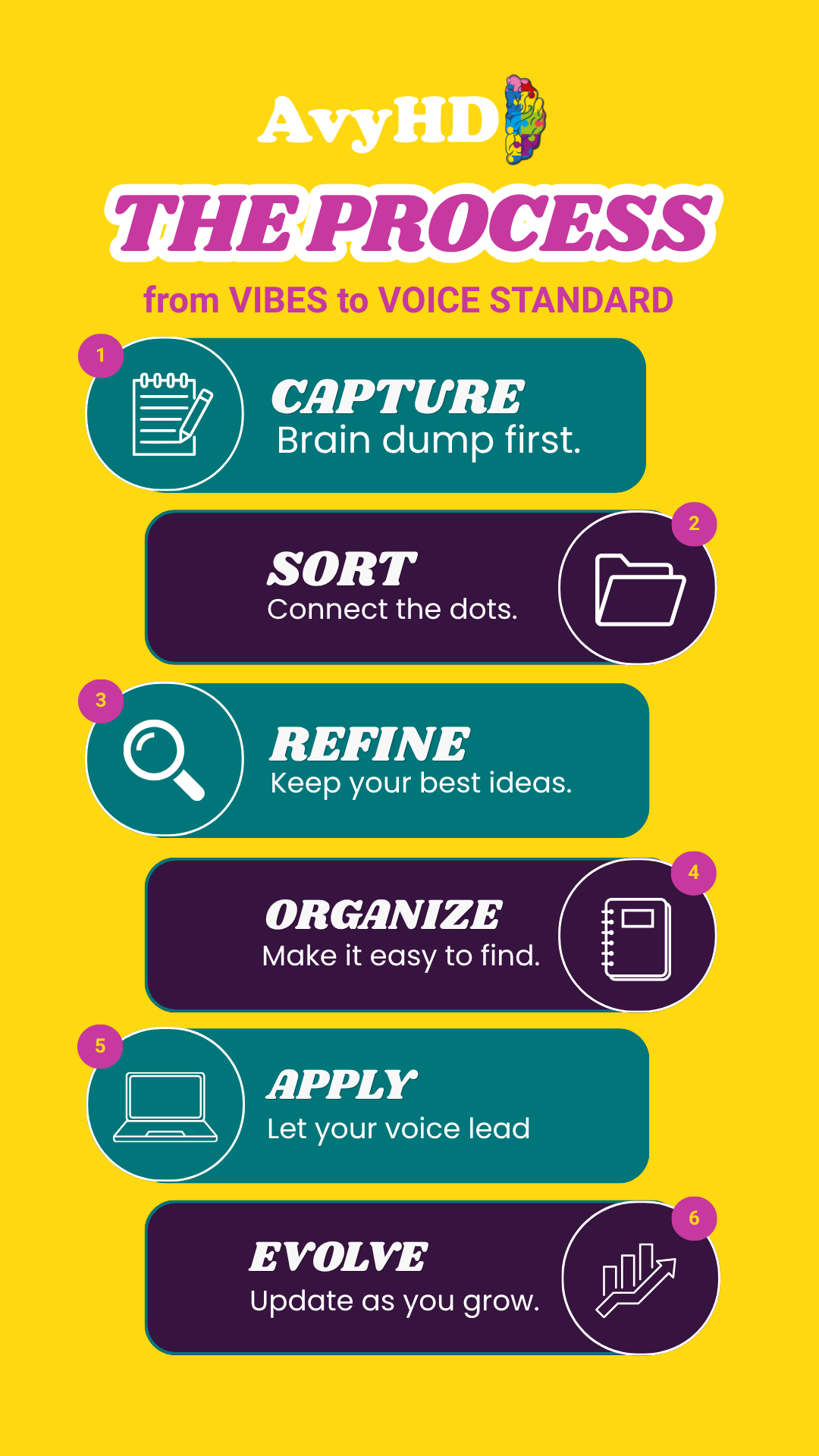
A real voice system is specific and it’s written down. Your word list, the phrases you actually use. Your banned list, the corporate garbage you never want in your mouth. Your tone rules for when you’re teaching versus when you’re calling something out. The hooks you reuse because they work. The opinions you’re on record holding. It’s a reference document, not a feeling. And the second it exists on paper, it stops depending on your memory.
You already have the raw material
Here’s the good news. You don’t have to invent your voice. You already have it. It’s just never been written down in one place.
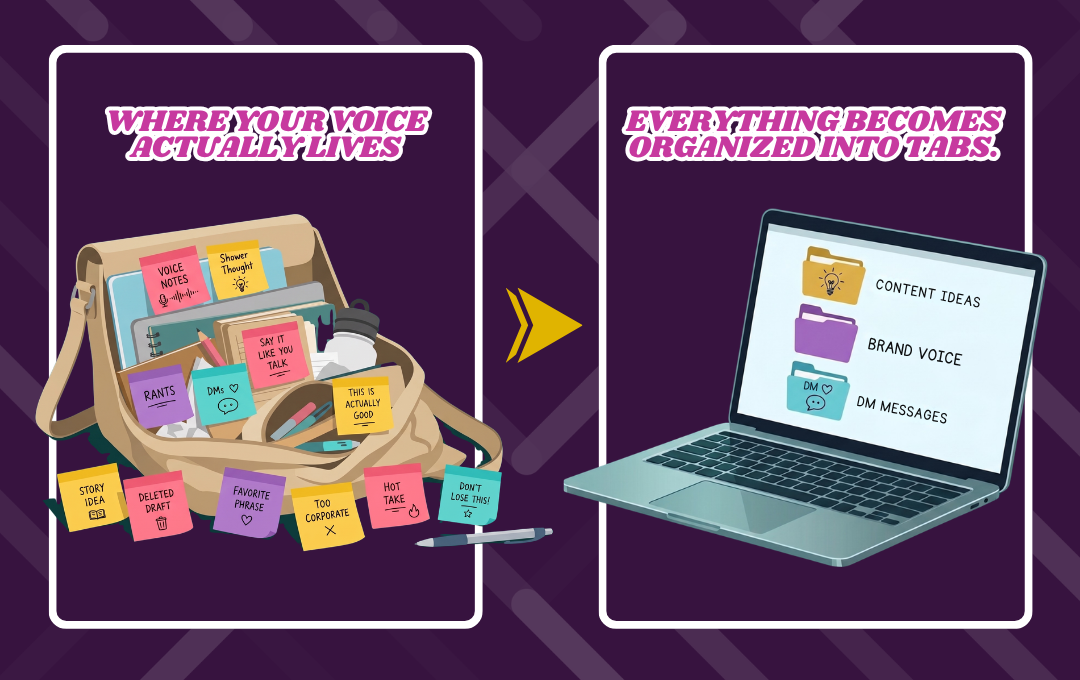
It’s sitting in the voice notes you send friends, where you’re funny and blunt and completely unfiltered. It’s in your DMs, your long rants, the way you explain your work to someone at a party when you’re not trying to sound impressive. It’s in your drafts folder, in every line you cut for being too much. Defining your brand voice is not a creative exercise. It’s an excavation. You dig the real voice out of where it already lives and you write it down.
The uncomfortable part
You’ve resisted documenting your voice, and it isn’t because you didn’t have time. It’s because writing it down makes it real. A documented voice is a standard you can be held to, by yourself and by anyone you hand it to. As long as it stays a vibe in your head, you never have to commit to it.
Keeping your voice undocumented feels like flexibility. It’s not. It’s the thing keeping you the only person who can ever sound like you.
What writing it down unlocks
Once your voice is a document, three things change fast. You can write from it on a bad brain day, because you’re not summoning the voice from nothing, you’re working from a reference. You can hand it to a team, so someone else can draft in your voice and you approve instead of writing every word. And you can quality-check content against it before it ships, which means content can finally go out without you touching every piece of it.
That’s the unlock. Sounding like yourself stops being something you can only do on your best days. It becomes a system you run, not a mood you wait for.
If you’re leading a nonprofit…
A documented voice protects more than your content. It protects institutional memory. When your organization’s voice lives only in the executive director’s head, every staff transition, board change, and grant cycle waters it down a little more, until the mission sounds like whoever wrote the last newsletter. A written voice standard means your grant writer, your comms coordinator, and your volunteer running social all sound like the same organization. That’s not overhead. That’s mission continuity.
A quick gut-check
Not sure if the undocumented voice is your real bottleneck? Sit with these honestly.
- Does sounding like yourself depend on whether you’re having a good day?
- If you had to hand your content to someone tomorrow, could they actually sound like you?
- Is your entire brand voice currently stored nowhere but your own head?
- When you try to define your voice, do you get stuck on vague adjectives instead of specifics?
- Do your voice notes to friends sound sharper than anything on your feed?
If those landed, your voice was never the problem. The problem is that it lives somewhere only you can reach, on the days you can reach it.
The final insight
You don’t need to find your brand voice. You already have it. You need to get it out of your head and onto paper, so it stops being a mood you wait for and becomes an asset you own.
You’re not broken. The system around your voice is. Let’s build a better one.
Start here
The Offer Spark Sprint shows you how much of your real voice is actually making it from your head to the page right now. It’s free. Download it now and get started.
When you’re ready to design the fix on your real business data, that’s a Strategy Call with Avy. It’s the working session where we map how to excavate your voice and get it documented, and you leave with a Decision Map within 72 hours.
