“If I could just stay motivated, I’d be unstoppable.”
Sound familiar?
We’ve all been sold the story that motivation is the magic fuel of success, the invisible force that keeps you disciplined, creative, and consistent. But if you live with ADHD, anxiety, depression, or chronic burnout, you already know the truth: motivation is fickle.
It arrives unannounced. Disappears early. And tends to ghost you right when you need it most.
So what if the problem isn’t your willpower?
What if the real key to progress isn’t motivation at all… but momentum?
And what if momentum isn’t a mindset — but a nervous system rhythm?
Let’s break that down.
Your Autonomic State Drives Your Ability to Act
Let’s talk science for a second. Your autonomic nervous system (ANS), the part of your body that regulates heart rate, breathing, digestion, and stress response, also influences your ability to take action before you consciously decide to.
When your body feels safe and regulated, your brain says: “I can move forward. I can focus. I can try this.”
That’s the ventral vagal state in action, where safety fuels curiosity and motivation naturally emerge.
But when your system senses threat, even subtle stress, overwhelm, or rejection sensitivity, it moves into fight, flight, or freeze. Your body pulls the brakes, not because you don’t care, but because it’s trying to protect you.
👉 This is why you can have a plan and still not move.
👉 This is why you can love your work and still feel paralyzed.
As polyvagal expert Deb Dana explains, “We move through the world not by thinking our way forward, but by feeling our way to safety.” (Deb Dana, Polyvagal Exercises for Safety and Connection, 2020)
When your nervous system is dysregulated, no amount of motivation quotes will help because the “action channel” in your body is closed. Regulation is what reopens it.

Rest Is Forward Motion
Hustle culture loves to glorify grind. It treats rest like a pause button — something you earn after progress.
But for neurodivergent entrepreneurs, rest is not the opposite of action. It’s the beginning of it.
Rest regulates the body. And regulation is what makes forward motion possible.
If you’re trying to build momentum while ignoring your need to pause, reset, or breathe — you’re skipping the one step that allows your nervous system to trust movement again.
Here’s the reframe:
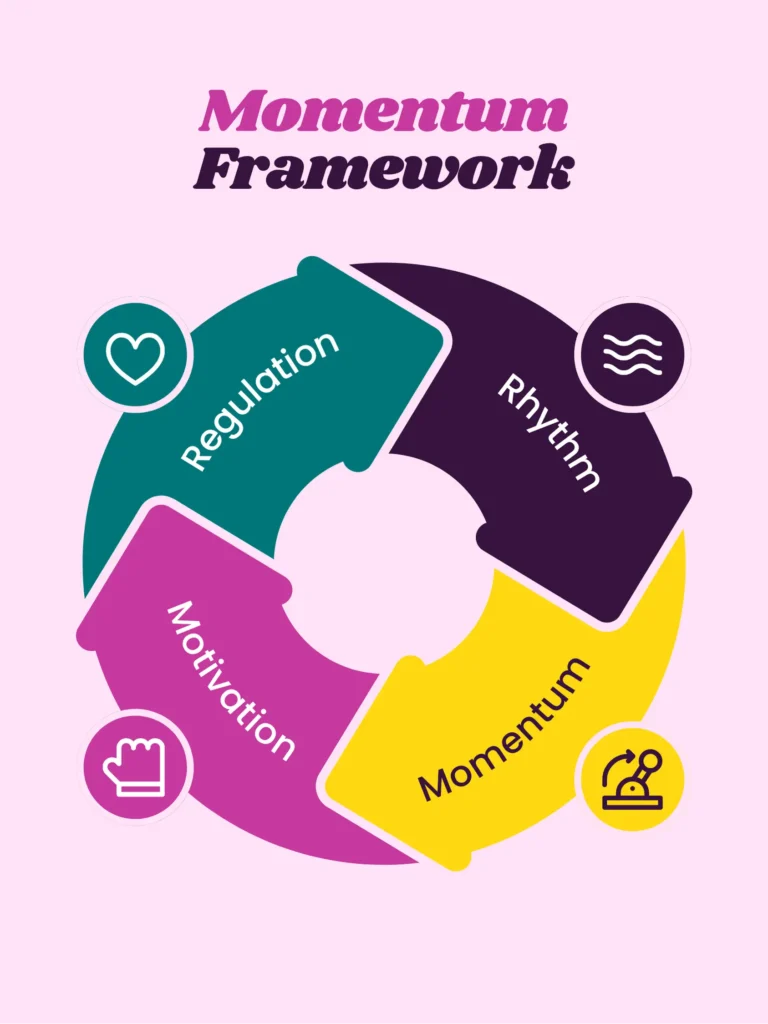
🧠 Motivation is a spark.
🌱 Momentum is a system.
🔄 Regulation is the ignition.
Think about it like tuning an instrument. You can’t play a song on strings pulled too tight — or too loose. Regulation tunes your body so momentum can flow.
After long client days, I used to jump straight into content creation. It always ended in frustration. Now, I take a 10-minute sensory reset: stretch, hydrate, slow my breathing. That pause is my ignition. I work less frantically and move more smoothly.
Micro-Routines That Spark Real Momentum
You don’t need a 5 a.m. miracle morning or a rigid routine to feel productive. What you need are low-pressure, repeatable rituals that tell your nervous system, “We’re safe. We can begin.”
Here are a few ADHD-friendly momentum starters we recommend to AvyHD clients:
1. The “Body-First” Start Sequence
Before you open your inbox or planner:
☑️ Move your body — stretch, shake, or walk.
☑️ Sip water.
☑️ Say out loud: “I’m beginning.”
This simple ritual grounds your nervous system before sensory input floods in.
2. Visual Progress Tracker (Not Just a To-Do List)
ADHD brains crave visible progress, not abstract checkboxes.
Create a wall or digital board where tasks move from “Idea → In Progress → Done.”
You’re training your brain to see movement, not just completion — a key difference in sustaining momentum.
3. Momentum Playlist + Sensory Anchor
Pick a short playlist that cues your body for action. Pair it with a sensory cue — a scent, a texture (weighted blanket), or a light you turn on at the start of work.
Over time, these cues become somatic triggers for regulation and flow.
Ritual > Routine. Predictable > Perfect.
4. Two-Minute Downshift
Momentum isn’t just about starting — it’s also about stopping well.
Before switching tasks, spend two minutes breathing, stretching, or shaking off energy.
This creates closure, helping ADHD brains transition smoothly instead of crashing between tasks.
You Don’t Need to Feel Motivated to Get Moving
Motivation is inconsistent because it’s emotional. Momentum is sustainable because it’s physiological.
When you prioritize regulation first, you stop waiting for motivation to “strike.”
You start building a rhythm that your nervous system trusts.
From safety, you build rhythm.
From rhythm, you build momentum.
From momentum… motivation often follows.
And even when it doesn’t, you’re already moving — calmly, consistently, enough.
🎧 Want to Go Deeper?
Tune into this week’s episode of the CALM Podcast: Momentum without Meltdowns: Building a Workflow That Works for You
You’ll learn how neurodivergent founders can build self-trust through nervous system regulation, instead of chasing the next wave of motivation.
Because the secret to unstoppable energy isn’t more hustle — it’s momentum built from safety.