
Over the years of establishing my business, I’ve lost count of how many times I’ve had to pivot, change strategies, refine my processes, adjust my target market descriptions, step back to move forward, consult with other entrepreneurs, and attend networking events. I am still doing that, and I won’t stop until I find the best way to serve. It’s not about me not being able to stick to the roadmap or strategic plan set, but it’s about me not wanting to be limited. My team has been keeping up with this neurodivergent entrepreneurship and we are rocking it!
Entrepreneurship can be challenging for anyone, but for neurodivergent entrepreneurs—those with ADHD, autism, dyslexia, and other complex thinkers—the entrepreneurial journey comes with unique hurdles and hidden strengths. Neurodivergent entrepreneurs often excel at innovative thinking, creativity, and problem-solving, but they might also grapple with time management, executive function difficulties, and overwhelm.
If you’re neurodivergent and striving to build or scale your business, know this: Your neurological makeup isn’t a limitation—it’s an opportunity to leverage unique talents and redefine what entrepreneurial success looks like.
In this guide, you’ll discover practical strategies for managing your business, delegating effectively, scaling sustainably, and finding the balance you need to thrive.
Understanding Neurodivergent Entrepreneurship
Entrepreneurs who are neurodivergent often see the world differently. This is a distinct advantage in business, where innovation is key. According to studies, neurodiverse individuals frequently possess strengths like divergent thinking, exceptional creativity, and high adaptability (Harvard Business Review, 2017).
Yet, despite these strengths, traditional entrepreneurial practices may unintentionally neglect the unique cognitive and emotional needs of neurodivergent founders. Entrepreneurs with ADHD, autism, dyslexia, and other neurological diversities commonly face specific challenges:
- Executive Function and Organization:
Many neurodivergent entrepreneurs struggle with tasks that require executive function—the brain’s ability to plan, organize, remember details, and manage multiple tasks simultaneously. Difficulties in this area can result in missed deadlines, scattered thoughts, and difficulty prioritizing tasks effectively. - Task Initiation and Time Management:
Starting projects can often feel overwhelming due to the difficulty of breaking down tasks into manageable steps. Additionally, accurately estimating how much time tasks take or staying on schedule can be particularly challenging for those with ADHD, potentially leading to frustration and anxiety. - Emotional Overwhelm and Sensory Processing Issues:
Neurodivergent entrepreneurs may also experience heightened sensitivity to environmental stimuli like noise, lights, or crowded spaces, contributing to quicker exhaustion or emotional overwhelm. High stress or sensory overload can negatively impact productivity, communication with team members, and overall well-being.
Understanding and acknowledging these unique difficulties is crucial. Not because they represent weaknesses, but because awareness allows you to proactively manage them—opening space for your innate strengths to flourish. Businesses that embrace neurodivergent perspectives not only overcome these hurdles but frequently innovate faster and remain more competitive (Forbes, 2020).
Being clear about your neurodivergent traits—both challenges and strengths—is the first step toward transforming your entrepreneurial journey into one of sustainable success.
Managing Your Startup with ADHD—Challenges and Proven Strategies
Entrepreneurs with ADHD often thrive in creativity and innovation but face significant challenges when it comes to implementation, consistency, and follow-through. Common struggles include maintaining productivity, staying organized, managing distractions, and avoiding burnout caused by chronic overwhelm or procrastination.
Addressing these challenges head-on with specific strategies and tools can dramatically improve your ability to manage and scale your business effectively.
Here’s how structured strategies and carefully selected tools supported by research can empower neurodivergent entrepreneurs to take control.
✅ Structured Routines & Time-Blocking
- Why it works:
An article from SAGE Journals (via The Journal of Attention Disorders, 2012) discusses how poor time management, procrastination, and distractibility among adults with ADHD directly impact productivity and quality of life—suggesting that improving time management skills (such as through structured routines) can positively affect daily functioning and overall well-being. (journals.sagepub.com) - How it helps you in business:
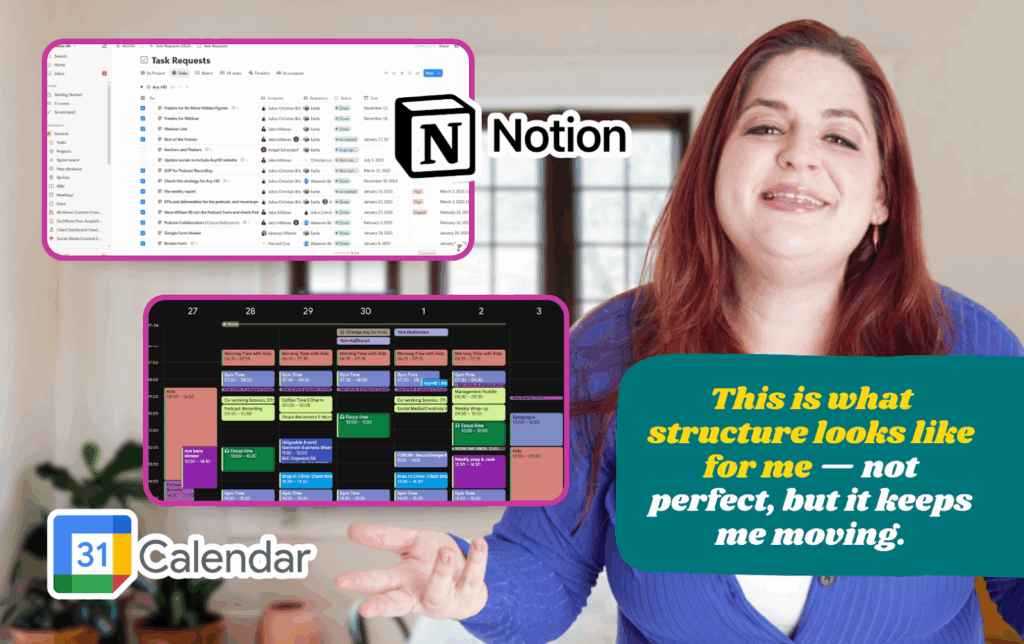
Consistent start and end times, regular breaks, and ritualized planning sessions anchor your day. Tools like Google Calendar and Sunsama let you time-block tasks, creating a visual schedule that prompts responses from your brain’s reward system rather than overwhelming it.
✅ Task Breakdown & Visual Planning
- Why it works:
Breaking large projects into smaller, clearly defined tasks is supported by research on ADHD and cognitive behavioral strategies. It reduces procrastination and helps overcome executive dysfunction. (Therapy Reframe) - How it helps you in business:
Tools like Notion or Trello help you create and track project steps visually. Instead of facing a vague “build website,” you can tackle clearly labeled cards—“write homepage copy,” “choose images,” etc.—making initiation and follow-through much simpler.
✅ ADHD-Friendly Productivity Tools
- Why it works:
Technology can support ADHD through external structure and incentives. Many ADHD-specific productivity tools embed visual rewards, reminders, and gamification to boost dopamine and decision momentum. - How it helps you in business:
- Todoist: Prioritizes daily tasks with clear labels and reminders, minimizing task-switching stress.
- Forest App: Offers gamified focus sessions (grow a virtual tree during uninterrupted work), turning attention into a tangible reward.
- Focus@Will: Delivers scientifically curated audio tracks that enhance focus by stimulating attention-related brain activity.
These tools help ADHD entrepreneurs maintain consistent progress without relying on mental energy alone.
✅ Accountability & Body Doubling
- Why it works:
ADHD body doubling—where someone works alongside you virtually or in person—boosts motivation, external accountability, and emotional regulation. It acts as a gentle external prompt to stay on task. - How it helps you in business:
Using platforms like Flow Club or pairing with an ADHD coach or accountability buddy can reduce procrastination and help maintain focus during difficult tasks. The presence of another person triggers subtle motivation and lowers distraction risk.
✅ Weekly Planning & Priority Setting
- Why it works:
Harvard Business School and Project Management Institute research emphasizes the benefits of weekly planning, including setting priorities, reviewing goals, and designing workflows ahead. This approach boosts focus by up to ~60%, reduces task-switching, and increases completion rates. (Learn to Thrive with ADHD) - How it helps you in business:
Set aside time on Sunday evening or Monday morning to map out your priorities. Choose your top 3 tasks for the week and use systems like a daily planner or calendar to slot them in visually, so you can maintain progress on essential business goals.
Why These Strategies Work Together
| Strategy | Executive Support | Emotional & Cognitive Impact |
| Structured routines | Reduces executive load, increases predictability | Less anxiety, better mood regulation |
| Task breakdown + visual tools | Decreases initiation friction | Produces momentum and dopamine feedback |
| ADHD-friendly tools | External structure, built-in reminders | Motivation via gamification and clarity |
| Accountability & body doubling | External prompts for focus and task start | Social motivation reduces shame and inertia |
| Weekly planning & priorities | Clarifies direction and aligns workflow | Prevents burnout from overcommitting work |
When combined, structured routines, visual task breakdowns, ADHD-specific productivity tools, and supportive accountability create a powerful ecosystem for neurodivergent entrepreneurs. These strategies are not optional—they’re transformative, helping you channel your strengths while minimizing mental friction.
Leveraging Neurodiversity as a Competitive Edge
Your neurodivergence isn’t a setback, rather your superpower. Businesses that embrace neurodiversity cultivate environments where innovation thrives. For instance, billionaire entrepreneur Richard Branson, who has dyslexia, credits his entrepreneurial success to his neurodivergence (Entrepreneur Magazine, 2019).
Strengths neurodivergent entrepreneurs bring include:
- Innovation: Out-of-the-box thinking leads to novel solutions.
- Hyperfocus: Intense focus can drive significant business achievements.
- Intuitive Problem-solving: Quickly spotting connections others may miss.
Real-world Example:
One compelling example of leveraging neurodiversity as a competitive edge is climate activist Greta Thunberg, who openly shares her experiences with Asperger syndrome, a form of autism, calling it her “superpower.” Thunberg credits her neurodivergent traits including intense hyperfocus, unwavering moral clarity, and straightforward communication—for her effectiveness in cutting through complexity and mobilizing millions around climate activism (BBC, 2019).
Greta’s authenticity and ability to perceive problems differently allowed her to resonate deeply with diverse audiences, rapidly building a global following. In entrepreneurship, this highlights how neurodivergent founders can similarly leverage their unique cognitive profiles by transforming traits often viewed as barriers into profound strategic advantages. Neurodiverse entrepreneurs may, like Thunberg, find strength in their capacity to hyperfocus, communicate transparently, and think innovatively, positioning themselves uniquely in a crowded marketplace.
Greta’s journey demonstrates clearly that neurodiversity, when embraced rather than hidden, can drive impact, inspire loyalty, and fuel sustained growth.
Your neurodivergence is a strategic advantage, so embrace and leverage it for competitive success.
4. Scaling and Delegating Tasks as a Neurodivergent Entrepreneur
Scaling a business requires effective delegation—something neurodivergent entrepreneurs can find particularly challenging due to difficulties in task prioritization, trust-building, and clarity of communication. However, strategic delegation can dramatically improve productivity, reduce stress, and free up mental energy for high-value tasks.
Here are evidence-backed strategies designed specifically to help neurodivergent entrepreneurs delegate tasks effectively and scale sustainably:
✅ Clarify & Document Processes Clearly
Neurodivergent entrepreneurs often find delegating difficult due to the challenge of clearly communicating complex or intuitive processes to others. Ambiguity can lead to confusion, mistakes, or hesitation in delegating critical tasks.
- Why it helps:
Clear documentation provides explicit guidance for your team or freelancers, reducing misunderstandings and eliminating guesswork. It establishes a repeatable standard, enabling consistent performance without your constant oversight. - Recommended Tools & How They Help:
- Loom: Quickly record step-by-step video tutorials, visually explaining processes, tasks, or procedures clearly—saving significant time compared to written instructions.
- ClickUp: Document workflows in detail, create checklists, track task progress, and maintain accountability. Its visual interface reduces executive-function overwhelm by clearly outlining what needs to happen next.
- Loom: Quickly record step-by-step video tutorials, visually explaining processes, tasks, or procedures clearly—saving significant time compared to written instructions.
✅ Outsource Strategically
Neurodivergent entrepreneurs often experience rapid burnout when they focus excessively on tasks outside their strengths—particularly routine, administrative, or repetitive tasks. Outsourcing strategically allows you to stay aligned with your natural strengths and talents, significantly improving your overall productivity and job satisfaction.
- Why it helps:
Outsourcing reduces mental fatigue and prevents procrastination on tasks that trigger overwhelm. It also frees your cognitive energy to focus on core business growth activities that you do best. - Recommended Platforms & How They Help:
- Upwork: Find skilled freelancers in areas like bookkeeping, marketing, graphic design, or administrative tasks. You can hire flexibly and manage workloads without full-time commitments.
- Fiverr: Quickly access specialists for one-off tasks, such as social media content creation, copywriting, or technical tasks that require specialized skills.
- Virtual Assistant Companies: Services such Alisto and VA Support Services provide dedicated professional assistants who manage schedules, email, data entry, and other repetitive tasks, significantly reducing daily overwhelm.
- Upwork: Find skilled freelancers in areas like bookkeeping, marketing, graphic design, or administrative tasks. You can hire flexibly and manage workloads without full-time commitments.
✅ Leverage Automation
Routine tasks—scheduling meetings, sending invoices, client follow-ups—can quickly drain your cognitive energy, particularly if you have ADHD or another neurodivergent condition. Automating these processes significantly reduces decision fatigue and executive overload.
- Why it helps:
Automation eliminates repetitive tasks that consume disproportionate mental energy. This reduces overwhelm, increases accuracy, and frees up your brain to engage in creative or high-impact activities. - Recommended Tools & How They Help:
- Zapier: Connects and automates workflows across your favorite apps (e.g., auto-syncing leads to CRM, automating social media posting, or tracking invoices), drastically reducing the time spent on administrative tasks.
- Calendly: Automates meeting scheduling, eliminates email back-and-forth, and sends automatic reminders to reduce missed appointments or forgotten tasks.
- FreshBooks: Automates invoicing, tracks expenses, and simplifies financial management, reducing stress around managing financial details manually.
- Zapier: Connects and automates workflows across your favorite apps (e.g., auto-syncing leads to CRM, automating social media posting, or tracking invoices), drastically reducing the time spent on administrative tasks.
Research consistently demonstrates a direct correlation between effective delegation, strategic outsourcing, and automation, and reduced burnout among ADHD and neurodivergent entrepreneurs. By delegating effectively and leveraging automation, neurodivergent founders regain control, reduce overwhelm, and position their businesses for sustainable, scalable growth (Inc., 2022).
Finding Balance and Community
Entrepreneurship can feel isolating, particularly for neurodivergent individuals navigating unique challenges. Building a supportive network is crucial.
Ways to build balance and community include:
✅ Join Neurodivergent-Focused Communities
Online groups provide accountability, support, and a safe space to exchange ideas.
- Recommended Communities:
✅ Prioritize Work-Life Boundaries
Set clear boundaries around your workday and schedule regular downtime. Mindfulness and structured breaks can reduce burnout.
- Recommended App: Headspace
Studies indicate that neurodivergent entrepreneurs who maintain healthy boundaries and participate in supportive communities have higher resilience and overall business satisfaction (Psychology Today, 2020).
Balance and support networks are essential for long-term success.
Conclusion
Your neurodivergence can become your greatest entrepreneurial asset. With tailored strategies, specialized tools, effective delegation, and community support, your path as a neurodivergent entrepreneur can lead not only to success but also to deep fulfillment and impact.
It’s not about conforming to traditional methods but rather adapting entrepreneurship to fit your unique strengths and needs. Embrace your neurological uniqueness—because thriving differently is exactly what’s needed in today’s entrepreneurial world.
References: