I want to tell you about the moment I realized the standard advice was not just unhelpful — it was actively making things worse.
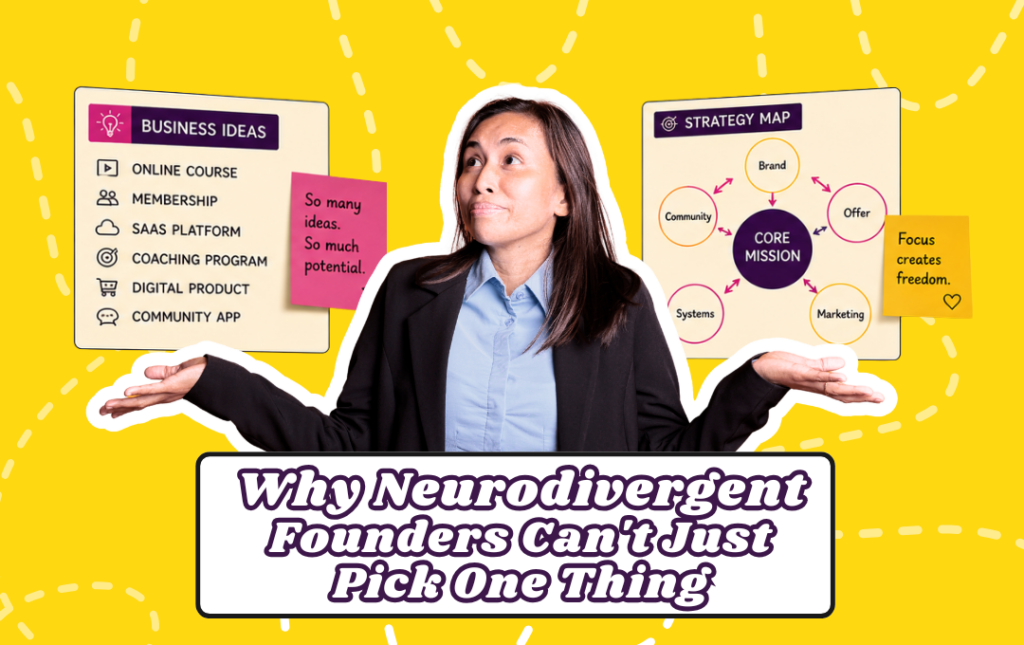
I was at a business event. Someone on stage said, with genuine conviction: “Successful entrepreneurs have one thing. Pick yours and protect it.” And I watched twelve neurodivergent founders in that room write it down. Like it was the instruction they had been waiting for. And I thought: they are going to go home, try to pick one thing, fail to pick one thing because their brain generates seventeen viable options in the car on the way home, and then add this to the growing pile of evidence that something is wrong with them.
Nothing is wrong with them. The instruction is incomplete.
This blog is the part that got left out.
How the Neurodivergent Brain Actually Processes Optionality
Most productivity and business frameworks were built for a specific kind of brain — one that processes options sequentially, evaluates them with some reasonable degree of detachment, and can set an unchosen option down without it continuing to compete for attention.
That is not the neurodivergent brain’s experience.
ADHD in particular is characterized by divergent thinking patterns that generate more lateral connections between ideas than neurotypical cognitive processing typically produces. That is not a flaw — it is the reason neurodivergent founders are disproportionately represented in entrepreneurship. The ability to see connections others miss, to generate options in situations where most people only see one path, to hold multiple possibilities simultaneously — these are genuine advantages.
Until you need to commit to one thing. Then the same wiring that makes you exceptional at ideation makes the narrowing process genuinely harder. Not impossible. Harder. And harder in a specific, neurologically grounded way.
Part of what makes it harder is how the brain weights options against each other. For a high-generating brain, every new idea arrives carrying its full potential — the complete picture of what it could become if conditions are right. The current direction does not get that same treatment. It gets evaluated against its current reality: the messy middle, the friction, the parts that are not exciting yet. That asymmetry is not laziness or lack of commitment. It is the brain doing exactly what it is wired to do — find the highest-potential option — using a comparison process that is structurally biased against anything already in progress.
The Comparison Problem
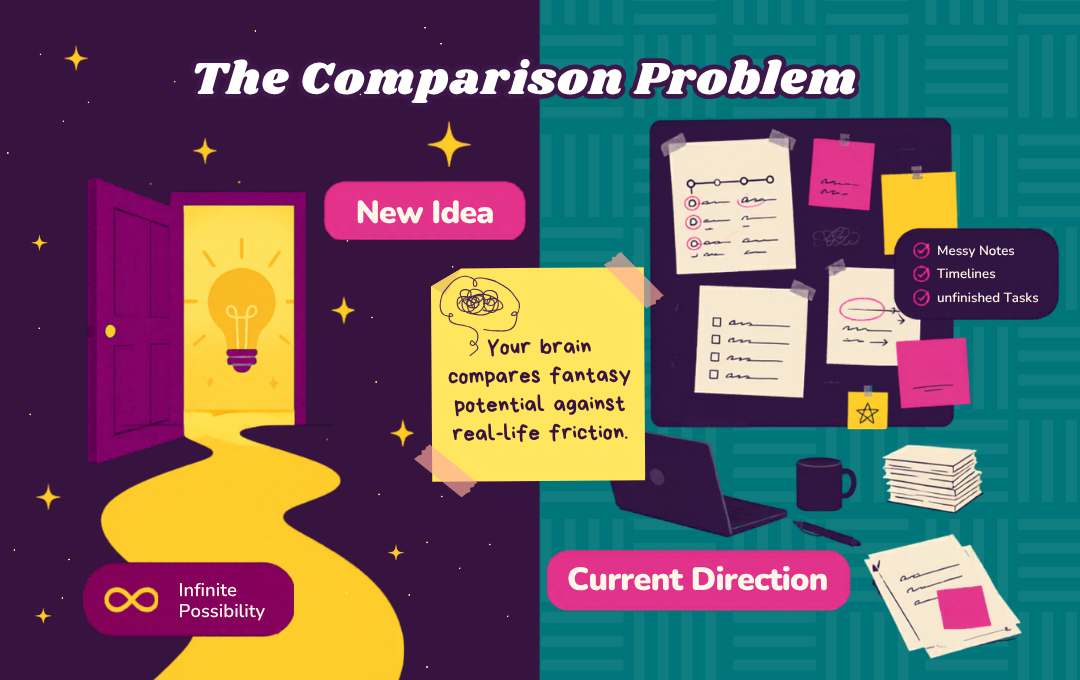
Every time a new idea arrives, your brain runs a comparison. And the comparison is rigged.
On one side: the new direction. Full potential, zero friction. You can see exactly what it could become. The audience it would reach, the revenue it could produce, the version of your business it represents. Everything is possible because nothing has started yet.
On the other side: the current direction. Which is in the messy middle. The place where real work lives — the part that is not glamorous, not exciting, not giving you feedback yet because results take time. The part that requires showing up on days when the inspiration is not there.
No current direction can win that comparison. Not because it is not the right choice — because it is being evaluated at its worst against something being evaluated at its theoretical best.
This is not a discipline failure. This is not a commitment problem. It is a structural flaw in the way the decision is being made. And the fix is not to want the current direction more. The fix is to change the basis of the comparison.
Why Discipline and Motivation Are the Wrong Tools
Most of the advice aimed at founders who struggle to commit to one direction assumes the problem is motivational. Work on your mindset. Build better habits. Get an accountability partner. Want it more.
None of that addresses the structural problem, which is that you are making high-stakes decisions from inside a comparison process that is biased toward novelty by design.
Motivation is not the missing ingredient. Discipline is not the missing ingredient. The missing ingredient is a filter — a set of external criteria that evaluates every option against the same standard, removes the emotional comparison from the equation, and produces a decision that is based on evidence rather than excitement.
The founders who move fastest are not the most disciplined ones. They are the ones whose decision-making process does not require them to override their own neurology every time something new arrives.
The Five Criteria That Actually Work
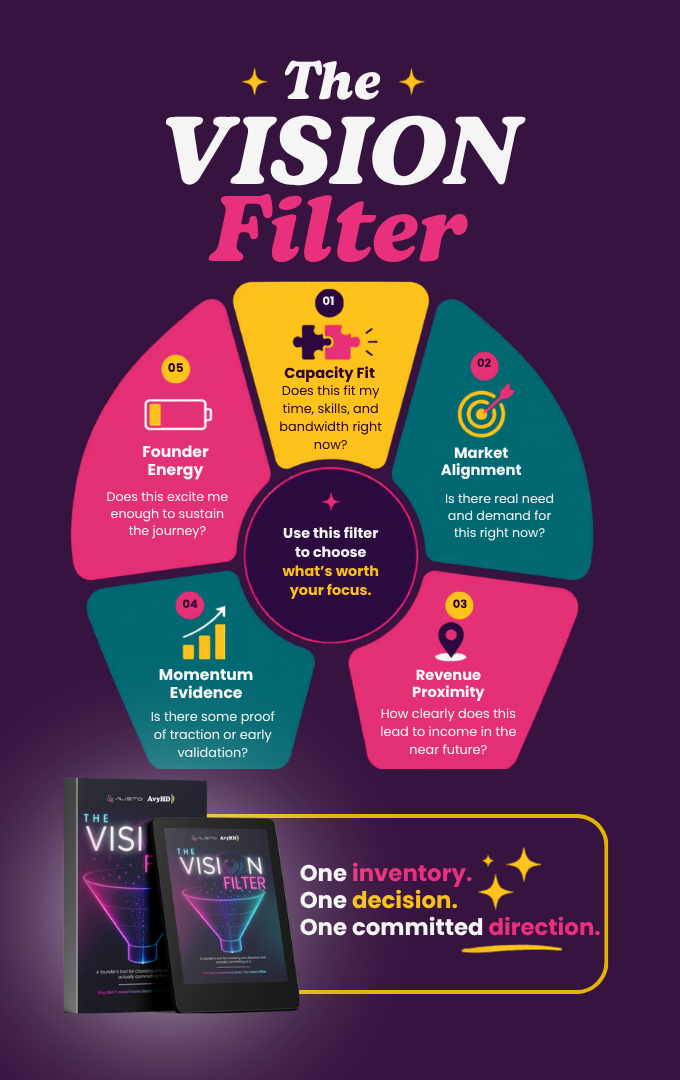
The VISION Filter uses five criteria. Each one was chosen specifically because it addresses a place where neurodivergent founders’ instincts tend to lead them astray.
Capacity fit asks whether the direction is compatible with what you can actually sustain right now — not in an ideal scenario, not if you hire two more people, not if you restructure everything. Right now, with current energy, time, and support. Founders who score this honestly are often surprised to find their most exciting option is their least sustainable one.
Market alignment asks whether there is an audience already looking for what this direction produces, or whether you would be building demand from scratch. Both are valid in the long term. In the short term, they are very different bets.
Revenue proximity asks how far the direction is from actual money. Weeks, months, or years? This question is not about killing big-vision directions — it is about being honest about the timeline so you can make a clear-eyed decision rather than an optimistic one.
Momentum evidence asks whether there is already movement here. Traction, client interest, early results, signals from the market that this is working. Starting from zero is not disqualifying, but it is a different kind of commitment than accelerating something that is already moving.
Founder energy asks the most honest question of all: when you imagine working on this specific direction for the next 90 days — not the launch moment, not the hypothetical success, the daily work — does your energy go up or down?
Run every direction through all five. Score them. The one at the top of the list is almost always already known. What the filter provides is the permission to choose it — and the documented rationale to return to when the next shiny thing arrives.
The Tiebreaker Question
Sometimes two directions score almost equally. The filter narrows the field but does not fully close it. When that happens, there is one question that cuts through the analysis every time.
If you could only move one of these forward and the other disappeared entirely — which loss would you actually grieve?
Not which loss sounds more strategic. Not which loss you think you should grieve. Which one would actually hurt.
The answer to that question is almost always faster than people expect. And it is almost always different from the direction they have officially been claiming is the priority.
The grief question surfaces what the data cannot: the direction that has your real commitment, underneath all the strategic reasoning. Go with that one.
How to Use the Filter Without It Becoming Another Thing You Avoid
One thing I want to name directly, because it is real: the filter can become a procrastination tool if you let it.
You run the inventory and you do not finish it. You start scoring and you get stuck on one criterion. You decide you need more information before you can answer honestly. And the filter joins the pile of things that were supposed to help but became their own kind of open loop.
The way to avoid this is to treat the filter process as a time-boxed work session, not an ongoing project. Set aside 45 to 60 minutes. Finish the inventory before you evaluate anything. Score every item before you analyze the results. And make the decision before you close the document, even if it feels incomplete.
An imperfect committed direction will move your business further than a perfect evaluation that never ends.
The filter is a tool. Use it in one sitting. Trust the output. Then go build the thing.
A note for nonprofit leaders: neurodivergent staff are disproportionately represented in mission-driven organizations — particularly in creative, program, and strategy roles. Building organizational systems that account for how different brains process optionality makes the whole team more effective, not just the individuals who are most visibly affected. A shared decision filter applied at the program level gives everyone a structure for prioritization that does not rely on any one person’s executive function to hold.
The VISION Filter is the tool. Five criteria, one inventory, one committed direction — in about 45 minutes. Free download below.