

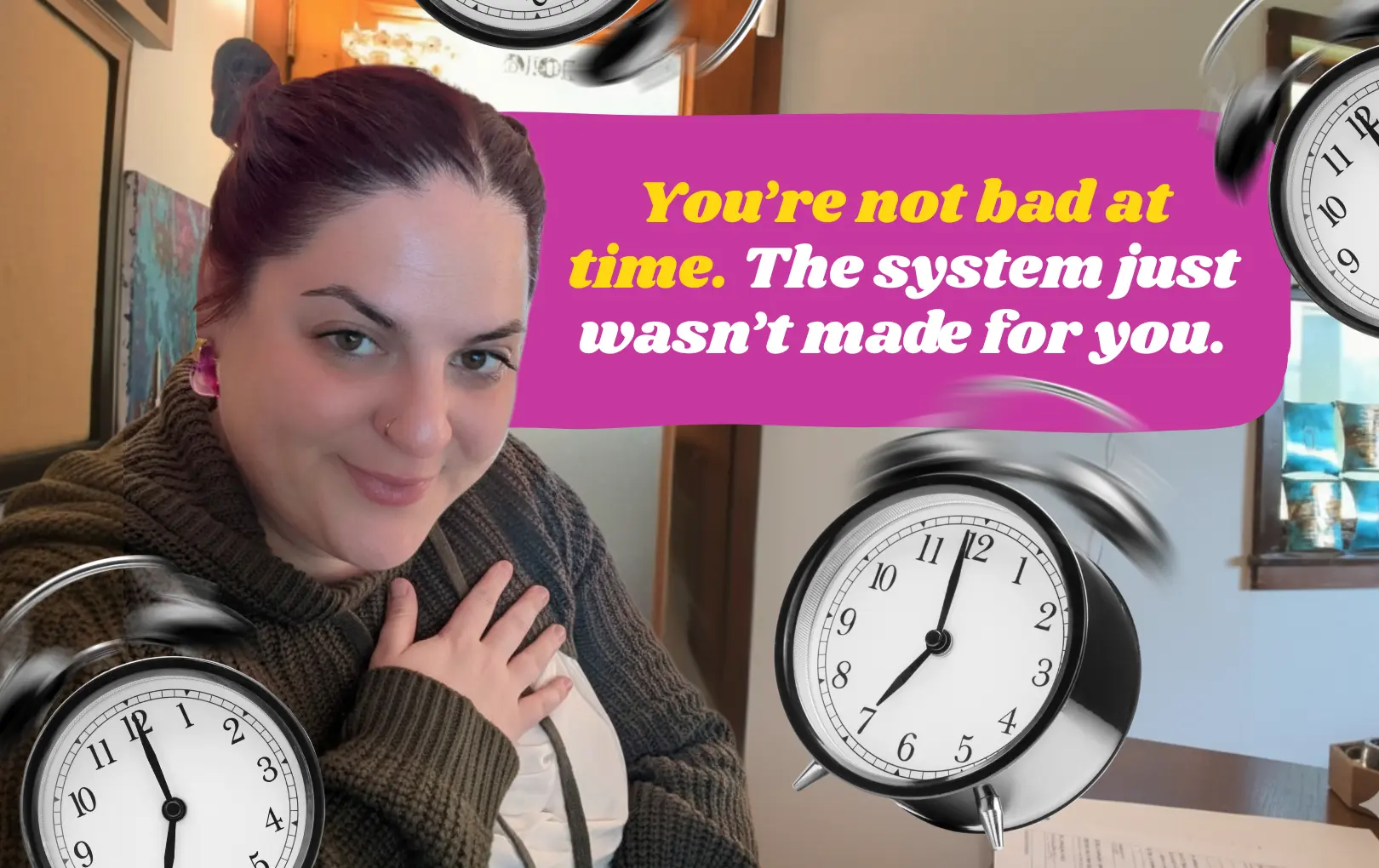
You sit down on Sunday night with the best intentions. A fresh planner, a color-coded to-do list, even a new pen. You swear this is the week it all clicks. But by Wednesday? It’s chaos. The list is buried, the schedule’s off-track, and the shame creeps in. Why can’t I just stick to the plan?
If this feels familiar, it’s not because you’re lazy, scattered, or “bad at time.” It’s because the system you’ve been trying to follow was never built for how your brain actually works. Especially if you’re neurodivergent, conventional time management often feels more like self-punishment than support. For the mind like ours — thriving in bursts, riding momentum, and shifting gears — you’re simply trying to make a square peg fit a round hole. It’s not you. It’s the mismatch.
Why Conventional Time Systems Collapse
Traditional time management frameworks assume that your brain moves in straight lines. The day begins, you greet the clock, you tick off tasks one by one. They assume your energy curve is even; your executive function behaves reliably; your attention flows. But if your brain works in bursts—creative sprints, hyper‑focus flashes, momentum surges. That’s rigid systems collapse.
With neurodivergence (like ADHD), this is a familiar story. Executive functions—planning, scheduling, initiating, time management—are less consistent; the energy curves are steeper and less predictable.
So what looks like “inconsistency” might actually be a patterned rhythm—you just haven’t recognised your rhythm.
The Link Between Executive Function & Energy Cycles
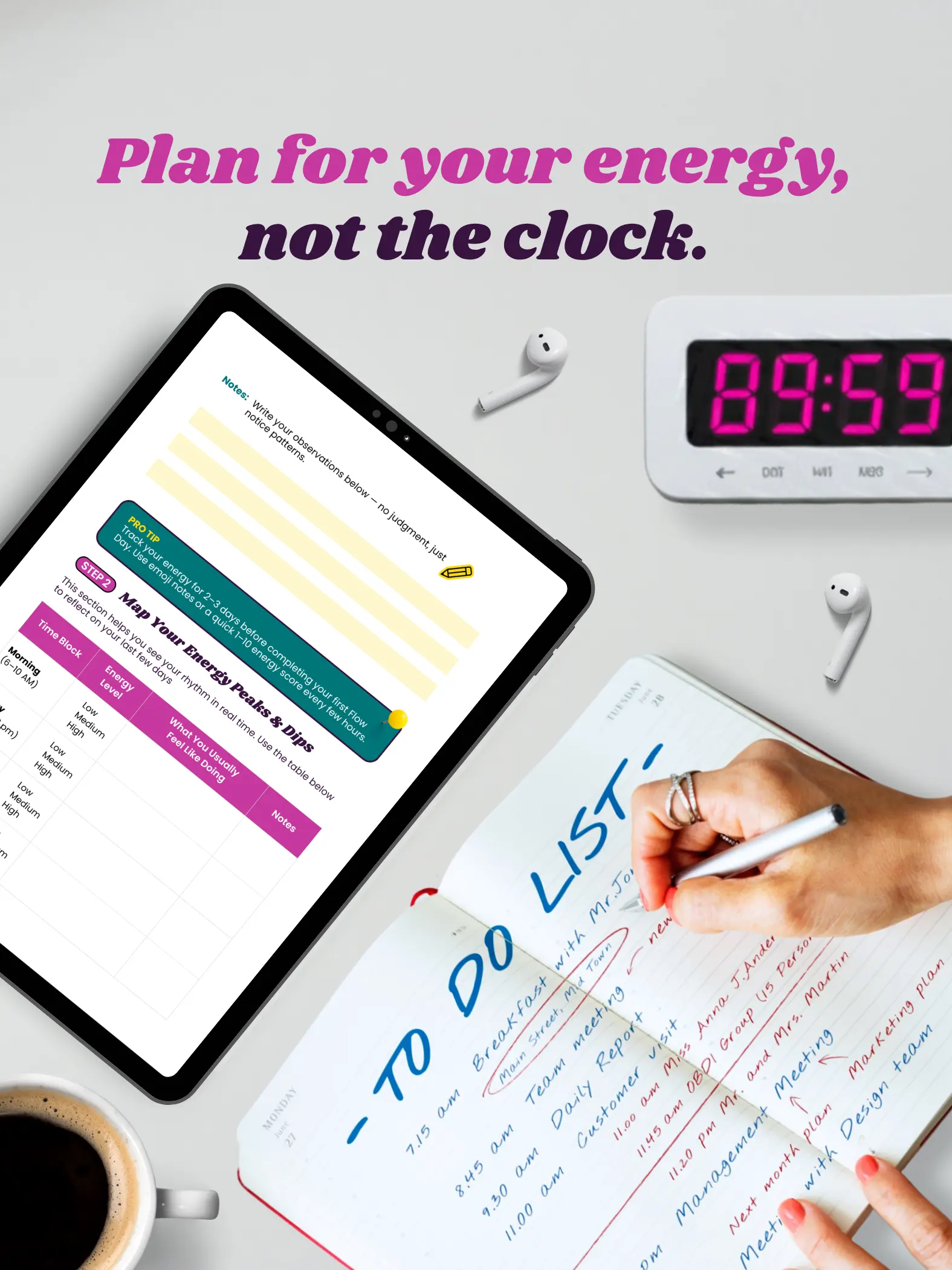
Executive function isn’t just “willpower” or “motivation” in a vacuum. It’s deeply tied to your body’s energy state—nervous system tone, neurochemical rhythms, attention circuits. Planning might demand high executive function; initiating requires a different thrill; follow‑through depends on sustained attention when novelty fades.
When those demands collide with a mismatched system, one built for linear energy curves, you feel stuck. If you begin your day checking the clock rather than checking your energy, you’re already one beat behind.
Research shows executive‐function difficulties are core in ADHD brains, impacting organizing, time, planning.
The strategy? Meet your energy where it is. Start your planning by asking: How is my nervous system today? Not: What time is it?
What Time Blindness Really Means
“Time blindness” is not irresponsibility. It’s not “lazy.” It’s the difficulty of feeling the passage of time, estimating how long something will take, and transitioning from one task to another when the clock is neutral.
Picture this: you open your laptop to reply to one email at 3:00 pm. Somehow, it’s 4:40 pm and you’re still there. Or you swear you left at noon, but the clock says you’re late. To you, five minutes and an hour feel the same until… bam, the deadline.
Here are gentle strategies:
- Use body‑timers or alarms that connect to your physical rhythm.
- Use visual clocks (yes, even analog ones) so you see time passing.
- Schedule by energy type, not just by fixed hours: when you’re alive, when you’re foggy.
ADHD Evidence notes a meta‑analysis found consistent impairments in time perception among people with ADHD—so this is real, measurable.

It’s Not About Managing Time, It’s About Managing Rhythm
So, here’s the shift: you’re not bad at time. You’re just working against a system that expects uniform time behavior. Let’s turn that on its head.
Start each day by noting: How is my rhythm today? Are you in burst‑mode? Fog‑mode? Momentum‑mode? Choose tasks that match your energy, not the clock. When your brain feels alive: schedule creative work, heavy asks, passion‑projects. When your brain feels foggy or steady: pick transitions, small tasks, buffer zones.
Time‑management then becomes rhythm‑management. You’re orchestrating your internal tempo instead of battling the clock.
You become the conductor of your day, not the captive of someone else’s tempo.