
There was a day last year I sat down to write a launch email.
Simple enough task, right?
I had my tea. My board was open. I even had a clear outline. But 10 minutes in, I found myself sketching out a totally unrelated podcast series idea. By noon, I had 3 voice memos recorded, 2 domain names bookmarked, and zero emails written.
If you’ve ever done that, you’re not broken—you’re brilliant and just a little hijacked by your own creativity.
Neurodivergent entrepreneurs like us don’t struggle with too few ideas.
We struggle with what to do when we have too many.
So let’s talk about how to honor your spark without letting it derail you.
The “Too Many Tabs” Cycle
Here’s how it used to go for me (and maybe for you too):
- A new idea shows up—bold, shiny, totally exciting.
- It feels so right. Like THIS is the thing.
- I start thinking about it… then planning it… then working on it…
- Suddenly, my current project feels boring or irrelevant.
- So I jump ship to the new thing.
- Repeat.
- End the month with 14 half-done things and a gut full of frustration.
Sound familiar?
For a long time, I thought this meant I was flaky or undisciplined.
But now I know: it’s just fast-brained creativity without a containment system.
What I Do Now: The Parking Lot
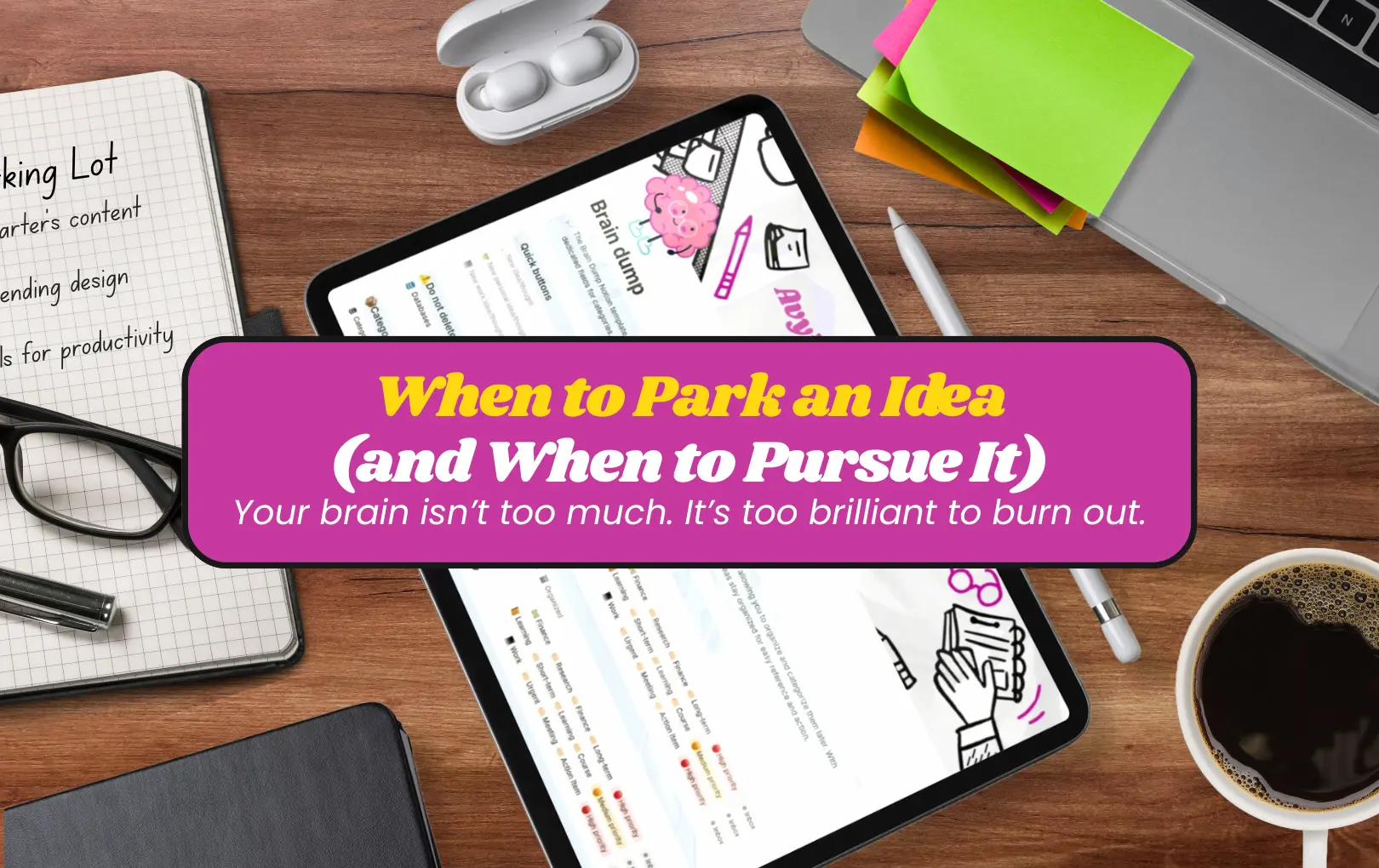
One day, after bouncing between four different projects in the same afternoon, I opened a new board in Notion and named it The Parking Lot.
It was my “I see you, but not right now” zone.
Not a junk drawer. Not a graveyard. Just a pause.
Now, when I get a wild idea mid-task, here’s what I do:
- I write it down in my Parking Lot board.
- I capture the spark—why it felt exciting in the moment.
- I tag it with today’s date.
- And then, I go back to what I was doing.
It sounds small. But honestly? It rescued my focus.
Because what I really needed wasn’t fewer ideas.
I needed a place to put them that didn’t require me to act on them right this second.
My 30-Day Rule (And What It Taught Me)
Here’s something wild: about half the ideas I park? I don’t care about them in 30 days later.
That course idea that felt life-changing in the moment? Total “meh” a month later.
So now I give every idea a 30-day cool-off period.
If it still excites me after that—okay, we’re listening.
If not? That was dopamine, not direction.
During my monthly review, I’ll ask:
- Does this still feel like me?
- Is this aligned with my current energy and priorities?
- Does this idea support what I’ve already committed to—or would it compete with it?
The answers are usually clear once a little time has passed.
No hype. No FOMO. Just clarity.
My Monthly Idea Review Ritual
This one changed everything: I made checking my Parking Lot part of my monthly CEO date.
It’s low pressure, usually with tea and music, and I do three things:
- I revisit what’s still exciting
- I cross out anything that feels flat
- I move 1–2 ideas to an “Incubator” column—stuff I’m actually going to explore soon
The rest? They stay parked.
And here’s the magic:
Instead of feeling like a failure for “not doing everything,” I feel grounded.
I’m building a backlog I trust—so I can focus on what’s real right now.

The Tools That Work for My Brain
I’ve tried a lot, and here’s what’s stuck (plus a few that work great for different brains):
- Notebook – When I want to get out of my head and onto paper
- Notion board – Tag ideas by date, energy level, category
- Voice memos – Because some ideas only show up when I’m walking the do
- Sticky notes + whiteboard – For when I need visual space to “see” the idea
The tool doesn’t matter as much as whether you’ll return to it.
Don’t build a system your brain avoids.
Three Questions I Ask Before I Act on an Idea
Every time I feel tempted to dive headfirst into something new, I ask:
- Is this solving a problem I’m already committed to?
- Will this idea help me finish something else—or just compete for my attention?
- Does this feel aligned with my long-term vision—or just today’s dopamine?
Sometimes the answer still surprises me.
Sometimes I park it. Sometimes I pursue it.
But every time—I choose on purpose, not out of panic.
Download the Brain Dump Blueprint
Before you park your ideas, you’ve got to get them out of your head.
The Brain Dump Blueprint is my go-to for clearing mental tabs and turning the chaos into calm. It helps you:
🧠 Clear the noise
🗂 Categorize and tag ideas
🎯 Create a system to revisit what matters
👉 Download the Brain Dump Blueprint Below
and give your brain room to breathe without losing your magic.
Here’s what I want you to know:
You don’t need to chase every idea.
You also don’t need to shut them down.
A Parking Lot isn’t a rejection.
It’s a loving “not yet.”
When you build rituals around how you collect and review your ideas, you stop being ruled by them—and start being supported by them.
And that’s when the real magic happens:
You finish what you start.
You trust your flow.
And the next idea? It doesn’t take you off track. It adds to your path.
 Download the Brain Dump Template Here and give your brain the structure it’s been asking for.