
Delegation doesn’t fail because people are unreliable.
It fails because founders are told to “just delegate” without anyone explaining the system that actually makes delegation work.
Hire people. Trust your team. Let go of control.
That’s the advice.
But here’s what most founders discover pretty quickly:
You can assign tasks all day long and still end up doing the work yourself.
Because when delegation breaks down, the work doesn’t disappear. It comes right back to you.
- Delegation usually fails because ownership and authority are unclear, not because people are unreliable
- Assigning tasks is not the same as delegating responsibility
- When decision rights are undefined, work escalates back to the founder
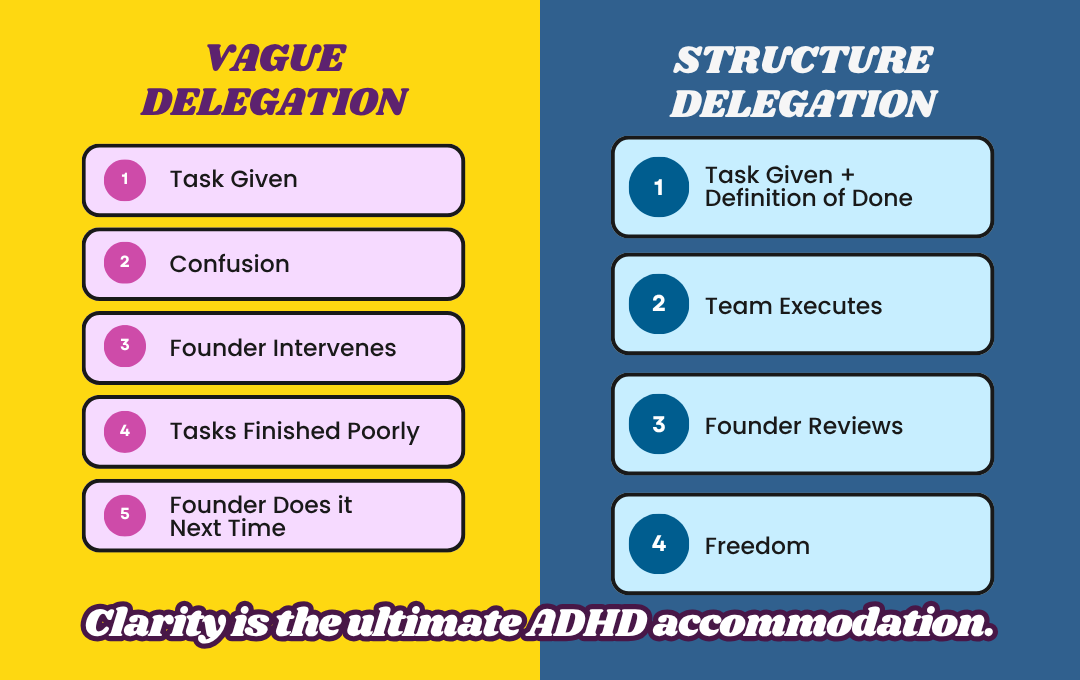
- ADHD entrepreneurs struggle most with delegation when expectations are vague
- Clear delegation systems distribute decisions and kill the founder bottleneck
A founder assigns a task. An hour later the questions start.
“Is this the right approach?” “Should we send this to the client?” “What do I do if they ask for changes?”
Soon the founder is reviewing the work anyway.
The task was delegated. The responsibility wasn’t.
That’s one of the most common causes of the founder bottleneck — and one of the fastest paths to burnout.
The Delegation Myth
Most founders think delegation is a simple formula.
Assign the task. Explain what to do. Expect the result.
But real work rarely unfolds as planned. Unexpected situations appear. Clients change their minds. Information goes missing. And suddenly a decision has to be made.
The team member knows what to do. But they don’t know what they’re allowed to decide.
So the safest move is escalation. And escalation almost always leads back to the founder.
The Advice Founders Get Is Incomplete
A lot of leadership advice says the solution is simple.
“Just trust your team.”
That sounds nice. It’s also wildly incomplete.
Trust doesn’t fix broken systems. If expectations, authority, and outcomes are unclear, even highly capable people will hesitate to act independently. And when they hesitate, they escalate.
Delegation doesn’t fail because founders are controlling.
Delegation fails when the structure around it is broken.
The Real Issue: Ownership Clarity
Effective delegation depends on one thing: ownership clarity.
Delegation works when two responsibilities are clearly separated.
Execution — completing the task.
Decision authority — what happens when circumstances change.
Take a team member preparing a client report.
Execution includes collecting information, preparing the document, sending the report.
Decision authority covers what happens if the client asks for revisions, if information is missing, or if additional analysis is needed.
If those decisions aren’t defined, every unexpected moment becomes a question for the founder.
What most founders call delegation quickly becomes something else entirely.
Supervision.
The Founder Bottleneck
When ownership and authority are unclear, decisions escalate upward. Every time.
Team members escalate to avoid mistakes. Clients escalate because they assume the founder makes the final call. And eventually the founder becomes the decision center for the entire organization.
This is the founder bottleneck. It shows up as:
- Constant approval requests
- “Quick questions” throughout the day
- Tasks returning for clarification
- Team members waiting before acting
Growth slows because every decision depends on one person’s attention. And attention is limited.
Why ADHD Entrepreneurs Struggle With This Most
Many ADHD entrepreneurs experience delegation frustration more intensely. Not because they lack leadership ability — because unclear systems create unpredictability.
When delegation is vague, the spiral starts fast.
“Will they do this correctly?” “What if I have to redo it later?” “Did I explain this clearly enough?”
Without clear systems, those concerns are completely valid. Inconsistent results create more work, not less. Delegation becomes stressful instead of freeing.
But when ownership and decision rights are clearly defined, delegation becomes predictable. And predictability builds trust — in your team and in yourself.
What Effective Delegation Actually Looks Like
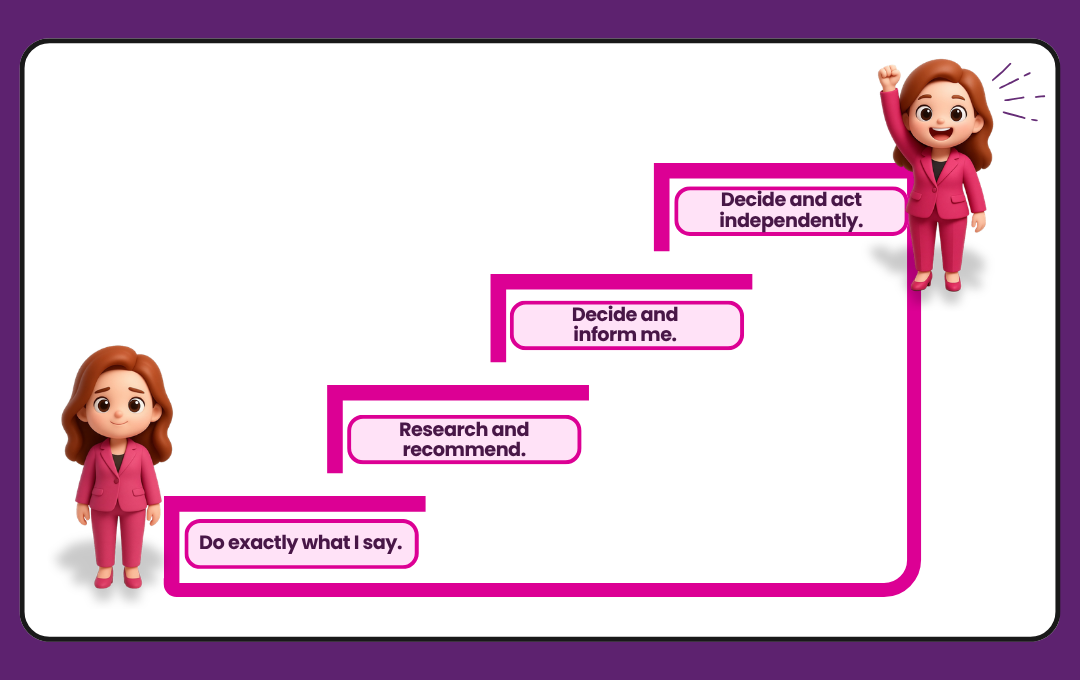
Delegation becomes sustainable when three structural elements exist.
Decision Rights. Who decides what. Simple concept. Almost nobody installs it.
Team decides: workflow adjustments, routine client responses, internal coordination.
Founder decides: pricing changes, strategic direction, major client commitments.
When authority is visible, escalation drops dramatically. When it’s not, everything lands on you — forever.
Task Ownership. One person is responsible for ensuring the task gets done. They may collaborate — but they are accountable for the outcome.
Without this, accountability becomes a group activity. Which means it belongs to no one. Which means it comes back to you.
Communication Boundaries. Teams need to know when updates are expected, how questions should be handled, and when escalation is actually appropriate.
Without these rules, every question becomes an interruption. Every interruption becomes your problem. And “I’ll just do it myself” starts sounding reasonable — which is exactly how you ended up here in the first place.
Quick Diagnostic
- Do team members frequently ask you to approve small decisions?
- Do delegated tasks return for clarification?
- Do you review work that should already be complete?
- Do you feel like you’re the only one who can resolve problems?
If several of these land — the issue probably isn’t delegation skill.
It’s missing delegation systems.
Final Insight
Delegation is framed as a leadership mindset problem. It’s not.
It’s a business design problem.
When ownership, decision authority, and communication rules are clear, work flows without constant supervision. Without those systems, delegation collapses and the founder becomes the bottleneck.
You don’t fix delegation with more trust. You fix it with better structure.
Start with the Boundary Leak Audit. It reveals exactly where ownership, authority, and communication boundaries need clarification — so your team can operate independently and your attention can return to strategy.
