How I Stopped Selling Tasks and Started Leading Transformation
If you’re a creative entrepreneur, especially one with a neurodivergent brain, you’ve probably spent years trying to “fix” the parts of you that felt too much or not enough.
Same.
For most of my life, I tried to smooth the sharp edges. I’d tone down the parts of me that obsessed over language, that needed more recovery time than my peers, or that froze when systems were unclear. I thought those traits made me harder to work with. Less consistent. Less scalable.
But I’ve learned something I wish I’d known earlier:
Those edges, those so-called “flaws”, are actually the foundation of your signature method.
When you stop working against your spiky strengths and start building from them, everything changes. You stop selling deliverables and start leading transformation. You create offers that feel easier to deliver, because they’re aligned with how your brain naturally works. And you position yourself not just as a helper, but as a method-maker.
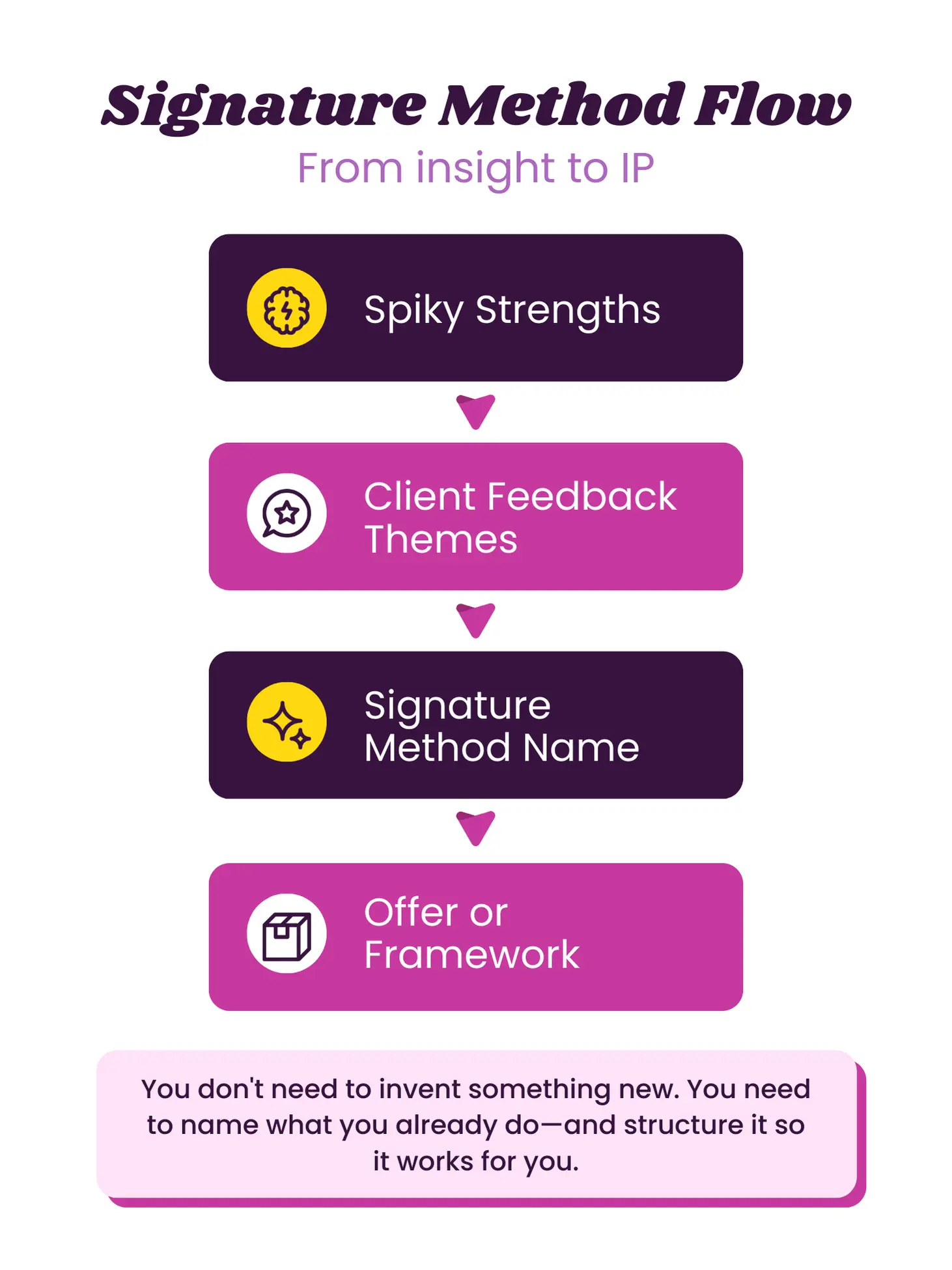
In this article, I’ll walk you through how I help founders map their spiky strengths into a clear, ownable, repeatable method they can build an offer around.
We do it in three steps:
Identifying your spiky strengths
Mining patterns through client conversations
Naming your signature method in a way that’s simple, sticky, and self-honoring
Let’s get into it.
Step 1: Identify Your Spiky Strengths
We all have “spikes”—traits that stand out either because we’re intensely good at something, or especially sensitive to it.
I call them high spikes and low spikes.
High spikes are your natural amplifiers. Think:
“I can see patterns no one else sees.”
“I hyperfocus on design details.”
“I thrive in structured systems.”Low spikes are your sensitivity zones. For example:
“I melt down in chaos.”
“I need longer recovery time between projects.”
“Too many live calls destabilize me.”
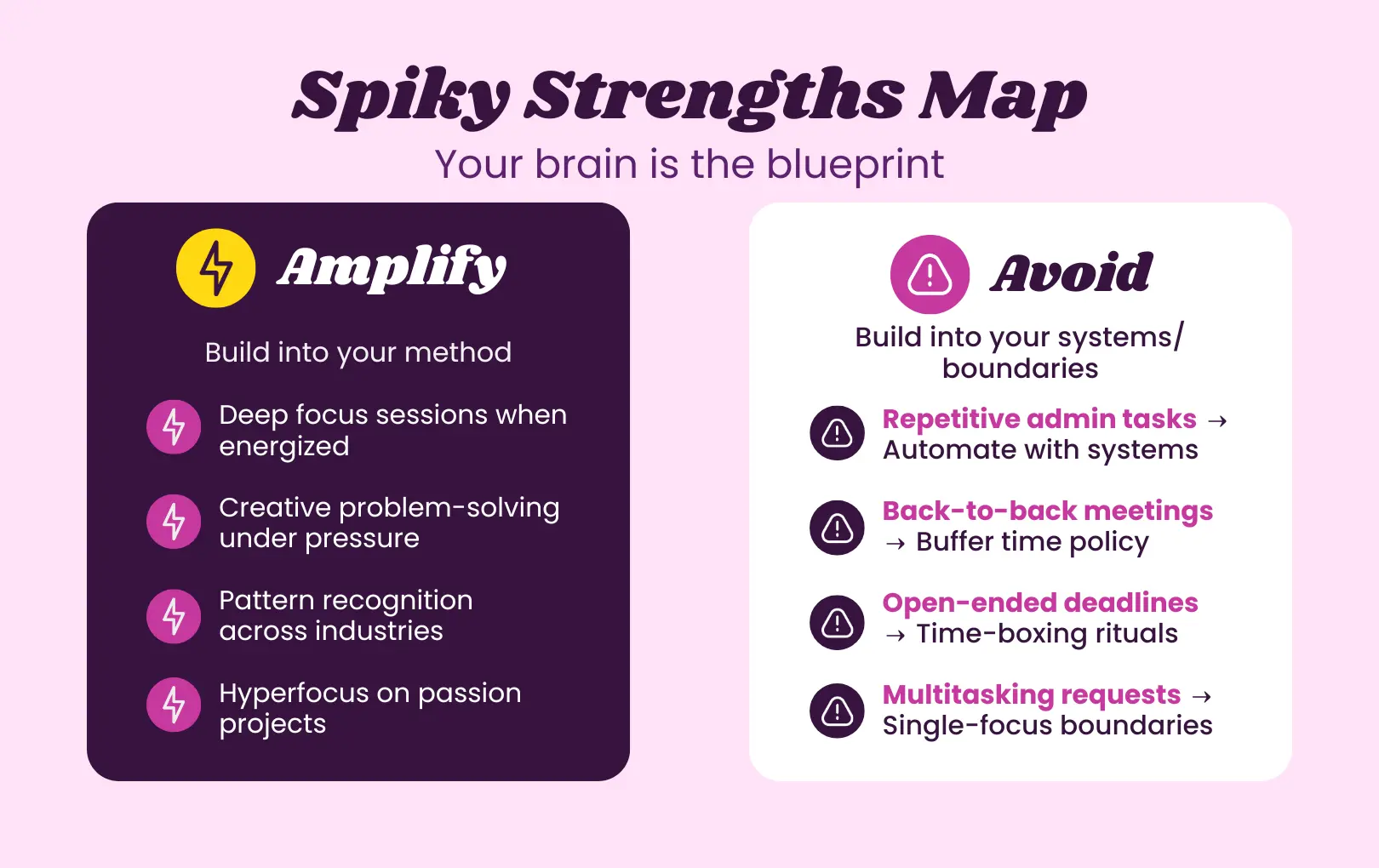
When I work with clients, I have them list 3–5 spikes in each category. Then we map them visually.
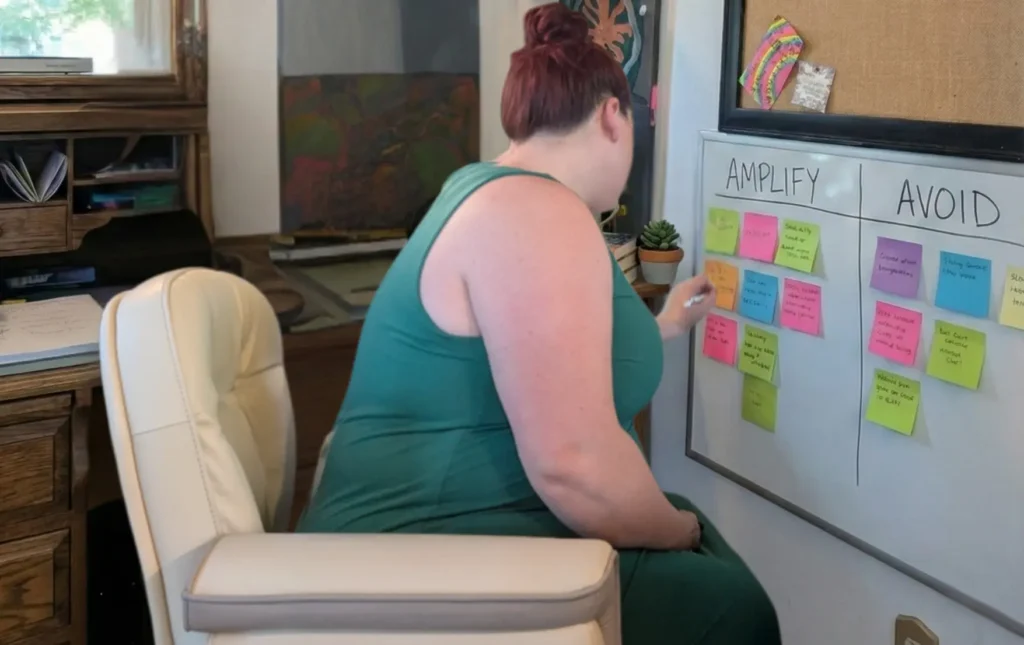
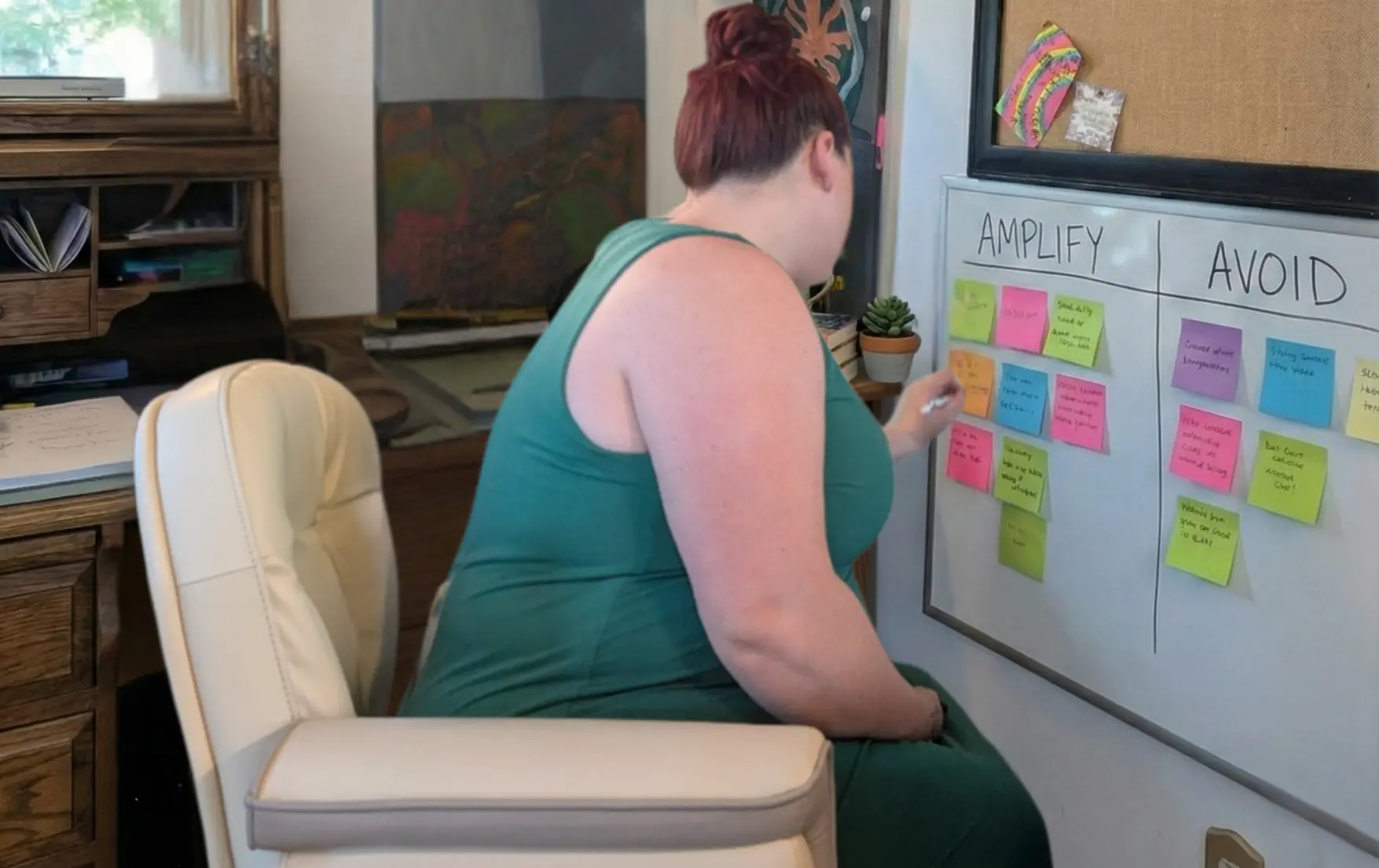
You can do this too. Grab a whiteboard or your Notion board, draw two columns, and label them:
Amplify → This is what fuels your method.
Avoid → This is what becomes a boundary, policy, or support system.
This step connects directly to the F.O.C.U.S. framework: it turns self-observation into design decisions.
Your method doesn’t come from what the market wants—it comes from what your brain does best
Step 2: Validate It Through Client Conversations
Once you’ve mapped your internal data (your spikes), it’s time to gather external data: client feedback.
I like to do this through what we call Pattern Mining Interviews.
You can do this with 3–5 past clients, collaborators, or even close peers. Ask questions like:
“What stood out to you about how I work?”
“What part of my process felt different or memorable?”
“If you had to describe my style in one sentence, what would it be?”
“What was the biggest relief or ‘aha’ moment you had working with me?”
Then color-code their answers by theme. I use categories like:
Structure / Clarity
Energy / Pace
Voice / Vibe
Transformation / Outcome
Soon you’ll see overlaps. Repeated words. Shared moments.
That’s your method DNA.
This is where the C.A.L.M. principle comes in—you’ll need some nervous system safety to see your difference as data, not defect.
Step 3: Name and Frame Your Signature Method
Now comes the fun (and sometimes frustrating) part: giving your method a name.
Think of this like designing a container—one that:
Packages your process clearly so clients understand it
Protects your boundaries through structure
Positions you as someone with a distinct approach, not just a skillset
Here are a few guidelines I share with clients when naming:
 Keep it short (3–5 words)
- Use rhythm or alliteration if it helps it stick
- Make it hint at the result, not just the tools
- Choose something you can use across multiple offers
A few real-life examples from my world:
Focus Ritual Builder → attention + calm
Flow Day Blueprint → energy peaks + flow sprints
Offer Spark Sprint → turning your ideas into actual products or offers
I always recommend batching this creative work during a T.I.M.E. peak window—a period when your energy is naturally high and focused.
And if naming feels high-pressure? Crowdsource it. Ask your audience, “Which of these sounds most like me?” Their engagement is often your answer.
Remember: resonance is the real trademark
Why This Process Matter
So many of us were trained to flatten our differences—to hide the quirks, the inconsistencies, the extremes.
But those spikes? They’re what make your work feel like you.
When you build from that place:
- Your process becomes easier to deliver
- Your boundaries become part of the structure
- Your offers become clearer, stronger, and more sustainable
And best of all? Your brain starts to feel like an asset, not an obstacle.
Your Next Step
Download the Offer Spark Sprint to sketch your spikes, map client feedback, and start naming your method visually.
Then join us inside the Idea-to-Offer Studio, where we help you co-create your first or next offer, live, with strategy and structure that actually fits your brain.
→ Join the Idea to Offer Studio here