
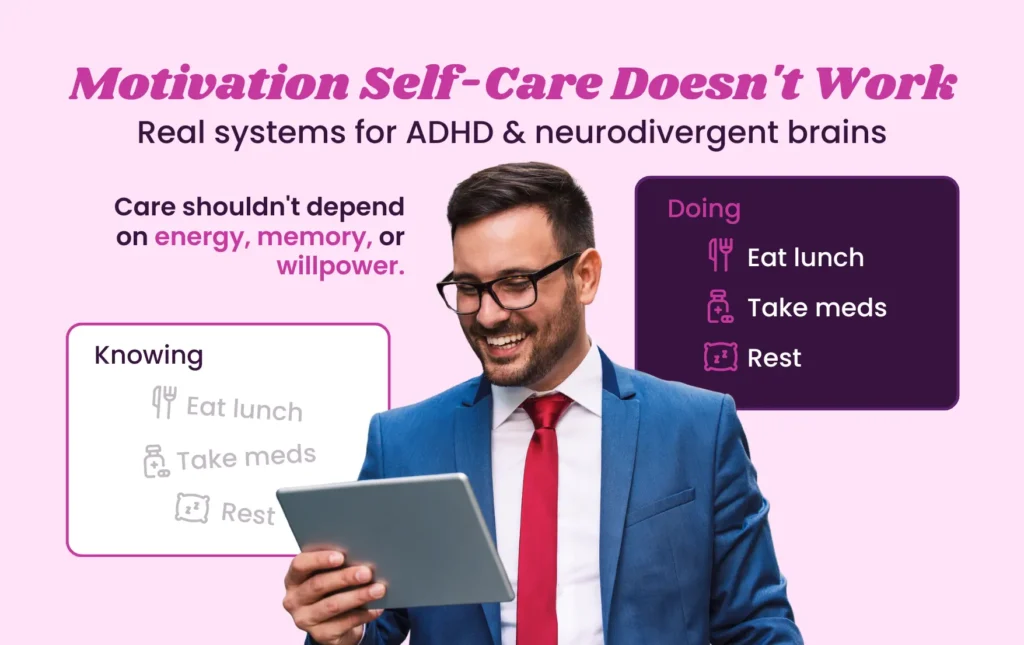
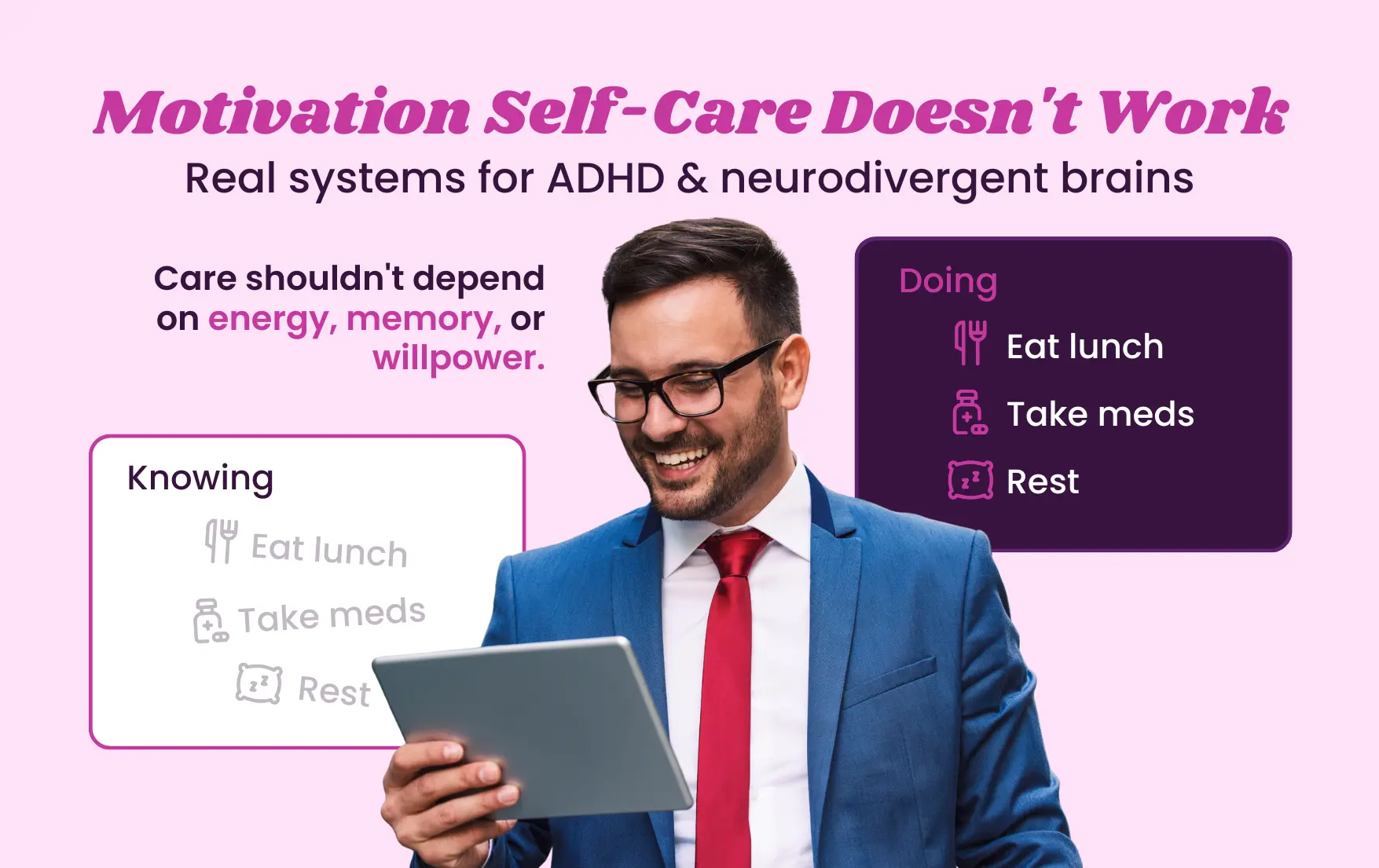
You know you should eat lunch.
You know you need your meds.
You know rest matters.
So why does it feel impossible to actually do it?
If your self-care only works when you have energy… it’s not really care. It’s a liability.
Neurodivergent people don’t lack self-awareness.
They lack support infrastructure.
You already know what helps: sleep, hydration, meals, meds, movement, breaks.
But knowing doesn’t translate to doing when your care routines depend on memory, motivation, or a perfectly regulated nervous system.
And that’s the whole point:
You shouldn’t need to feel good in order to care for yourself well.
It’s time we stop framing care as discipline — and start treating it as design.
Why Motivation-Based Self-Care Fails for ADHD Brains
Let’s get one thing clear:
There’s nothing wrong with you if you struggle to “stick to” routines.
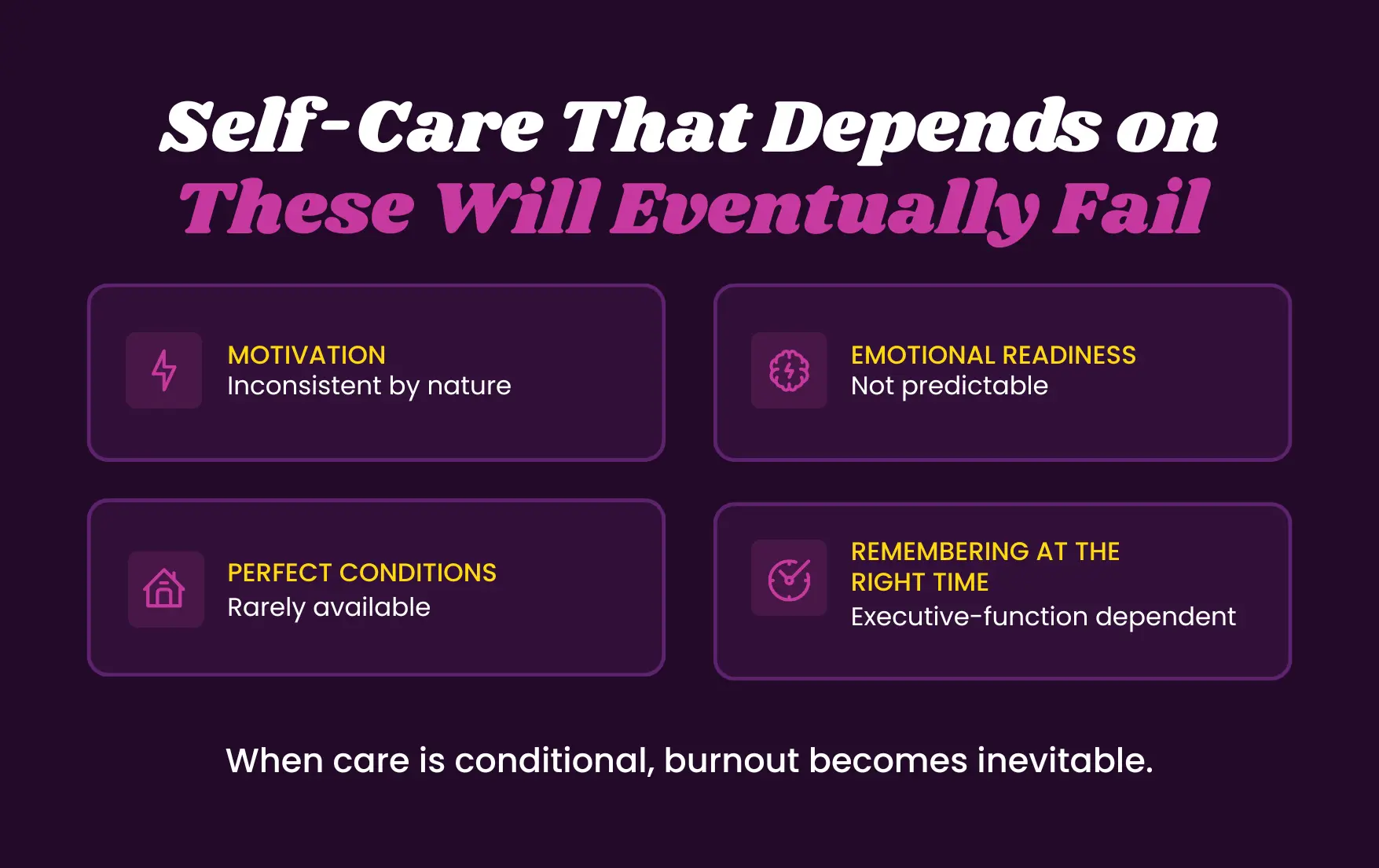
Neurodivergent nervous systems are inconsistent by nature.
You don’t always wake up with the same energy, focus, or capacity — so expecting your care habits to operate on willpower alone is setting yourself up to feel like you’re failing.
Self-Care That Depends on Variables You Can’t Control
Care routines that require:
- Motivation
- Emotional readiness
- A clean kitchen or a quiet house
- Remembering at the “right” time
… aren’t actually care. They’re a gamble.
What Happens When the Gamble Doesn’t Pay Off
When your systems fail, your body pays the price:
- You forget to eat until 3pm
- You miss a dose, a refill, a follow-up
- You haven’t washed your sheets in weeks, and every part of you feels crispy
You know what needs to be done. There’s just only so much energy in a day.
None of this makes you broken.
It just means your care needs to be systemized — not idealized.
When care is only available on high-capacity days, burnout becomes the pattern—not the exception.
The goal isn’t perfection.
The goal is predictability — even when you’re struggling.
Structural Self-Care: How Systems Replace Willpower
If you’ve ever thought:
“I just need to get my life together.”
Pause.
You don’t need to “get it together.”
You need a life system that supports you when you fall apart.
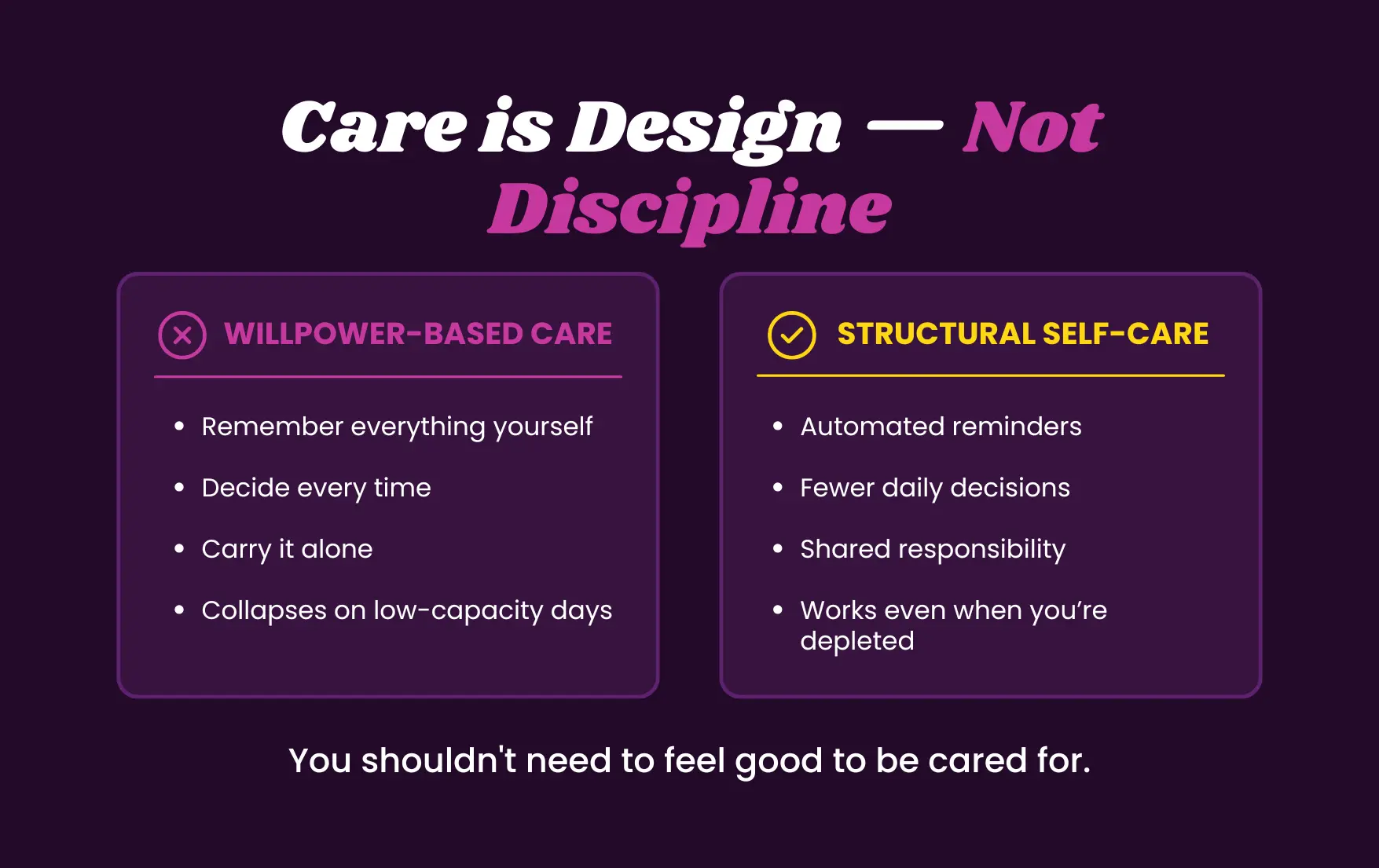
That’s where structural self-care comes in — the kind that happens even if you’re tired, anxious, or mid-cycle chaos.
What Neurodivergent-Friendly Care Systems Actually Look Like
Instead of relying on your brain to remember, regulate, and execute perfectly:
- Reminders that don’t rely on memory — automated prompts that catch you before you forget, not after
- Automation that handles repetitive decisions — meal planning that doesn’t require executive function every single day
- Shared responsibility for things you’ve carried alone — systems that distribute care across tools, people, and processes
This isn’t lazy.
This is intelligent design — care that’s engineered to work when your brain can’t.
As we covered in You’re Not Broken, executive function is infrastructure, not intelligence. The same principle applies to self-care.

From Individual Systems to Household Infrastructure
Here’s what many people discover once they start building personal care systems:
The chaos isn’t just about your executive function.
It’s about how care is coordinated across your entire household.
If dinner feels like a crisis every night…
If your fridge is full of guilt…
If you’re the only one tracking appointments, groceries, and emotional labor…
That’s not a personal planning problem.
That’s a household infrastructure gap.
This is where many neurodivergent individuals hit a ceiling: they’ve systemized themselves, but the shared systems are still running on invisible labor and assumed telepathy.
For couples navigating shared care infrastructure, Alisto’s Not Your Wife intensive addresses exactly this — how to build household systems that don’t rely on one person remembering everything.
But whether you’re building systems for yourself or for a household, the principle is the same:
Care has to be structural, not aspirational.
Your Next Step: From Awareness to Installation
If you’re reading this, you already have awareness.
You know something isn’t working.
You might not know what exactly—but that’s still awareness.
Here’s what most people do wrong: they look at a systems gap and diagnose laziness.
The next step isn’t trying harder.
The next step is installation — gently translating what you wish you could remember into systems that do the remembering for you.
You don’t need a personality change.
You don’t need a new routine.
You need:
- Visibility over what’s draining you
- Language for what support should look like
- A simple, systemized way to put care back in place
Start Here: See What You’re Actually Carrying
You don’t need a new habit tracker or a Monday morning miracle.
You need space to unload, observe, and begin again — with systems that actually fit your life.
The S.E.L.F. Reset Sheets help you:
✓ Unload what’s living in your head
✓ Name what’s been silently draining you
✓ Begin mapping where care needs to live outside your memory
No rules. No judgment. Just relief and clarity.
👉 Download the Free S.E.L.F. Reset Sheets
Build Structure That Actually Holds
Once you’ve identified your capacity drains with the Reset Sheets, the next step is building infrastructure that lasts.
The S.E.L.F. Systems Planner (also free) is your framework for moving from awareness to installation:
- Move from emotional labor to operational support
- Break the cycle of reactivity
- Design care that doesn’t collapse with your mood
This is where structure begins — not just for your household, but for your health, bandwidth, and peace.
Many people build complete care systems using just the Reset Sheets and the Planner. That’s what these tools are designed for.
👉 Get the Free S.E.L.F. Systems Planner
When Building Systems Isn’t the Problem—Knowing Which Ones to Build Is
Some people download the Planner and immediately start building systems that stick.
But others realize:
- “I don’t know which systems to prioritize”
- “I’ve built systems before and they don’t last”
- “I think I’m solving the wrong problem, but I can’t see what the right problem is”
If that’s you, the issue isn’t the tools—it’s strategic clarity.
You might need someone with an outside view to diagnose your actual constraints, map your friction points, and show you what to build first so everything else gets easier.
That’s what a Strategic Decision Call does. It’s not implementation—it’s constraint diagnosis before you invest time building the wrong systems.
👉 Learn more about Strategic Decision Calls or read Decision Fatigue Is the Real Burnout to see if strategic diagnosis is your next step.
The Full S.E.L.F. Series
Blog 1 → You’re Not Broken: Why executive function failure isn’t your fault
Blog 2 → This post: How to care for yourself without relying on energy
Blog 3 → Decision Fatigue Is the Real Burnout: When DIY systems aren’t enough—and how strategic diagnosis protects your capacity